
The 50 Indian Reality Show Review: Format, Gameplay, Cast & Zero-Rules Experiment
The 50 Indian reality show review covering format, gameplay, cast mix, audience response and the risks of its zero-rules experiment in India.


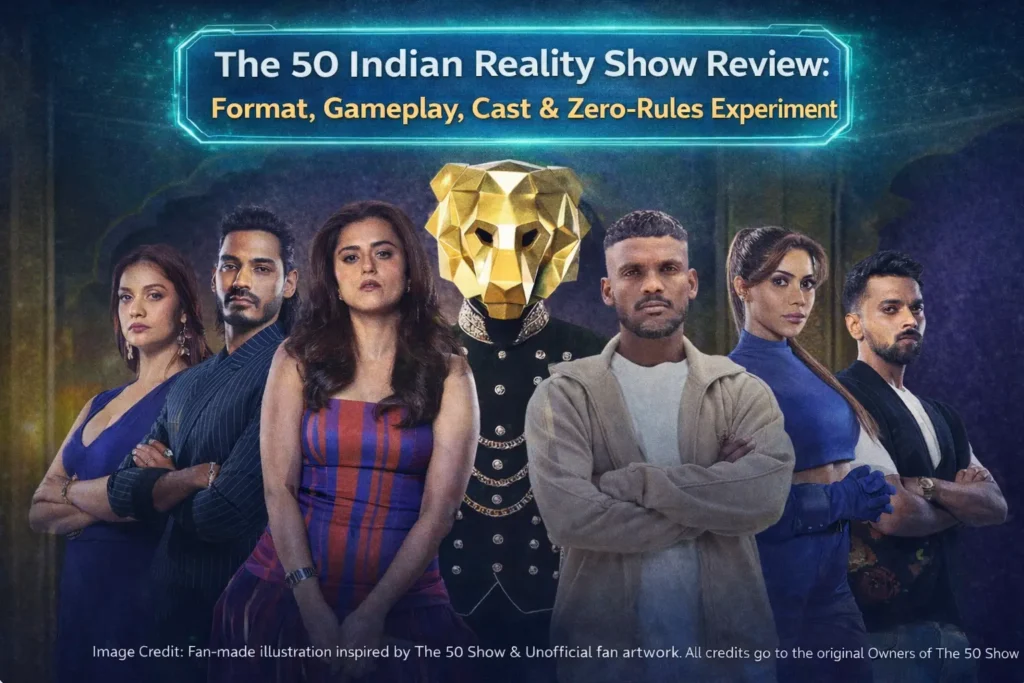
The 50 Indian Reality Show Review – Format, Concept and What Makes It Different
Is This the Show That Finally Breaks the Indian Reality TV Mold?
This in-depth The 50 Indian reality show review looks beyond surface-level hype to examine the mechanics, psychology and early impact of what is being positioned as India’s most ambitious unscripted experiment.
For years, the Indian television landscape has been dominated by a familiar trio: the family drama, the mythological epic and the reality show. When it comes to the latter, we’ve grown accustomed to a certain rhythm — the choreographed dance numbers of Jhalak Dikhhla Jaa, the death-defying stunts of Khatron Ke Khiladi, and the ever-present, emotionally volatile house of Bigg Boss. Just when you think the formula has been exhausted, a new contender arrives, promising to flip the script entirely.
Premiering on February 1, 2026, The 50 isn’t just another entry in the reality-TV catalog; it is designed as a large-scale social experiment staged inside a palatial set on Mumbai’s Madh Island. With 50 celebrities, a mysterious masked “Lion”, and a tagline built around “zero rules”, the show has already triggered intense curiosity and debate.
But is it genuinely a format shift — or simply familiar reality television dressed in premium spectacle? Let’s move beyond gossip and unpack the structure, the psychology and the early response to India’s newest mega-format.
The Origin Story: A French Blueprint with an Indian Twist
To understand The 50, we need to look west — to France. The show is adapted from the French series Les Cinquante, a format that blended competitive gameplay with controlled social chaos.
The Indian version is produced by Banijay Asia in association with Endemol Shine India. The core mechanics remain intact, but the presentation has been significantly localised.
Instead of a conventional house, the action unfolds inside a purpose-built “Mahal” on Madh Island. The set design leans heavily into theatrical scale — sprawling courtyards, a technologically equipped Arena for physical battles and a looming Lion’s Den from where the unseen authority controls the game. The intent is clear: position the show visually closer to a high-budget thriller than a traditional living-room reality setup.
The Core Philosophy: Why “Zero Rules” Is More Terrifying Than It Sounds
The most provocative promise of The 50 is the idea of “zero rules”.
In established formats such as Bigg Boss, the rulebook defines the entire experience. Rule violations lead to warnings, penalties and predictable corrective measures. In contrast, The 50 is structured around what can best be described as controlled chaos.
The game still follows a recognisable framework — teams, tasks, nominations and eliminations — but the governance of that framework is deliberately unstable.
The house is divided into three major zones: the Courtyard, the Arena for competitive challenges and the residential quarters inside the Mahal. Contestants compete to secure safety, but the conditions for safety can change without notice. The Lion and his internal hierarchy retain the power to override expectations at any moment.
This uncertainty fundamentally alters player behaviour. Instead of optimising around a known system, contestants must constantly evaluate whether today’s advantage will still hold value tomorrow.
The Lion, the Foxes and the Rabbits: Understanding the Hierarchy
Unlike most Indian reality shows, authority in The 50 is not represented by a single host figure.
At the top is The Lion — the masked game master whose voice dictates the flow of the competition. He is an unseen but persistent presence inside the palace.
Below him exists an internal hierarchy — the Foxes, Dogs and Rabbits — who function as intermediaries, observers and operational agents.
Symbolically, the structure suggests:
- Foxes as information gatherers and strategic manipulators,
- Dogs as operational enforcers during tasks and transitions,
- Rabbits as messengers and procedural conduits.
This layered system creates a different psychological environment. Contestants are not merely aware of cameras — they are constantly conscious of invisible authority figures who can shape outcomes without becoming part of the competitive pool themselves.
The Gladiators: Dissecting the Contestant Pool
The casting of The 50 reflects a deliberate attempt to merge multiple celebrity ecosystems.
Television veterans
Actors such as Karan Patel and Urvashi Dholakia bring mainstream television credibility and an established audience base.
Reality-TV specialists
Names such as Divya Agarwal, Nikki Tamboli, Archana Gautam and Shiv Thakare represent contestants already fluent in alliance politics, screen presence and narrative creation.
Digital-first influencers
Personalities such as Mr Faisu, Manisha Rani and Abhishek Malhan bring strong online fan communities and an instinctive understanding of audience-facing behaviour.
Unpredictable outliers
The cast also includes Dino James, controversial public figure Rajat Dalal, and fitness entrepreneur Krishna Shroff.
The result is a deliberately volatile mix of reputation, fame logic and competitive temperament.
Case Study: Karan Patel’s Calculated Gamble
Speaking to Indo-Asian News Service, Karan Patel explained why he had previously avoided long-format reality television but accepted The 50.
He drew a clear distinction between emotionally driven confrontation formats and what he described as a more strategy-led structure. He highlighted decision-making, positioning and endurance as the show’s primary attractions, noting that the format encourages participants to reveal composure and vulnerability through pressure rather than conflict.
This is a meaningful signal. If mainstream television actors view the format as cognitively demanding rather than emotionally exhausting, The 50 may indeed occupy a different creative space.
Decoding the Gameplay: How to Survive the Lion’s Den
The road to the ₹50-lakh prize follows a layered competitive pipeline.
- The Arena : Contestants participate in physically and mentally demanding challenges. Defeats do not simply reduce status — they push players directly toward nomination risk.
- The Nomination Event : A card-based mechanism introduces randomness and social pressure. Some cards protect the holder, while others force public or private nominations, expanding the scope of betrayal.
- The Safety Competition : Nominated players face a final endurance or skill challenge that can reverse their fate.
- Team architecture : Ten captains draft five-member teams. Victorious teams receive the authority to eliminate members from the losing side, placing immense ethical and strategic pressure on leadership roles.
This Bigg Boss vs The 50 format comparison clearly shows how the new show shifts attention away from emotional confrontation and toward structured strategic uncertainty.
Bigg Boss vs The 50 — A Format-Level Comparison
| Element | Bigg Boss | The 50 |
|---|---|---|
| Power structure | Host-centred authority | Hierarchical, unseen authority (The Lion and agents) |
| Rule clarity | Fixed and predictable | Dynamic and alterable |
| Conflict driver | Interpersonal disputes | Task performance and shifting power |
| Viewer focus | Relationships and fights | Strategic positioning |
| Confessional tone | Emotional and narrative | Tactical and outcome-oriented |
| Elimination logic | Nomination and perception | Task results and rule manipulation |
The Premiere Episode: Setting the Tone
The opening episode launches without hesitation. Contestants are immediately introduced to obstacle-based challenges and competitive set pieces. A live performance by Himesh Reshammiya adds scale, but the core emphasis remains gameplay-driven.
Early promotional clips reveal confrontations involving Rajat Dalal and Digvijay Rathee, a tense exchange between Karan Patel and Siddharth Bhardwaj, and emotional breakdowns from Monalisa, who is participating alongside her husband Vikrant Singh Rajpoot.
This first episode viewing experience of The 50 clearly signals that the makers are prioritising psychological pressure and strategic urgency over extended emotional spectacle.
What Actually Feels Different While Watching The 50 — First-Episode Viewing Impression
From a viewing-experience perspective, the first episode viewing experience of The 50 feels structurally different from traditional Indian reality show premieres.
Pacing
The episode moves rapidly. Reaction shots are brief and narrative pauses are minimal. Scenes shift quickly between conversations, task spaces and announcements, preventing emotional settling.
Editing style
The editing is intentionally abrupt. Strategic discussions are frequently interrupted by announcements or transitions from the Lion’s chamber, keeping tension elevated rather than allowing interpersonal storytelling to dominate.
Background music and sound design
Instead of emotional scoring, the soundtrack relies heavily on low-frequency tension cues and rhythmic pulses. Even neutral conversations are framed as strategic moments.
Confession-room tone
Private speaking segments function more like tactical briefings. Contestants focus on alliance logic, uncertainty and positional risks rather than personal history or emotional expression.
Overall, the episode positions the audience as observers of behaviour under pressure rather than spectators of personality conflict.
The Verdict So Far: Critical Reception and Viewership
According to Ormax Media, the show recorded approximately 6.5 million digital views during its first week on JioHotstar.
The show ranked just behind Ranveer Singh’s Dhurandhar during the same tracking window.
However, traditional television response presents a contrast. The show placed 25th in weekly television rankings with a reported TRP of 1.0, while long-running drama Anupamaa continued to lead with significantly higher viewership.
The divergence suggests that The 50 currently resonates more strongly with digitally native audiences than with habitual television viewers.
Why the “Zero-Rules” Format Can Backfire After a Few Weeks
One of the biggest zero-rules reality show format risks is the perception that outcomes may gradually feel production-driven rather than skill-driven.
When advantages earned through performance can be overridden by sudden rule changes, strategic investment loses clarity. Over time, audiences may struggle to track why certain eliminations occur, reducing trust in the competitive framework.
There is also a narrative risk. Constant power resets interrupt the development of long-term alliances and rivalries — a storytelling foundation on which most successful reality franchises rely.
From a contestant psychology perspective, excessive unpredictability may encourage defensive behaviour and risk-avoidance, ultimately reducing both spectacle and strategic depth.
The sustainability of the zero-rules concept will therefore depend on whether unpredictability enhances gameplay — rather than replaces it.
Conclusion: A New Chapter or a Temporary Trend?
This The 50 Indian reality show review ultimately highlights how the format attempts to reframe competitive reality television in India.
By destabilising rule structures and introducing an invisible hierarchy of control, The 50 shifts the emphasis from emotional confrontation to strategic survival. Whether this approach can sustain long-term viewer engagement will depend on how carefully unpredictability is balanced with competitive credibility.
At its core, The 50 functions as a behavioural audit of fame and pressure. When certainty disappears and authority becomes abstract, the show asks a far more revealing question than most reality formats:
how do individuals behave when strategy matters more than sympathy?
FAQ – The 50 (First Episode, Format & Zero-Rules Concept Explained)
How is The 50 different from Bigg Boss?
The biggest difference is structural.
Bigg Boss runs on a fixed rulebook and host-driven authority.
The 50 operates on a dynamic hierarchy (The Lion and internal agents) where rules and advantages can change mid-game.
This makes The 50 more strategy-driven and less relationship-driven.
Is The 50 an original Indian format?
No.
The show is adapted from the French format Les Cinquante and then localised for the Indian market with new production design and casting.
Where can viewers watch The 50 online in India?
The show is available on the OTT platform JioHotstar, along with its television broadcas
Are the viewership numbers mentioned in the article reliable?
Yes.
The digital viewership reference in this article is based on industry tracking published by Ormax Media, an independent media and audience measurement agency.
Who should read this article?
This article is most useful for readers who want:
a clear format-level understanding of The 50.
a strategic and psychological analysis of the gameplay.
an objective comparison with existing Indian reality formats.
and an early assessment of whether the “zero-rules” concept can sustain long-term interest.
Editorial Disclaimer
This article is an independent editorial review of The 50 based on publicly available information, promotional material and the author’s personal viewing and analysis of the show.
All opinions expressed are solely those of the author and are not influenced by the producers, broadcasters, streaming platforms or any associated parties.
Viewership figures, format references and industry data mentioned in this article are used for informational and contextual purposes only.
This content is not sponsored, paid for, or endorsed by the makers of the show.

Shark Tank India vs Shark Tank US: Two Tanks, Two Worlds, and the Art of the Deal

A deep editorial comparison of Shark Tank India vs Shark Tank US, exploring deal-making styles, shark credibility, startup culture, profitability, and how business realities differ across two economies.