
Shark Tank India vs Shark Tank US: Two Tanks, Two Worlds, and the Art of the Deal
A deep editorial comparison of Shark Tank India vs Shark Tank US, exploring deal-making styles, shark credibility, startup culture, profitability, and how business realities differ across two economies.


I remember sitting on my couch a few years ago, flipping channels, and landing on a rerun of Shark Tank US. There was Mark Cuban, in his signature baseball cap, grilling a founder about customer acquisition costs. It was sleek, it was fast, and it was brutally efficient.
Fast forward to 2022, and I’m watching Shark Tank India. Suddenly, the boardroom is technicolor, the Sharks are arguing in Hinglish, and a founder is crying as he talks about his father. It hit me then that Shark Tank India vs Shark Tank US isn’t just a surface-level comparison between two TV shows — it represents two completely different business cultures. This isn’t just a dubbed version of the same format. This is a completely different biological species.
On paper, both shows share the same skeleton: entrepreneurs pitch to rich investors (Sharks) for funding. But peel back the skin, and the bone structure is entirely different. Having followed both franchises obsessively—up to the most recent seasons—I’ve realized the differences aren’t just cosmetic. They are a reflection of the economies, the cultures, and the very definition of what it means to be a “successful business” in these two countries.
The Vibe Check: Shark Tank India vs Shark Tank US
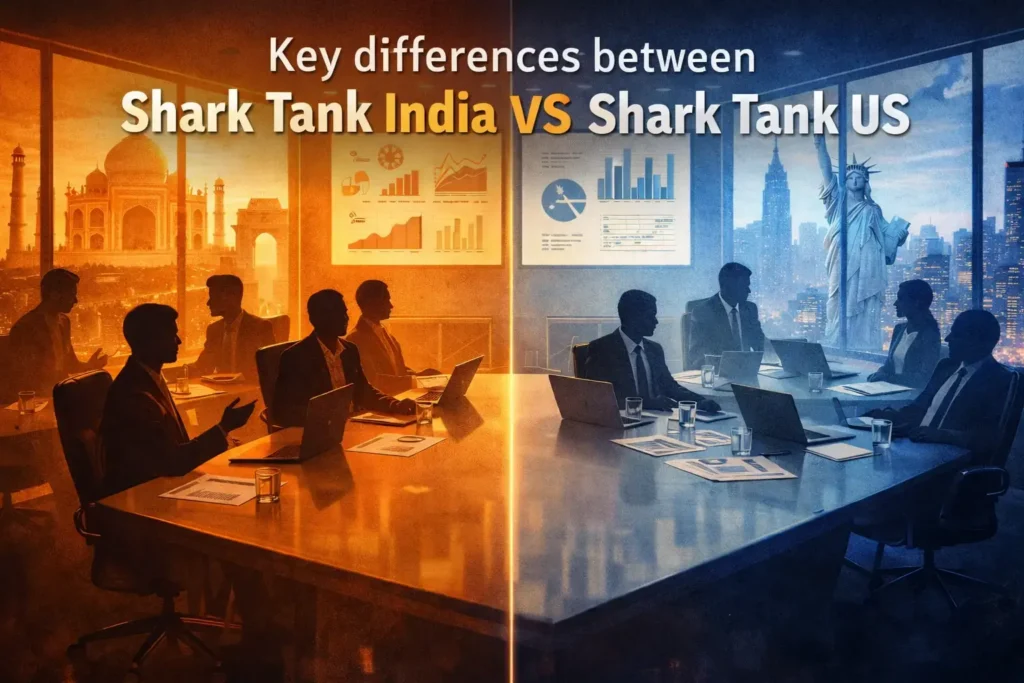
Walk onto the set of Shark Tank US. The lighting is cool, the chairs are leather, and the background is a muted cityscape. It screams efficiency. The conversation is transactional. A US Shark will listen to your pitch, and within ninety seconds, they want to see your numbers. If you don’t have them, you’re shown the door politely (or not so politely, if Kevin O’Leary is in a mood). There’s very little hand-holding.
Now, step into Shark Tank India. The set is warmer, almost resembling a luxurious living room rather than a corporate boardroom. The show understands its audience. As one observer noted, reality TV in India thrives on “voyeurism and specific human sentiments”—fear, anxiety, and the timeless appeal of a good underdog story. The Indian Sharks often act as mentors first and investors second.
The “Masala” Factor
During the Sampark pitch in Season 5, we saw this dynamic play out in real time. The founders, Rahul and Almas, pitched a QR code sticker for parked cars to facilitate calling the owner. In Shark Tank US, this would have been a 5-minute discussion on market size. In Shark Tank India, it turned into a philosophical debate about human nature. Namita Thapar questioned the very soul of the consumer:
“Have you seen the honking culture in India? People are so impatient, so do you think in a culture like this, someone will put a sticker and people will call him?”
This is a quintessential Indian Shark moment. The focus wasn’t just on the Gross Merchandise Value (which was a healthy ₹3.5 crore), but on whether Indian society was “nice enough” to accommodate the business model. You rarely see a US Shark question the moral fabric of the customer base; they accept the market as it is and ask how you plan to capture it. In India, the Sharks are still debating what the market should be.
The Sharks: Industry Titans vs Startup Celebrities
This is where the “deep research” gets juicy. A critique that has followed Shark Tank India since its inception is the credibility of the Sharks themselves.
In Shark Tank US, the panel reads like a list of “Who’s Who” of American enterprise: experienced franchise investors and serial entrepreneurs. These are people who built wealth over decades and have weathered multiple economic cycles.
In Shark Tank India, the Sharks are largely first-generation entrepreneurs from the startup boom of the 2010s. They are founders of unicorns or soon-to-be unicorns. On the surface, that’s exciting. But it opens them up to a specific kind of scrutiny that US Sharks rarely face.
The Glass Houses Debate
In early 2023, a widely shared LinkedIn post by Ankit Uttam highlighted a paradox many viewers felt uncomfortable about: several Sharks on Shark Tank India were leading companies that were losing money or just recently profitable. (The Times of India)
For example:
- Vineeta Singh’s SUGAR Cosmetics reported significant losses in FY22. (The Times of India)
- Peyush Bansal’s Lenskart was reported to have consolidated losses in FY22. (Indiatimes)
- Ghazal Alagh’s Mamaearth only recently reported a modest profit after years of losses. (The Times of India)
This led to headlines questioning whether some of the Sharks are better at building personal brands than profitable businesses.
Instagram Fame: Marketing Hustle for Sharks
Another data point that ties into this credibility debate is social media growth. Analysis by Inc42 found that many Sharks on Shark Tank India saw exponential increases in their Instagram followers after joining the show—Aman Gupta’s following grew from around 14 K to over 1.3 M after his tenure as a judge began. (Inc42 Media) This shows that the show itself can act as a massive marketing engine, bolstering personal brands in ways that traditional investor reputations might not.
The Deal Flow: Collaboration vs Competition
Watch a deal go down in Shark Tank US. If two Sharks are interested, they usually take turns making offers, trying to outbid or outsmart each other. It’s competitive, and the ego clashes are subtle but present. The deal is usually a 50-50 split between two Sharks, or one Shark takes it all.
In Shark Tank India, collaboration is the spice of the show. It’s common to see three, four, or even five Sharks pile into a deal. They form “Juntas” (groups) on the fly. This isn’t just for show; it’s a risk-mitigation strategy. Since the Indian market is vast but fragmented, having multiple Sharks with different retail networks (e.g., offline retail, online channels) is a strategic advantage for a startup.
However, this also leads to the “ego” factor. Because the Sharks are contemporaries and often competitors in the real world, the tension is more palpable. Their interactions feel personal in a way rarely seen in the US tank.
The Consumer: The American Dream vs Aspirational Bharat
Shark Tank US: The Luxury of Niches
The US version is famous for its quirky, niche products—think products like sponges, lifestyle gadgets, or novelty items that solve relatively small pain points. The American consumer’s higher disposable income allows for spending on lifestyle enhancements, if not essentials.
Shark Tank India: Solving Everyday Pain Points
In Shark Tank India, pitches usually revolve around fundamental problems: education, healthcare, affordable essentials, or context-specific challenges like chaotic parking in urban India. The audience doesn’t just watch to see people get rich; they watch to see solutions to problems they face daily.
Profitability vs Reality: The Elephant in the Room
We also have to address the shadow that sometimes hangs over Shark Tank India’s narrative: by prioritising emotional resonance and dramatic storytelling, the show can sometimes set unrealistic expectations about founders’ journeys. Some critics argue this sensationalisation may skew what founders think is required to raise investment versus what actually matters in real-world venture and growth trajectories.
Conclusion: Why Both Tanks Work
So, which one is better? That’s the wrong question. They are both perfect for their ecosystems.
Shark Tank US is a masterclass in capitalism—clinical, numbers-driven, and highly focused.
Shark Tank India is a masterclass in potential—messy, emotional, culturally grounded, and rooted in a narrative about why someone started a business.
The US show tells you how to run a business. The Indian show tells you why someone started one.
Frequently Asked Questions about Shark Tank India vs Shark Tank US
What is the main difference between Shark Tank India and Shark Tank US?
The core difference lies in investor mindset and storytelling. Shark Tank US focuses heavily on numbers, scalability, and fast decision-making, while Shark Tank India places greater emphasis on founder journeys, social context, and mentorship alongside financial evaluation.
Why does Shark Tank India feel more emotional than Shark Tank US?
Shark Tank India highlights personal struggles, family backgrounds, and social challenges to connect with a broader audience, whereas Shark Tank US maintains a more transactional, data-driven pitch environment focused primarily on business performance.
Are the business expectations different in Shark Tank India compared to Shark Tank US?
Yes. Shark Tank US typically prioritizes proven traction, strong margins, and scalable models, while Shark Tank India often evaluates startups within the realities of a developing and fragmented market where long-term potential and problem-solving matter as much as immediate profitability.
Why do multiple investors frequently join a single deal in Shark Tank India?
In Shark Tank India, joint investments are common because different investors bring varied distribution networks, industry access, and operational strengths, which helps startups navigate India’s complex and highly diverse market more effectively.
Does Shark Tank India focus more on marketing impact than actual investment outcomes?
For many founders and investors, the show also functions as a powerful visibility platform. The exposure often leads to significant brand awareness and customer acquisition, making media impact an important side benefit alongside the investment itself.
Which show is better for learning real-world business strategy: Shark Tank India or Shark Tank US?
Shark Tank US is more useful for learning negotiation tactics, valuation logic, and investor expectations in mature markets, while Shark Tank India is better for understanding early-stage entrepreneurship, local market challenges, and the role of culture in building startups
Do all deals shown on Shark Tank India and Shark Tank US actually close after filming?
No. In both shows, on-camera agreements are followed by detailed due diligence, and some deals may not be completed after filming due to legal, financial, or operational issues discovered later.
Editorial Disclaimer
This article is an independent editorial analysis based on publicly available information, media reports, and the author’s personal viewing and interpretation of the shows. The views expressed are solely for informational and educational purposes and do not represent any official affiliation with the television networks, production houses, investors, or brands mentioned. Financial figures, examples, and references are cited from third-party sources and are intended only to support journalistic commentary.