The Slow Burn: Why Slow Burn Indian Web Series Are Trading Masala for Mood
Discover how slow burn Indian web series are reshaping OTT storytelling in 2026, replacing fast-paced masala with deeper characters, atmosphere, and emotionally driven narratives.


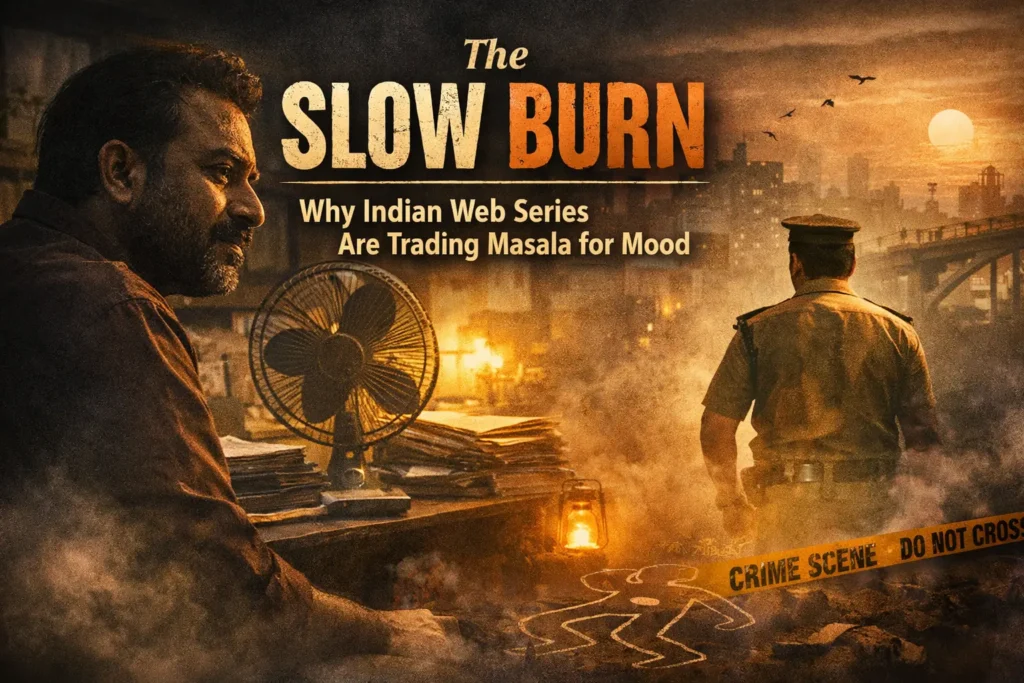
There is a moment in Paatal Lok Season 2 that encapsulates everything changing in Indian storytelling. It is not a dialogue. It is not an action sequence. It is simply Hathiram Chaudhary sitting in a cramped Delhi office, staring at a file he has read a hundred times, while the ceiling fan struggles against the heat. The camera holds on him. Nothing happens for nearly a minute. And yet, you cannot look away.
This moment perfectly captures why slow burn Indian web series are redefining how stories are told on streaming platforms today.
Ten years ago, Indian writers were taught that “nothing happening” was a sin. Today, it is becoming the entire point.
As we move through 2026, the landscape of Indian web series has undergone a transformation so complete that it is easy to forget how we got here. The shows dominating conversations—Black Warrant, Mandala Murders, Paatal Lok, and Dahaad—share something deeper than genre. They share a philosophy. They trust you to wait.
This is the age of the slow burn. And unlike the industrial assembly line of “content” that preceded it, this shift tells us something profound about what Indian audiences actually want when the door closes and the screen lights up.
The Audience Grew Up. The Stories Had To Follow.
Let us be honest about something uncomfortable: for a very long time, Indian mainstream entertainment did not trust its audience.
The assumption, baked into decades of filmmaking, was that viewers needed constant stimulation. A twist every fifteen minutes. A fight sequence before the interval. A song to “lighten the mood” when things got too serious. This was not malice—it was economics. In a theatrical model, you had ninety minutes to recover your investment. You could not afford to lose anyone.
Then came the pandemic, and something unexpected happened.
People stayed home. They discovered international content. They watched Dark with subtitles. They sat through the four-hour director’s cut of movies they would never have attempted in a theatre. They learned, slowly, that patience in storytelling was not a flaw—it was a feature.
Director Nandhini JS, whose work Inspector Rishi exemplifies this new approach, explains it simply: when you cannot control the environment in which someone watches—when they might be on a phone in broad daylight or half-asleep at 2 AM—you have to build the narrative differently. You cannot rely on jump scares or sudden twists. You have to create something that seeps in rather than jumps out.
This is the foundation of the slow burn. It is storytelling designed not for the moment of impact, but for the hours and days after, when the images refuse to leave your mind.
Why Crime Became the Vehicle for Slow Burn Indian Web Series
If you look at the slow burn wave sweeping Indian OTT, you will notice something immediately: most of these shows are crime thrillers.
Black Warrant unfolds inside Tihar Jail, building tension not through dramatic escapes but through the mundane horror of systemic corruption. Dahaad, the first Indian series to premiere at the Berlin International Film Festival, follows a police officer investigating deaths that look like suicides—until you look closer. Mandala Murders weaves cult psychology and geometric symbolism into a mystery set in a fictional town, creating something closer to a nightmare than a police procedural.
Crime serves the slow burn because crime, at its best, is not about “whodunit.” It is about why. It is about the soil in which violence grows.
Consider Sacred Games. When it exploded onto screens in 2018, what captivated audiences was not the mystery of who Kukoo was—it was Ganesh Gaitonde’s journey from nothing to something. The show took its time showing you how power corrupts not in one dramatic moment, but in a thousand small compromises. That patience established a template that scores of shows have since refined.
The crime genre also offers something the slow burn needs: moral complexity. In Paatal Lok, the line between hunter and hunted blurs until it disappears entirely. In Kohrra, grief becomes its own kind of investigation. These shows understand that the most compelling mysteries are not about events, but about people.
The Economics of Patience
Here is where it gets interesting, and where the standard “audiences want quality” explanation falls short.
The shift toward slow burn Indian web series is not just artistic—it is deeply economic. And understanding this requires looking at how streaming platforms actually make money.
In the theatrical model, a film had one chance. If it did not work in the first weekend, it disappeared. But OTT platforms operate on a library model. A show released today might find its audience six months from now. It might be discovered by someone browsing for something completely different. It has no shelf life.
This changes the calculation entirely.
A slow burn series, by its nature, rewards rewatching. It contains details you missed the first time. It invites discussion, theory-crafting, and the kind of engagement that keeps a show alive in public conversation for months. Asur, with its blend of mythology and forensic science, inspired countless YouTube videos dissecting its symbolism. Mirzapur became a cultural phenomenon not only because of shocking moments, but because viewers wanted to live in that world, with those characters.
Platforms have noticed. In 2026, franchises dominate the conversation—Mirzapur Season 4, Paatal Lok Season 2, Criminal Justice, and The Family Man on Amazon Prime Video India. They are shows designed to become part of viewers’ lives.
There is another economic factor, less discussed but equally important: the failure of the alternative.
The Hollywood Reporter India recently published a detailed analysis of why Indian streaming platforms have struggled with light, disposable entertainment. Shows attempting fluff—The Royals, Call Me Bae, and Do You Wanna Partner—have consistently fallen flat, often feeling like algorithm-driven imitations of Western formats rather than organic storytelling.
The conclusion is uncomfortable but unavoidable: Indian creators have not yet mastered the art of meaningful nothingness. What they have mastered is serious drama.
When you cannot do fun well, you double down on what works. And what works, in the Indian OTT space, is the slow burn thriller.
The International Validation
There is another factor, one that executives rarely admit but creators feel deeply: the world is watching.
When Dahaad premiered at the Berlin International Film Festival, it signaled something significant. Indian series were no longer just competing domestically—they were entering the global conversation. And the global conversation, in prestige television, has increasingly favored the slow burn.
Look at the shows that travel. True Detective. Mindhunter. The Nordic noir tradition that inspired The Buckingham Murders. These are not fast-paced entertainments. They are mood pieces, character studies, and explorations of atmosphere and psychology.
Indian creators, watching what resonated internationally, realized they had something unique to offer: a cultural tradition of philosophical depth, of moral questioning, of stories that do not provide easy answers.
Asur exemplifies this beautifully. On its surface, it is a police procedural. Beneath that, it is a meditation on good and evil, on the mythological patterns that repeat across human history. The show trusts its audience to engage with these ideas while still delivering the satisfactions of a crime drama.
This international orientation has also pushed production values upward. Mandala Murders features cinematography and background score that would stand alongside any global release. Black Warrant uses its period setting to create a visual texture that rewards close attention. These are shows designed not just for consumption, but for appreciation.
When Slow Burns Fail
It would be misleading to suggest that every slow burn succeeds. They do not. And the failures reveal something important about the form.
Consider Daldal, the Bhumi Pednekar thriller released in early 2026. Critics praised its ambition and visual style, but audiences were divided. Many found the pacing too deliberate, the tone relentlessly bleak, and the experience exhausting rather than engaging. The show became a case study in the risks of the slow burn: when mood overwhelms momentum, when atmosphere substitutes for story.
Mistry, the Indian adaptation of Monk, faced different problems. Viewers familiar with the original recognized it as a near scene-by-scene copy, robbing it of the freshness that makes discovery meaningful. The pacing—stretched scenes and rushed resolutions—suggested a creative team unsure how to adapt the procedural format to Indian sensibilities.
Even Mandala Murders, despite its ambition, received criticism for becoming so entangled in timelines and symbolism that following the story required unreasonable effort. The show demonstrated that patience and confusion are not the same thing.
These failures teach an important lesson: slow does not mean static. The best slow burn Indian web series maintain forward momentum through character revelation, atmosphere, and the gradual unveiling of meaning. The worst simply stop.
The Psychology of Attention
There is something else happening here—something that touches on how we live now.
We are drowning in stimulation. Notifications. Alerts. Infinite scroll. In this context, a show that demands patience becomes something more than entertainment—it becomes a form of resistance.
This is exactly why slow burn Indian web series resonate so strongly with modern audiences.
When you watch Paatal Lok, you cannot multitask. You cannot glance at your phone every thirty seconds. The meaning lives in the spaces between events—in a look, a silence, a moment of hesitation.
This is deeply appealing to viewers exhausted by the attention economy. The slow burn offers permission to focus.
Director Nandhini JS understood this when she lit Inspector Rishi’s darker scenes specifically to remain legible in daylight environments. The show’s gradual build, its refusal of cheap jump scares, and its commitment to psychological unease create a different kind of engagement. You watch differently when you are not waiting for the next shock.
The slow burn requires something rare today: the willing suspension of impatience.
The Future of the Form
Where does this go? The evidence from 2026’s most anticipated releases offers clues.
Mirzapur Season 4 will inevitably deliver the violence and power struggles fans expect. But its longevity suggests something deeper—viewers want to spend time with these characters, not just see what happens next.
The Family Man Season 3 will continue balancing national security with middle-class domestic life, a formula that works precisely because it treats both with equal seriousness. Its creators have often spoken about the importance of seemingly “boring” scenes—the moments where characters simply live.
Panchayat Season 5, though a comedy, shares the same DNA. Its pleasures come from observation, from gradual character growth, and from situations allowed to develop naturally. It proves that the slow burn is not a genre—it is an approach.
Even historical and science-driven dramas like Freedom at Midnight and Space Gen – Chandrayaan are shifting focus toward people behind events rather than grand spectacle.
The common thread is unmistakable: audiences are embracing slow burn Indian web series because these stories breathe.
What Gets Lost
This shift is not without cost.
Middle-class comedies, once central to the rise of platforms like TVF, are becoming harder to find. Pure romance—without crime, trauma, or darkness—struggles to get greenlit. Light entertainment often feels embarrassed about its own simplicity.
There is a danger in seriousness becoming the default tone.
The continued success of Gullak, now in its fifth season, proves audiences still crave warmth and humour. But such shows increasingly feel like exceptions.
The platform economy also pushes toward uniformity. Netflix has Sacred Games and Mandala Murders. Prime Video has Paatal Lok and Mirzapur. JioHotstar has Criminal Justice and Aar Ya Paar. Individually strong, collectively they risk blurring into a single aesthetic.
The challenge ahead is expanding the emotional range of the slow burn—applying its patience to joy, love, and everyday life.
The Deeper Truth
When people talk about why they love Paatal Lok, they rarely mention the plot. They talk about how it felt. How Hathiram’s exhaustion felt familiar. How the world on screen mirrored the world outside.
The power of slow burn Indian web series lies in their emotional truth.
Not the truth of facts—though shows like Delhi Crime are grounded in real events—but the truth of experience. Life does not unfold in neat climaxes. Understanding accumulates. People reveal themselves in small, repeated moments.
Indian audiences have always been capable of this kind of engagement. What changed was the willingness to serve them.
What Comes Next
Standing in 2026, it is tempting to see the slow burn as the final destination. But storytelling forms evolve.
Already, the blending of genres—mythology and crime in Asur, horror and investigation in Inspector Rishi—suggests a future where categories matter less than creative vision. The rise of regional originals in Tamil and Telugu, now reaching national audiences, promises new narrative traditions. Experiments with form, from nonlinear structures to immersive episodes, hint at what lies ahead.
For now, the slow burn reigns.
And it reigns because it earned its place—by trusting the audience to stay.
In a world engineered to fragment attention, that trust feels quietly revolutionary.
Editorial Disclaimer
This article is an independent editorial analysis based on publicly available information and the author’s interpretation of Indian OTT and web series trends. The views expressed are personal and are not affiliated with, sponsored by, or endorsed by any streaming platform, production house, or rights holder.