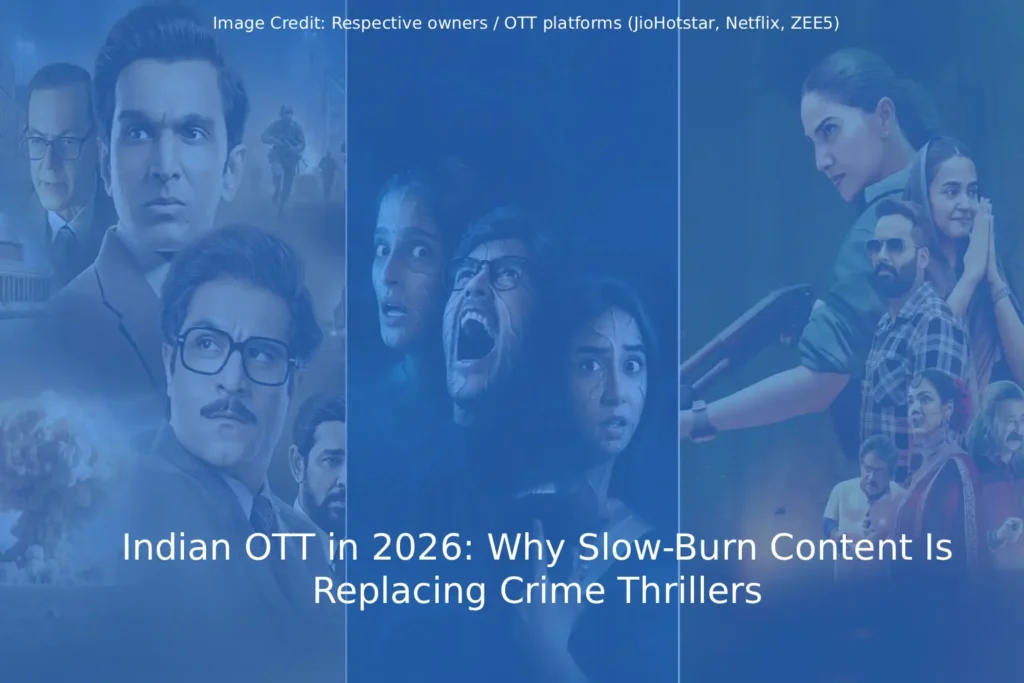
Indian OTT in 2026: Why Slow-Burn Content Is Replacing Crime Thrillers
Explore how Indian OTT platforms are shifting from crime thrillers to slow-burn storytelling in 2026. Discover trends, top shows, and what viewers really want now.


Let me be honest with you—if you look at the streaming landscape in India just a couple of years ago, it felt like every other show was trying to be the next Sacred Games. Dark alleys, gritty cops, complex gangsters, and that signature “gali-galoch” dialogue delivery. And honestly? It worked. For a while.
But 2026 tells a completely different story. Something shifted. And if you’re still expecting every big release to be a crime thriller with a body count, you’re about to be pleasantly surprised.
This year, Indian OTT platforms are betting big on what industry insiders call “slow-burn” content—stories that take their time, that breathe, that let you sit with characters over multiple episodes without needing a murder every fifteen minutes to hold your attention. It’s not about being boring; it’s about being patient. And Indian audiences are finally ready for that patience to pay off.
Take Sangamarmar on JioHotstar, for instance. A romantic drama that spans 25 years. Twenty-five years! Produced by Rajshri Productions with Sooraj R. Barjatya as showrunner, it follows Amrita and Aditya through decades of love, sacrifice, and family duty. In any other year, a platform executive might have looked at this pitch and asked, “Where’s the crime angle? Where’s the suspense?” But in 2026, this is exactly the kind of content that’s generating genuine buzz.
The series doesn’t rush. It doesn’t rely on cliffhangers every episode. Instead, it builds emotional resonance slowly, episode by episode, trusting that audiences have the attention span to care about characters before they care about plot twists. And you know what? Early reception suggests they were right.
This shift isn’t accidental. It’s a calculated response to something viewers have been saying for years but platforms are only now hearing: we’re tired of being manipulated.
The Death of the “Gali-Galoch” Formula: What Viewers Actually Want Now
Let’s talk about something uncomfortable. For the better part of five years, Indian OTT was stuck in what I call the “gali-galoch” loop—shows that relied on a predictable cocktail of profanity, stylized violence, and that specific kind of gritty urban aesthetic that was supposed to signal “this is NOT your mother’s TV.”
And look, some of those shows were genuinely good. But somewhere along the way, the formula became the point, not the story.
What’s fascinating about 2026 is how the data is forcing platforms to confront this reality. According to the latest FICCI-EY report on the media and entertainment sector, the Indian OTT market has moved past pure content competition—it’s now about distribution, retention, and actual viewer engagement. And guess what keeps viewers engaged? Not shock value. Authenticity.
Take Honeymoon Se Hatya on ZEE5. On paper, it sounds like it could be another crime thriller. But here’s what makes it different: it’s based on five real cases from across India, including the infamous Meerut Blue Drum case where a murder victim was dismembered and hidden in cement. The series doesn’t sensationalize. It builds slowly, using police files, interviews, and meticulous reconstruction to show how small issues—control, affairs, money problems—escalated into tragedy.
This is what viewers want now. They want stories that feel real, that don’t insult their intelligence with predictable twists, that respect the complexity of human motivation. Vikram Malhotra, founder of Abundantia Entertainment, put it perfectly: “A show or film must deliver on creative ambition and resonance, while also being positioned to stand out in a crowded content environment.” That crowded environment means you can’t just shock people anymore. You have to actually move them.
And here’s the hidden detail most people miss: the death of the formula isn’t just about audience taste. It’s economic. With subscription growth slowing and retention becoming the real battleground, platforms can’t afford to churn out content that viewers finish and forget. They need shows that people talk about, that they recommend, that they stay subscribed for.
Regional Powerhouse: How South Indian OTT Content is Dominating Hindi Markets
Now, let me tell you about the most significant shift you probably haven’t noticed unless you’re inside the industry. Remember when “regional content” meant niche offerings for specific language audiences? Those days are gone. Permanently.
In 2026, South Indian content isn’t just holding its own—it’s actively dominating Hindi-speaking markets, and the numbers are staggering. According to recent acquisition data, South Indian languages now account for 55% of all Pan-India theatrical releases planned for 2026. Fifty-five percent. That’s not a trend; it’s a structural realignment of the entire industry.
What’s driving this? Well, for starters, the so-called “Bollywood bubble” has effectively popped as a singular acquisition strategy. What that means in plain English: producers and platforms have realized that a Telugu or Tamil hit often performs better across India than a Hindi film with the same budget. Regional hubs like Hyderabad’s Tollywood and Chennai’s Kollywood can deliver production values comparable to Mumbai at nearly 40% lower cost.
Netflix understood this early. Their 2026 India slate includes the platform’s first-ever Telugu originals, creator-led Tamil series, and partnerships with production houses like Sithara Entertainments, Mythri Movie Makers, and Raaj Kamal Films International. As reported by Variety, Monika Shergill, Netflix’s VP of Content, put it bluntly: “This is about taking Indian cinema and stories to the world.”
But here’s what the official statements don’t tell you. The real reason platforms are going all-in on South content? Distribution efficiency. When a Telugu show like Takshakudu (starring Anand Deverakonda) gets dubbed into Hindi, Tamil, Malayalam, Kannada, and Bengali simultaneously using AI-powered localization tools, the release becomes a unified national event rather than staggered regional rollouts. That means marketing budgets go further, word-of-mouth spreads faster, and the show has a real shot at becoming a genuine Pan-India hit.
Anup Chandrasekharan from The EPIC Company explained it this way: “South audiences show higher engagement metrics. Watch time is higher, genre exploration is wider, and viewers consume more titles than the national average.” If you’re a platform looking to grow subscriptions, those are exactly the audiences you want to attract.
And the cross-pollination is real. JioHotstar’s ‘South Unbound’ initiative revealed that nearly 75% of original South content commissions today come from mainstream platforms, and the data suggests that South audiences spend more time watching content and sample across genres more aggressively than any other demographic segment.
5 Upcoming Web Series in March 2026 You Can’t Miss
If you’re looking for what to watch right now, here are five releases from March 2026 that are worth your time. And no, not all of them are crime thrillers.
1. Chiraiya (JioHotstar) – March 20
This six-episode series starring Divya Dutta and Sanjay Mishra is fascinating for two reasons. First, it’s a character-driven rural drama—a slow-burn story set outside urban India. Second, JioHotstar is dropping all six episodes at midnight on March 20. Why midnight? Industry insiders suggest it’s a calculated “binge-trap”—they want hardcore cinephiles to finish it by morning and flood social media with takes, driving the Friday evening casual audience. Smart strategy for a show that needs word-of-mouth momentum.
2. Andha Pyaar 2.0 (ZEE5) – Already Streaming
Launched March 14, this is something refreshingly different. It’s a blind dating reality show where a woman talks to four men while blindfolded—no looks matter, just voice, jokes, and personality. Hosted by Vivek Samtani with comedians like Rawhitsingh and Kushagra Srivastava as wingmen, it tackles modern dating issues like ghosting and fake profiles. Light, funny, and genuinely heartfelt.
3. Honeymoon Se Hatya (ZEE5) – Already Streaming
True crime done right. Five episodes covering five real cases from across India, including the Meghalaya case where a wife conspired to kill her husband during their honeymoon, and the Meerut Blue Drum case that shocked the nation. What sets this apart is the pacing—it doesn’t rush. Each episode builds methodically, showing the small betrayals that led to horrific outcomes.
4. Sangamarmar (JioHotstar) – Currently Streaming
The poster child for 2026’s slow-burn trend. A 25-year romance from the Rajshri Productions stable, directed by Vikram Ghai with Sooraj R. Barjatya as showrunner. New episodes drop every Thursday, and it’s available dubbed in Tamil, Telugu, Marathi, Kannada, Malayalam, and Bengali. If you want to understand why platforms are betting on emotional depth over instant gratification, this is your case study.
5. Devkhel (ZEE5) – Streaming Now
A Marathi crime thriller set in the coastal Konkan village of Devtali, where a mysterious death occurs every Holi festival. For 15 years, villagers blamed it on the mythical demon Shankasur. When another man dies on Holi Pournima, a newly arrived inspector must separate superstition from reality. Rural mystery, cultural roots, and genuine suspense.
Subscription Fatigue: Is the Indian Audience Moving Back to TV?
Here’s the uncomfortable truth that OTT platforms don’t want you to think about too much: subscriptions are plateauing, and viewers are getting tired of paying for six different apps.
According to the latest FICCI-EY report, India’s total time spent on video rose to 32 billion hours in 2025, but in-app purchases nearly tripled from $31 million in 2022 to $97 million in 2025. That sounds like growth until you realize that most of that growth is coming from micro-dramas and short-form content, not premium long-form series.
Let me explain what this means in practical terms. The average Indian household now has to decide which OTT subscriptions to keep and which to drop. And increasingly, they’re choosing one or two platforms that offer the most value—often JioHotstar, which benefits from being bundled with Jio mobile networks. The platform’s 883.5 crore revenue (23.3% market share) is driven not by original content but by IPL cricket and deep integration with telecom services.
YouTube, meanwhile, has quietly become the biggest OTT platform in India with 37.7% market share—and it doesn’t charge a subscription at all. It’s ad-supported, free, and reaches more Indians than any paid platform could dream of.
So is the audience moving back to TV? Not exactly. But they’re moving toward platforms that offer either (a) unbeatable value bundles, or (b) free, ad-supported content. And they’re increasingly turning to micro-dramas—shows with 2-3 minute episodes designed for mobile viewing—that Kuku TV, Story TV, and Quick TV have pioneered. These platforms have entered India’s top 5 most downloaded streaming apps, ahead of established players like ZEE5 and Netflix in download rankings.
The subscription fatigue is real, and platforms know it. That’s why you’re seeing more AVOD (ad-supported) tiers, more bundling with telecom services, and more experimentation with freemium models.
FAQ: Which is the best OTT platform in India 2026?
This question doesn’t have a simple answer anymore, because “best” depends entirely on what you’re looking for. Let me break it down.
Which OTT platform is best for free content in India?
YouTube is the best free OTT platform in India in 2026 due to its large content library, accessibility, and ad-supported model.
Additionally, Amazon MX Player also offers free streaming with a growing collection of web series and movies.
Which OTT platform has the best regional content in India?
ZEE5 is considered the best OTT platform for regional content in India.
It provides shows and movies in languages like Marathi, Bengali, Tamil, Telugu, and Kannada, making it ideal for diverse audiences.
Which OTT platform is best for premium web series in India?
Netflix is the best OTT platform for premium web series in India in 2026.
It focuses on high-quality storytelling, international collaborations, and original Indian content across multiple languages.
What is the best OTT strategy for Indian users in 2026?
The best OTT strategy in 2026 is to combine one premium subscription with free platforms.
This allows users to access high-quality exclusive content while also enjoying free, ad-supported entertainment.
Conclusion
If you take away one thing from this article, let it be this: Indian OTT has stopped trying to be Hollywood. The industry has realized that what works here is authenticity, regional roots, and stories that respect the audience’s intelligence. The crime thriller dominance is fading not because people stopped liking thrillers, but because they got tired of formula. They want something real, something that takes its time, something that doesn’t insult them with predictable plot twists every twenty minutes.
The regional revolution—especially from the South—isn’t a trend; it’s a permanent restructuring of how content gets made and consumed in India. When production costs are lower, engagement metrics are higher, and stories travel better across languages, that’s not just good business. That’s a better product.
And yes, subscription fatigue is real. Platforms that survive the next few years won’t necessarily be the ones with the biggest budgets. They’ll be the ones that offer genuine value, whether through unbeatable bundles, free ad-supported tiers, or content that people actually want to watch more than once.
The streaming wars aren’t over. But the battlefield has fundamentally changed. And for once, it feels like the audience is finally winning.
This article draws on industry data from FICCI-EY reports, BARC ratings, platform announcements, and interviews with content executives. All streaming release dates and platform information are accurate as of March 2026.
Editorial Disclaimer
This article is intended for informational and editorial purposes only. All views and analysis are based on publicly available data, industry reports, and media sources at the time of writing. Streaming platform names, logos, and content titles mentioned in this article are the property of their respective owners. We do not claim ownership of any third-party trademarks or media assets. Any images used are for illustrative purposes only and are credited to their respective sources.