
Global OTT Series: How Streaming Shows Took Over the World
An in-depth editorial analysis of global OTT series and how streaming platforms reshaped storytelling, audience behavior and worldwide viewing culture.


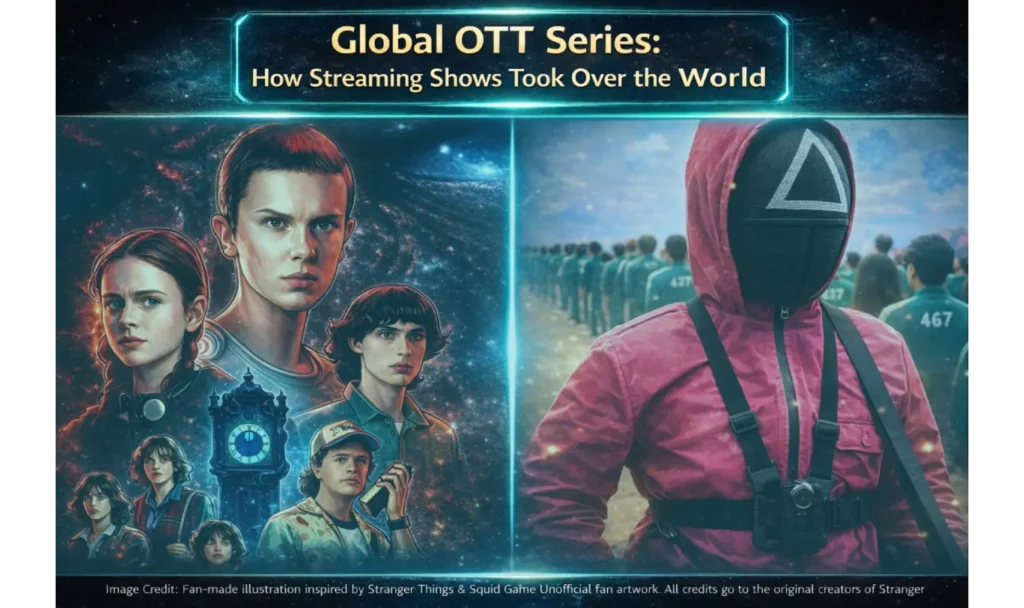
Remember the watercooler moments of the past? Monday mornings were once dominated by debates about who shot J.R. or the latest antics of the Seinfeld crew. That shared cultural experience hasn’t vanished; it has simply migrated. Today, global OTT series carry that same collective conversation forward. It’s no longer confined to a single night or a single channel. It now lives in the cloud, accessible on our phones during a commute, on our laptops during lunch, and on our 65-inch smart TVs at night.
We are living in the golden age of storytelling, powered by Over-the-Top (OTT) platforms. But calling it just “streaming” feels reductive. It’s a tectonic shift in how the world consumes content. As someone who has spent years analyzing media trends and watching more pilot episodes than I care to admit, I’ve seen this evolution from a novelty to the new normal. This isn’t just a list of shows; it’s an exploration of the phenomena that made them global touchstones.
The Great Unbundling and the Birth of “Must-Watch” TV
To understand the “top” series, we must first understand the battlefield. The rise of Netflix, Amazon Prime Video, Disney+ Hotstar, Apple TV+, and a host of regional players didn’t just create more content; it created a war for your attention span. This is often called the “Peak TV” era, a term that feels both exhilarating and exhausting.
The primary weapon in this war? What many industry observers describe as a data-driven creative gamble.
In the old studio system, a show was greenlit based on a pilot and the gut feeling of a network executive. Today, algorithms whisper in the ears of producers. Netflix knows when you pause, when you rewind, and what genre you watch at 2 AM. This data informs production decisions and investment levels that, according to industry observers, can reportedly reach figures in the range of $200 million for large-scale flagship projects led by showrunners like the Duffer Brothers (Stranger Things) or David Benioff and D.B. Weiss (3 Body Problem).
But data alone doesn’t create art. The magic happens when data meets vision. From an industry analysis perspective, the top global series are widely seen as the ones that have mastered this alchemy. They are shows that feel both meticulously engineered for mass appeal and uniquely personal.
The Titans: A Look at the Series That Defined the Landscape
When we talk about the top global series, we aren’t just talking about ratings. We are talking about cultural infiltration. These are the shows that broke the algorithm and entered the lexicon.
The Prestige Heavyweights: Stranger Things and The Crown
You cannot discuss OTT dominance without mentioning Stranger Things. It is the quintessential example of a show that built a bridge between generations. For Gen X and Millennials, it was a nostalgia-soaked love letter to the 80s—Spielberg, Stephen King, John Carpenter. For Gen Z, it was a fresh, terrifying, and heartfelt story of friendship. The show’s brilliance lies in its ability to scale. One moment, it’s a small-town mystery; the next, it’s an apocalyptic showdown with a Lovecraftian monster. Its global appeal is simple: it’s about the universal terror of growing up and the universal need for connection.
On the opposite end of the spectrum lies The Crown. Peter Morgan’s magnum opus turned the royal family into a global soap opera, but with the production value of a feature film. What made it a global phenomenon wasn’t just the royal gossip; it was the existential exploration of duty versus self. It humanized figures we had only ever seen on currency and in tabloids. It sparked conversations in India, Brazil, and Japan about monarchy, legacy, and the crushing weight of expectation. It proved that “local” stories, told with enough nuance and universality, become global properties.
The Global Heist: Money Heist (La Casa de Papel)
If any single show deserves credit for flattening the world, it’s Money Heist. Here is a textbook case of “hidden details” becoming a global movement. Initially released on Spanish network Antena 3, it was a decent hit. But when Netflix acquired it and began promoting it globally, something strange happened.
It wasn’t just watched; it was adopted.
Viewers in Italy, South Korea, and Turkey didn’t just read the subtitles; they felt the Espíritu (spirit) of the Professor and his gang. The red overalls and the Salvador Dalí mask became symbols of resistance far beyond the show’s narrative. The show’s success lies in its simplicity. It stripped the heist genre down to its core: a charismatic leader, a team of misfits, and a plan. But it layered it with a deep emotional core about love and rebellion against “the system.” It proved that language is no longer a barrier. If the emotion is raw and the plot is taut, the world will listen.
The Korean Wave: Squid Game
And then came Squid Game. It didn’t just break records; it shattered the glass ceiling for non-English content. When I first watched it, I was struck by the visceral irony. The sets were playgrounds—vibrant, colorful, innocent—built on the backs of human desperation.
Its global resonance wasn’t a fluke. It tapped into a universal anxiety of the 2020s: crippling debt and the feeling that the game of life is rigged against the common person. The “Red Light, Green Light” doll became an icon overnight. It also showcased the genius of Korean storytelling—the ability to blend extreme violence with profound pathos, brutal competition with unlikely friendships.
The hidden detail here is the production design. The V.I.P.s wearing animal masks wasn’t just a style choice; it was a commentary on how the ultra-wealthy dehumanize the desperate, viewing their suffering as mere entertainment. That level of thematic depth, wrapped in a high-concept thriller, is what made Squid Game the benchmark for global OTT success.
The Shifting Sands: What Makes a Hit in 2024 and Beyond?
The landscape of 2024 is different from the wild west of 2020. We are seeing a market correction. According to many industry analysts, the long-running “subscriber at all costs” model is increasingly seen as unsustainable, and the focus is shifting toward profitability. This has fundamentally changed the definition of a “top” series.
The Rise of the “Comfort Watch”:
Not every hit needs to be a dystopian thriller. Look at the enduring power of Ted Lasso. In a world exhausted by bad news, a show about relentless kindness became a phenomenon. It proved that optimism, done well, is a revolutionary act. Similarly, reality shows like Indian Matchmaking or Love is Blind have found global footing by exploring the messy, complicated nature of human relationships, sparking debate from dinner tables to Twitter threads.
IP is King (But Only If You Respect It):
This is the era of the adaptation. The Last of Us on HBO Max (Max) is the gold standard for how to treat source material. Gamers, notoriously difficult to please, were not just satisfied; they were moved. By expanding the story (the episode with Bill and Frank was a masterclass in television writing, entirely original to the show), the creators honored the game while making it accessible to millions who had never picked up a controller. It wasn’t a cash grab; it was a creative expansion.
The Niche is the New Mainstream:
Shows like Succession (HBO Max) and The Bear (Hulu/Disney+) dominate the cultural conversation despite having relatively niche premises—a dysfunctional media dynasty and a Chicago beef shop, respectively. Their success lies in execution. The dialogue in Succession became a meme (“You can’t make a Tomlette without breaking some Gregs”). The anxiety of The Bear became a feeling. These shows prove that “top” doesn’t always mean “most watched”; sometimes it means “most discussed.” They are the ones setting the trends that everyone else follows.
Regional Giants: The Rise of Local for Global
We cannot ignore the behemoth that is the Indian market. With Disney+ Hotstar, JioCinema, and Amazon Prime Video investing heavily, the line between Bollywood and OTT has blurred.
Panchayat on Amazon Prime Video is a perfect case study. A gentle, slice-of-life comedy set in a remote Indian village became a massive hit not just among Indians, but in the diaspora. Why? Because its humor is rooted in universal human folly. The frustration of a city-boy stuck in a village, the petty politics of a local council—these themes travel.
Similarly, South Korea and Japan continue to dominate with romance and thriller genres. Crash Landing on You remains a cultural phenomenon for its star-crossed lovers premise, proving that romance, at its core, speaks a universal language of longing and sacrifice.
The Future: Fragmentation and the Search for the Next Big Thing
As an analyst, the current trend I find most fascinating is the fragmentation of the market. There is no single “watercooler” show anymore because there are too many coolers.
The top series of tomorrow will need to be more than just good; they need to be “sticky.” They need to create universes that fans want to live in. We are moving towards a future of interconnected stories, where a hit show spawns spin-offs, prequels, and animated specials (the Marvel model, now being applied to everything from The Boys to Game of Thrones).
At the same time, many platform strategists and industry commentators believe that a weekly-release model can help sustain audience attention and extend subscriber engagement over a longer period, even in a world dominated by binge watching.
Conclusion: It’s Still About the Story Of Global OTT series
For all the talk of algorithms, data, and market fragmentation, the truth remains beautifully simple. A great story will always find its audience. Whether it’s a Spanish professor planning a heist, a Korean gambler playing deadly children’s games, or an American football coach navigating English football, the core remains the same.
The OTT revolution has democratized storytelling. It has allowed a creator in Seoul to speak directly to a viewer in a small town in Iowa, without a studio gatekeeper in between. The “Top Global OTT Series” aren’t just the most expensive or the most-watched. They are the ones that remind us of our shared humanity. They are the stories that, despite the miles and the languages, make us all feel like we are in the same room, gathered around the same fire, waiting to hear what happens next.
And honestly, as a viewer, there has never been a better time to be sitting around that fire.
Frequently Asked Questions About Global OTT Series
What does “global OTT series” actually mean?
Global OTT series refers to streaming shows that achieve significant viewership and cultural impact across multiple countries and regions, regardless of the language in which they are produced.
These series succeed internationally because their themes, storytelling formats and distribution strategies work across different markets and platforms.
Why have global OTT series grown faster than traditional television shows?
The rapid growth of global OTT series is mainly driven by mobile-first viewing, international platform expansion, and algorithm-based content discovery.
Streaming services can release shows worldwide at the same time, allowing stories to reach international audiences instantly without relying on local broadcast schedules.
How do streaming platforms decide which series can become global hits?
Streaming platforms analyse audience behaviour, viewing patterns and completion data to understand what types of stories resonate across regions.
However, industry analysts widely note that data only guides creative decisions — strong storytelling, emotional connection and cultural authenticity remain essential for a series to succeed globally.
Are non-English shows important for the future of global OTT series?
Yes. Non-English and regional-language productions play a central role in the future of global OTT series.
Viewers are increasingly open to subtitles and culturally rooted narratives, allowing local stories to perform strongly on international platforms without heavy localisation or remakes.