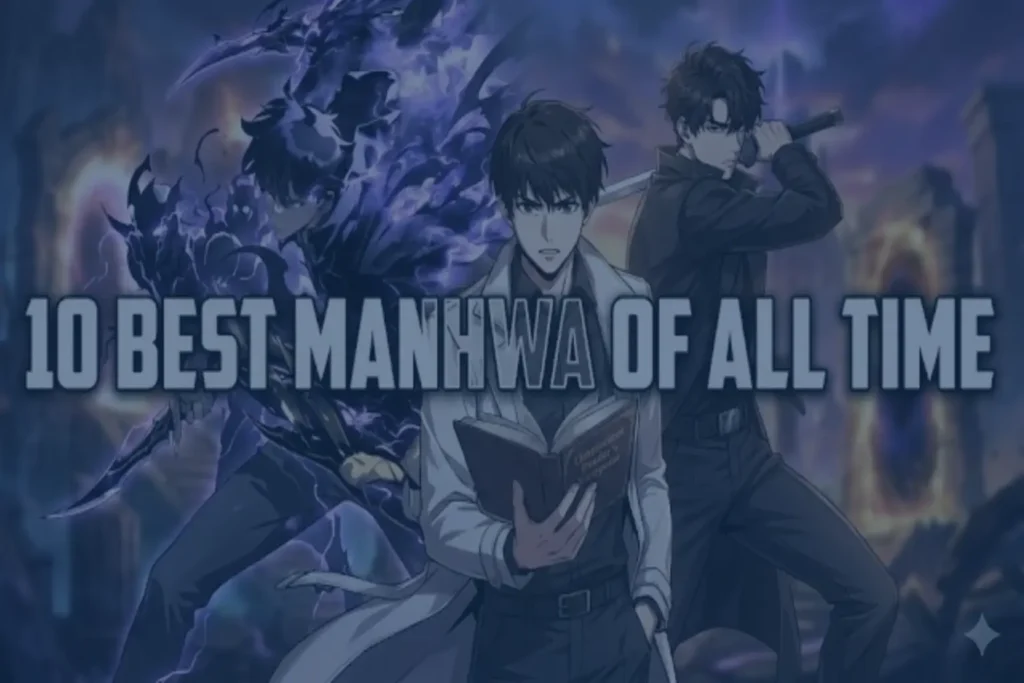
The 10 Best Manhwa of All Time (2026): Ultimate Ranked List Every Fan Must Read
Discover the 10 best manhwa of all time ranked for 2026. From Omniscient Reader’s Viewpoint to The Greatest Estate Developer, explore the ultimate must-read webtoon list every fan should know.


We need to have an honest conversation. For years, when we talked about “Korean comics,” the conversation started and ended with a question: “Is it as good as manga?” We treated manhwa like a minor-league farm system for anime adaptations, a place to find raw talent that might one day make it big in Japan.
That perception has changed dramatically over the past decade. Today, manhwa has evolved into a global storytelling powerhouse with its own unique style, format, and devoted fanbase. From groundbreaking webtoons to genre-defining fantasy epics, Korean creators have produced some of the most influential digital comics in the world. To understand just how far the medium has come, we need to look at The 10 Best Manhwa of All Time—the stories that shaped the industry and redefined what modern webcomics can achieve.
That narrative feels outdated in 2026.
Today, the global comics market is a tectonic force. According to Fortune Business Insights, the comic book market is approaching $18.63 billion in 2026, with manhwa and webtoons leading the charge in digital innovation. The webtoon revolution—vertical scrolling for mobile devices—didn’t just change how we read; it changed what we read. Pacing shifted. Character development evolved. The power fantasy, the regression trope, the system administrator—these aren’t just genres anymore; they’re a storytelling language that Korean creators have perfected.
What Exactly Is Manhwa?
Before diving in, let’s clarify the terminology. As defined by Wikipedia, manhwa (만화) is the general Korean term for comics and print cartoons. Outside of Korea, the term specifically refers to South Korean comics. Unlike Japanese manga, which is traditionally read from right to left and printed in black and white, manhwa is read in the same direction as English books (left to right). Modern webtoons—the digital form of manhwa that first gained popularity in the early 2000s—are typically full-color and designed for vertical scrolling on smartphones, as detailed in the Bowling Green State University Library research guide.
This format has proven revolutionary. Grand View Research projects the global webcomics market could reach significant growth by 2030, with the Asia Pacific region currently dominating with a substantial market share driven by strong demand in South Korea, Japan, and Southeast Asia. What makes manhwa distinctive is its artistic style—realistically proportioned bodies paired with detailed clothing and intricate backgrounds, as noted by TheFreeDictionary.com. The vertical scrolling format isn’t just a gimmick; creators use it strategically to demonstrate movement and convey the passage of time in ways that traditional page-turning formats cannot replicate.
I’ve been reading this stuff for over a decade. I’ve waded through the endless sea of “SSS-class” grindfests and dropped more “greatest returner” stories than I care to remember. But amidst the noise, there are masterpieces. These are the stories that didn’t just entertain me; they re-wired my brain. They made me care about a fictional stock market crash, weep for a murim warrior who just wanted peace, and laugh until I choked at a civil engineer using modern physics to swindle fantasy nobles.
This isn’t a list pulled from a generic “top reads” algorithm. This is a curated guide to the manhwa that have earned their place in the pantheon, based on narrative impact, artistic merit, and cultural influence—updated for what we know and love in 2026.
Here is the definitive list of the 10 Best Manhwa of All Time.
The List: Titans of the Scroll
10. The Breaker (and The Breaker: Eternal Force)
- Authors: Jeon Geuk-jin (story) and Park Jin-hwan (art)
- Genre: Murim, Martial Arts, Action
- Why it’s timeless: The “Gateway Drug” to Murim.
Before we talk about the new guard, we have to tip our swords to the elder statesman. The Breaker is the reason many of us in the West even know what “Murim” is. It took the familiar tropes of a weak high school kid (Shiwoon) getting mentored by a reclusive master (Chunwoo, a.k.a. Goomoonryong) and injected it with the most visceral, fluid martial arts choreography manhwa had ever seen.
Park Jin-hwan’s art in the original The Breaker and New Waves was a revelation. It felt like a fighting game come to life. But the reason it makes this list in 2026 is its endurance. After a nearly decade-long hiatus, the fandom’s fervor didn’t just bring back Eternal Force; it reminded the industry that a well-told murim story has a shelf life of forever. The emotional gut-punch of its narrative—the constant cycle of betrayal and mentorship—set the template for every “master-disciple” story that followed.
9. Sweet Home
- Author: Kim Carnby and Hwang Young-chan (Art)
- Genre: Horror, Thriller, Psychological
- Why it’s timeless: The Apocalypse Lives in the Closet.
Netflix put it on screen, but the screen could never capture the claustrophobic dread of the canvas. Sweet Home isn’t just a monster story; it’s a study in isolation and the monsters we carry inside. The premise is genius: people in a rundown apartment complex turn into monsters that embody their secret desires.
What elevates Sweet Home is its restraint. Hwang Young-chan’s art doesn’t just show you the grotesque creatures; it shows you the space between them and the survivors. The heavy inks, the oppressive shadows of the hallway—you can feel the concrete dust. In a post-2020 world, a story about people trapped inside, fighting an enemy that could be their neighbor (or themselves), hits with a force that pure entertainment can’t match. It’s a masterclass in building tension through verticality, using the webtoon scroll to emphasize the descent into the floors below and the madness within.
8. Wind Breaker
- Author: Jo Yongseok
- Genre: Sports, Slice of Life, Action
- Why it’s timeless: Found Family on Two Wheels.
Don’t confuse this with the delinquent anime of the same name. Jo Yongseok’s Wind Breaker is a monster of a different color. It’s a coming-of-age story wrapped in the high-octane world of bike racing, and it has been running consistently for years, building one of the most expansive and beloved casts in manhwa.
The genius of Wind Breaker is its commitment to the “nebula”—the supporting cast. Main character Jay Jo starts as a solitary ace, but the story isn’t about him becoming the best rider. It’s about him realizing that riding alone is boring. The Hummingbird crew feels like your friends. You root for their romances, you agonize over their rivalries, and you cheer during the races not because you care about the finish line, but because you care about them. It proves that manhwa can sustain long-form, character-driven drama just as well as any premium cable series.
7. Who Made Me a Princess
- Author: Plutus (Story) and Spoon (Art)
- Genre: Fantasy, Romance, Reincarnation
- Why it’s timeless: The Gold Standard of OI (Otome Isekai).
Before this title, the “reincarnated as a villainess” genre was niche. Who Made Me a Princess turned it into a global phenomenon. The premise is deceptively simple: a fan of a novel wakes up as the doomed princess Athanasia, daughter of the terrifying Emperor Claude. To survive, she must win his heart.
Spoon’s art is the stuff of legend. The dresses, the sparkles, the sheer elegance of the character designs—it defined the visual language for an entire genre. But beneath the beautiful surface lies a genuinely tense psychological drama. Emperor Claude isn’t just a stern dad; he’s legitimately frightening, a man who killed his daughter in the original timeline. Watching Athanasia navigate his mercurial moods with the terror of a child and the mind of an adult creates a unique, nail-biting tension. It’s a fairy tale where the monster under the bed is your father, and the only weapon you have is a hug.
6. Legend of the Northern Blade
- Author: Woo-Gak (Story) and Hae-Min (Art)
- Genre: Murim, Revenge, Wuxia
- Why it’s timeless: The Poetry of Silent Fury.
If you ask any seasoned manhwa reader in 2026 to name the most satisfying martial arts series ever drawn, nine times out of ten, they’ll say Legend of the Northern Blade. This is the story of Jin Mu-Won, the heir of a defunct sect, living in obscurity while his former allies thrive. It’s a revenge story, yes, but it’s told with a patience that is almost painful.
Hae-Min’s art is minimalist in its genius. Early chapters are sparse, lonely, reflecting Jin Mu-Won’s isolation. But as he grows, the art explodes. The fight scenes aren’t just brawls; they are philosophical debates expressed through ink. A single sword stroke can convey years of suppressed rage and quiet discipline. The series understands that the best revenge isn’t a loud scream; it’s the silent, devastating proof that you were right all along. It remains a benchmark for murim storytelling, influencing the visual direction of countless series that followed.
5. The Boxer
- Author: Jung Ji-Hoon (a.k.a. JH)
- Genre: Sports, Drama, Psychological
- Why it’s timeless: Nietzsche with a Left Hook.
The Boxer is not a sports manhwa. It’s a philosophical treatise disguised as one. The story follows Yu, a prodigy with “talent that arrives once a century,” and the coach who finds him. But it’s not about Yu becoming champion. It’s about the nature of genius, the meaning of effort, and the hollowness of victory.
Each arc of The Boxer is told from the perspective of an opponent. You meet a man who devoted his life to hard work only to be rendered meaningless by natural talent. You meet a man who fights for the love of his dead wife. You meet a monster who only feels alive in violence. Jung Ji-Hoon’s use of color is revolutionary; the stark, minimalist linework during fights contrasts with explosive splashes of color that represent emotional states. By the final round, you aren’t asking “Who won?” You’re asking, “What was the point of it all?”—and that’s a question few manhwa dare to ask.
4. Return of the Mount Hua Sect (a.k.a. Return of the Blossoming Blade)
- Author: LICO (Story/Art) / Biga (Original Novel)
- Genre: Murim, Comedy, Action
- Why it’s timeless: The Divine Martial Artist with the Mouth of a Sailor.
Chung Myung is the greatest character in modern manhwa. Full stop. He was the greatest swordsman of the Mount Hua Sect, who died saving his comrades from a demonic invasion. Hundreds of years later, he wakes up in the body of a talentless disciple in a broken-down, bankrupt version of his former sect.
What makes Mount Hua genius is the contrast. Chung Myung retains the skills and memories of a divine ascetic, but he has the patience of a toddler and the temper of a wet cat. He screams, he complains, he beats up his juniors for being lazy, and he extorts money from wealthy merchants with the enthusiasm of a con artist. But beneath the slapstick, there is a deep, profound sorrow. He sees how far his sect has fallen, and his rage is fueled by love. The series balances laugh-out-loud humor with genuine emotional stakes, proving that you can respect tradition while also mocking it mercilessly.
3. SSS-Class Suicide Hunter
- Author: Shin Noah (Story) and Bill K (Art)
- Genre: Fantasy, Regression, Psychological, Romance
- Why it’s timeless: The Regressor Who Learned to Die.
On the surface, this looks like every other “SSS-class” tower-climbing power fantasy. It is not. It is, hands down, the most emotionally intelligent regression story ever written.
Kim Gong-Ja’s skill is not to become stronger by dying; it’s to copy the skills of anyone who kills him. It’s a brutal, punishing loop. But the story pivots hard when he meets the “Flame Emperor,” a villain who is living his own regression hell. The arc that follows—the “Reincarnator” arc—is a masterclass in narrative empathy. It forces the protagonist (and the reader) to walk a mile in the shoes of the villain, to understand his pain, and to offer not a sword, but a hand.
Then, the romance arc with the Black Witch drops, and it redefines what a relationship can be in a fantasy setting. It’s a story about trauma, legacy, and the courage it takes to stop fighting and start living. It took a genre defined by numbers and levels and made it deeply, heartbreakingly human.
2. The Greatest Estate Developer
- Author: BK_Moon (Story) and Kim Hyunsoo (Art)
- Genre: Fantasy, Isekai, Comedy, Engineering
- Why it’s timeless: The Civil Engineer Who Became a Legend.
In a genre full of warriors and mages, the hero of The Greatest Estate Developer is a civil engineer. And he is the most overpowered protagonist of all time.
Suho Kim is transported into a novel as a dying noble, but he doesn’t use magic or swordsmanship. He uses physics, economics, and the tears of his enemies. The series is a comedic masterpiece, driven entirely by the sociopathic smirk of its protagonist, Lloyd Frontera, and the suffering of his loyal (and deeply traumatized) friend, Javier.
Kim Hyunsoo’s art is perfectly calibrated for comedy. Lloyd’s facial expressions range from maniacal glee to dead-eyed exhaustion, often on the same page. The genius is that the logic is sound. The solutions to magical problems are grounded in real-world engineering principles. It’s a story that says intelligence and hard work are the real magic. It’s become the definitive comfort-read for the fandom in 2026 because it proves that you don’t need to be the strongest; you just need to be the smartest person in the room.
1. Omniscient Reader’s Viewpoint (ORV)
- Author: Sing-Shong (Story) and Sleepy-C (Art)
- Genre: Fantasy, Meta-Fiction, Action, Tragedy
- Why it’s the Greatest: Because the Story Ate Itself and Became Something New.
There is no debate. Omniscient Reader’s Viewpoint is the magnum opus of manhwa. It is the pinnacle of what the medium can achieve when it fully embraces its own medium.
The premise is pure metafictional genius. Kim Dokja is the only reader of a completed web novel, “Three Ways to Survive the Apocalypse (TWSA).” When the events of that novel suddenly become reality, he is the only person who knows how the story ends. But here’s the kicker: he’s not the protagonist of that story. He’s a nobody. The protagonist is the novel’s hero, Yoo Joonghyuk, who Kim Dokja must now help, manipulate, and befriend.
ORV is a story about the relationship between a reader and a book. Kim Dokja loves TWSA. He loves its characters so much that he sacrifices everything—his sanity, his life, his very existence—to give them a better ending. It asks the question: “If you could enter your favorite story, would you try to change it, even if it meant destroying yourself?”
Sleepy-C’s art captures the grand scale of the constellations and the intimate sorrow of Kim Dokja’s smile. It’s a story layered with foreshadowing; details that seem minor in chapter 20 become devastating plot points in chapter 200. It explores themes of loneliness, fandom, and the power of narratives to define our reality. In 2026, discussions about its philosophical depth are still raging, its characters are still beloved, and its ending remains one of the most talked-about conclusions in all of genre fiction. It’s not just a manhwa; it’s a literary experience about the very act of reading itself.
The Honorable Mentions: The Depth of the Bench
A list of ten can never be enough. The beauty of the current manhwa landscape is the sheer depth of quality. We have to acknowledge the brutal survival game of “Pick Me Up: Infinite Gacha,” where the main character is trapped as a mere 1-star hero in a mobile game, and death is permanent. We have to tip our hats to the consistent, emotional fantasy of “The Beginning After the End,” which has matured into a nuanced exploration of family and duty. And we can’t forget “Leveling With the Gods,” which continues to be the gold standard for “tower” narratives because it treats each floor like a genuine mythological challenge.
These series, along with genre-defining works like Solo Leveling (which, for all its influence, is surpassed in narrative depth by almost everything on this list), form the bedrock of a thriving ecosystem.
The 2026 Verdict: Why We Read
So, why do we read manhwa in 2026? It’s not just for the leveling systems or the overpowered returns. It’s for the moments in between.
It’s for the panel in ORV where Kim Dokja smiles sadly, knowing he’s the only one who understands the tragedy about to unfold. It’s for the quiet rage in Legend of the Northern Blade that fuels a decade of solitude. It’s for the look on Lloyd Frontera’s face right before he swindles another unsuspecting noble. It’s for the realization in Suicide Hunter that some things are worth more than winning.
These ten stories represent the best of what happens when a culture embraces digital storytelling and pushes it to its absolute limits. They are not just comics. They are the literature of the 21st century, designed for our scrolls but aimed directly at our hearts.
If you’re new to the ViewersPoint, start here. If you’re a veteran, come back to these. They’re worth the re-read. They’re worth the time. They’re worth it.
What do you think is the greatest manhwa of all time? Is there a series that changed your life the way ORV changed mine? Drop a comment below—I genuinely want to hear your story.
Frequently Asked Questions About the 10 Best Manhwa of All Time
What is the best manhwa of all time?
Omniscient Reader’s Viewpoint is widely considered one of the best manhwa of all time because of its unique meta-storytelling, complex characters, and emotional depth. The story follows Kim Dokja, the only reader of a web novel that suddenly becomes reality, forcing him to use his knowledge to survive the apocalypse.
What are the 10 best manhwa of all time?
Some of the most popular and critically acclaimed manhwa include Omniscient Reader’s Viewpoint, The Greatest Estate Developer, SSS-Class Suicide Hunter, Return of the Mount Hua Sect, The Boxer, Legend of the Northern Blade, Who Made Me a Princess, Wind Breaker, Sweet Home, and The Breaker.
What is the difference between manhwa and manga?
Manhwa refers to Korean comics, while manga refers to Japanese comics. Manhwa is usually read left-to-right like English books and is often published as full-color vertical webtoons, whereas manga is traditionally black-and-white and read right-to-left.
Where can you read manhwa legally?
You can read manhwa legally on official platforms such as WEBTOON, Tapas, Tappytoon, and Lezhin Comics. These platforms support creators and provide high-quality translations for international readers.
Why has manhwa become so popular worldwide?
Manhwa has gained global popularity because of webtoon platforms, mobile-friendly vertical scrolling, and diverse storytelling genres. From fantasy and action to romance and psychological drama, manhwa offers accessible digital comics that appeal to readers around the world.
What are some beginner-friendly manhwa to start with?
If you are new to manhwa, popular beginner-friendly titles include Solo Leveling, Omniscient Reader’s Viewpoint, The Greatest Estate Developer, The Boxer, and Return of the Mount Hua Sect. These series are known for strong storytelling and engaging artwork.
Editorial Disclaimer
This article contains editorial opinions and commentary on various manhwa series. The rankings presented are subjective and based on the author’s analysis of storytelling, artistic quality, and cultural influence. All referenced titles, images, and trademarks remain the property of their respective authors, artists, and publishers. This content is intended for informational and review purposes only.