
The Lookism Universe EXPLAINED | Viral Hit, Manager Kim, My Life as a Loser
Explore the Lookism Universe with a complete 2026 timeline, mastery system breakdown, and full connections between Lookism, Viral Hit, Manager Kim, My Life as a Loser and Questism.


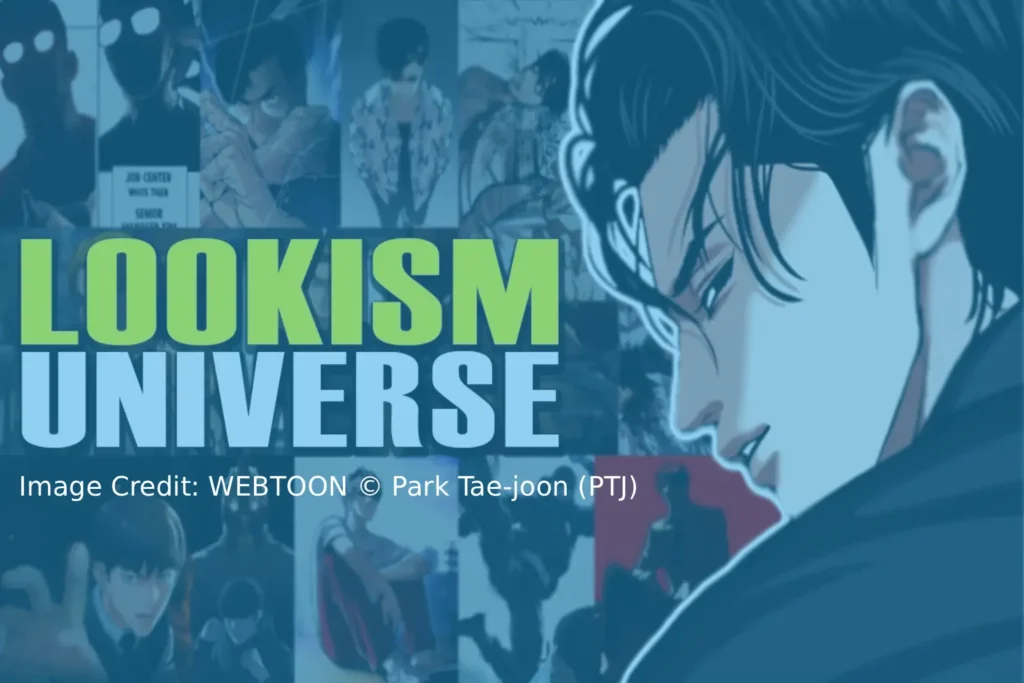
This article is an independent fan analysis of works created by Park Tae-joon. All characters, series, and related properties belong to their respective copyright holders. This content is for informational and discussion purposes only.
Picture this: you are four hundred chapters deep into Lookism Manhwa, and suddenly a character named Manager Kim shows up — quiet, deadly, and clearly hiding a long, dangerous past. That is when the scale of the Lookism Universe really starts to sink in. You read his spin-off and realize he was once a legendary NIS agent who trained alongside characters who later appear in Viral Hit. And that guy from My Life as a Loser? Inside the same Lookism Universe, he has now become a washed-up mentor, teaching a kid how to fight for YouTube money.
This is the Park Tae-joon Universe. It is one of the most carefully constructed shared universes in webtoon history.
After spending considerable time reading and re-reading these series, cross-referencing chapters, and digging through Korean fan forums, I am here to walk you through everything. The connections you might have missed. The timeline that actually makes sense. The “Mastery” system that generates endless discussion. And where things stand as of early 2026.
Let us dive in.
What Exactly Is the PTJ Universe?
The Park Tae-joon Universe (named after the creator) is a collection of webtoons that take place in the same world. Characters cross over. Events in one series ripple into another. If you are only reading one, you are missing substantial context.
Think of it less like the MCU (where everyone teams up every two years) and more like a neighborhood. In real life, the guy who runs the corner store might have been a champion boxer twenty years ago. The delivery driver might have connections to organized crime. That is how this universe operates.
The core titles are:
- Lookism (2014-present): The flagship series. A bullied boy discovers he has a second, physically perfect body.
- My Life as a Loser (2014-2015): A thirty-year-old man is sent back in time into his former bully’s body.
- Viral Hit (2015-present): An isolated teenager starts streaming fights to make money. (Also known as How to Fight)
- Manager Kim (2018-present): The quiet bodyguard from Lookism is revealed as a retired special forces operative.
- Questism (2021-present): A gamer discovers a real-life system window that allows him to level up.
There are other connected works (Loser Coin, Baek XX, Juvenile Offender), but these five form the foundation.
The “Mastery” System Of Lookism Explained
By the time readers reach the later arcs of Lookism, the fighting has evolved significantly from street brawling. Characters demonstrate abilities that push beyond realistic human limits. Their eyes glow in distinct colors. They move faster than the eye can track. They demonstrate the ability to shatter concrete.
This is Mastery (경지 / Gyeongji).
Park Tae-joon introduced Mastery to solve a legitimate storytelling challenge. As characters grew stronger, the narrative needed a framework to establish meaningful tiers of power. Mastery creates that framework. It provides readers with a consistent way to understand where each fighter stands.
How Characters Achieve Mastery
According to the lore established in Lookism Episode 409 and reinforced throughout subsequent chapters, reaching Mastery is not simply a matter of physical training. It represents a psychological and physiological breakthrough.
The progression follows a consistent pattern:
- The Path: A fighter pushes their body so intensely that they temporarily lose their sense of identity. They become completely absorbed in the pursuit of strength.
- The Wall: They encounter someone so overwhelmingly powerful that they feel completely powerless. This creates an emotional and physical barrier that seems insurmountable.
- Overcoming: When they refuse to surrender despite facing that wall, they begin growing at an accelerated rate during combat itself. This phase is described as the “Stage to Mastery.”
- Achievement: They finally cross the threshold. Their eyes take on a characteristic glow. They have achieved Mastery in one specific domain.
Gongseop Ji (the former king of Dongdaemun) explains it this way: “If you fight, you can meet a much stronger opponent. The fighters saw it and met the walls. If you give up in front of the wall, you cannot get anything, but if you are willing to go, you will start to see a new area.”
The Five Types of Mastery
As of the completed Busan Arc (2025), the visual coding for Mastery types has been firmly established. Here is what each one represents:
| Mastery Type | Visual Cue | Primary Characteristic | Representative Fighter |
|---|---|---|---|
| Speed | Blue glow | Perception accelerates; user moves faster than opponents can track | Johan Seong, Zack Lee |
| Strength | Red glow | Raw destructive power; strikes shatter concrete | Taesoo Ma, Vasco |
| Endurance | Green glow | Exceptional durability; user withstands devastating blows | Gun Park |
| Technique | Pink/White glow | Perfect efficiency; no wasted movement | James Lee (DG) |
| Overcoming | Purple glow | Limit-breaking through sheer will, typically when protecting others | Jake Kim |
Recent Development (2026): For some time, readers criticized Mastery because it seemed to reduce combat complexity. Characters would simply hit harder (Strength) or move faster (Speed) without tactical depth. However, beginning with the Busan Arc, Park Tae-joon addressed this feedback. Masteries now interact with each other. They have compatibility dynamics. Combat outcomes depend less on which Mastery a fighter possesses and more on how they apply it and when they deploy it.
The Invisible Attack Phenomenon
There is a related concept called Invisible Attack. This is not a separate Mastery category. Rather, it describes what occurs when a fighter combines Speed and Technique at such a high level that their opponent cannot perceive the strike coming.
James Lee (DG) exemplifies this ability. When he fights, his movements appear minimal. His opponents, however, find themselves on the ground without understanding what happened.
The Daniel Park Theory
Korean fan communities have been discussing an interesting theory since late 2025. Daniel Park’s perfect body has been subtly hinted to possess all Mastery types. Not sequentially. Simultaneously.
The theory proposes that Daniel is being positioned as the first character capable of combining all five Masteries at once, potentially achieving something beyond even “Overcoming.” If you re-read his major fights, you may notice his eye color flickering between different hues depending on his opponent’s fighting style.
The Complete Chronological Timeline (Updated for 2026)
Many guides list these series by release date. However, the in-universe chronology flows differently. Based on in-story events and recent chapter revelations, here is the actual sequence:
The Past (Lookism Generation Zero)
- Three to Four Decades Ago: Gapryong Kim forms the “Fist Gang” in Japan to oppose the Yamazaki Clan (Gun Park’s family). This conflict establishes the foundation for everything that follows. Gapryong had a disciple named Jinrang, whose significance would only become clear years later.
- Approximately Ten Years Ago: The “First Generation” of regional Kings (Taesoo Ma, Jichang Kwak, Gongseop Ji) consolidate power across Seoul. They are eventually defeated by James Lee operating under Charles Choi‘s direction.
- Approximately Eight Years Ago: Civil war erupts within the Yamazaki Clan. Shingen Yamazaki dies. His son, Gun Park, flees to Korea. Manager Kim is actively working as an NIS agent during this period.
The Present (Lookism Generations One and Two)
- 2013: Manager Kim (Main Story). This series depicts Hansu Seong and Jincheol Park in their prime, establishing their capabilities before they appear in other works.
- 2014:
- My Life as a Loser. Kang Jin-gu experiences his time displacement. This story adopts a darker, more realistic tone than the other series. It directly establishes the backstory for Park Jin-sung, who later appears in Loser Coin.
- Lookism (Early Chapters). Daniel transfers to his new school. The narrative focuses on social commentary regarding appearance-based discrimination.
- 2015:
- Viral Hit. Hobin Yu begins streaming fights. His mentor? Kim Dabin, previously depicted as a bully in My Life as a Loser.
- Lookism (Four Major Crews Arc). The narrative shifts significantly toward action-oriented storytelling.
- Completed Arc: Incheon. This story arc concluded with the resolution involving Jaegyeon Na and the Incheon organization.
- Completed Arc: Busan. The Allied Gang traveled to Busan to investigate the four crews operating there. They discovered that Busan is divided into four sectors, each controlled by a leader possessing a distinctive ring. All four answer to one individual: Jinrang, the disciple of Gapryong Kim. This arc officially concluded in late 2025.
The Current Arc (2026)
- Hunt for Workers Arc (Ongoing): Following the Busan developments, narrative focus has returned to dismantling Workers permanently. Eugene has revealed his concealed asset: the Black Workers, a specialized organization comprising twenty-eight fully trained fighters, personally developed by Mandeok Bang. They activate only under Eugene’s direct authorization.
The Allied Gang is now systematically pursuing Workers affiliates while managing the consequences of revelations from Busan. Jaegyeon Na (the King of Incheon) has temporarily aligned with them, a development that surprised many readers.
Connections You May Have Missed In Lookism Universe
The PTJ Universe rewards attentive reading. The connections are not always obvious. Here are some details that connect the larger narrative:
The Family Connections
- Taehoon Seong (from Viral Hit) is the son of Hansu Seong (from Manager Kim). Hansu is a Taekkyeon master who trained alongside Manager Kim. When Taehoon fights, attentive viewers can recognize his father’s techniques in his movement patterns.
- Park Jin-sung (from My Life as a Loser) is the same character who appears in Loser Coin. His entire narrative arc explores themes of redemption and escaping his history as a bully.
- Vin Jin (from Lookism) employs a combination of Karate, Judo, and Korean wrestling (Ssireum). His grappling-intensive style connects him thematically to the older generation of fighters.
Narrative Foreshadowing
In Lookism Chapter 491, James Lee makes a comment that seemed casual at the time: “People are so funny. I am just fast, yet they say I surpassed Mastery or whatever.” When originally published, readers interpreted this as characteristic understatement. We now understand he was revealing that Mastery represents a baseline, not a ceiling.
Similarly, in Manager Kim, young Hansu Seong’s eyes occasionally flash blue during training sequences. At the time, this appeared to be an artistic choice. We now recognize it as Speed Mastery manifesting decades before the concept was formally introduced in Lookism.
The Workers Organization
If you follow only Lookism, you understand Workers as the criminal organization led by Eugene. However, Workers recruits from across the connected series. Some rank-and-file fighters appearing in Lookism Universe are former characters from My Life as a Loser. The “Black Workers” introduced in Chapter 589 were trained using methodologies developed during Generation Zero.
Thematic Consistency Across Series
The fighting sequences attract significant attention, but the thematic content is what gives these stories lasting resonance.
Lookism began as social commentary on South Korea’s beauty standards. Daniel experiences life in two bodies. He observes directly how people treat him differently based solely on his physical appearance. That thematic foundation never disappeared. It evolved.
During the Workers Arc, lookism becomes institutional. Charles Choi and James Lee operate openly because society perceives them as attractive and successful. No one suspects the celebrity idol or the kindly elderly CEO of being criminal architects.
In Viral Hit, lookism becomes digital. Hobin is evaluated by his subscriber count. His appearance matters less than his metrics. This represents a thoughtful modernization of the original concept.
In My Life as a Loser, lookism becomes internalized. The protagonist despises himself for being a “loser.” He believes changing bodies will transform his life. The narrative demonstrates that it does not.
Current Story Direction (2026)
Based on recently published chapters and fan discussion, here is where the narrative appears to be heading:
The Black Workers Challenge
Eugene’s Black Workers represent twenty-eight elite fighters trained specifically to counter the Allied Gang. They are not random thugs. They are disciplined, organized, and highly capable. This development significantly raises the stakes.
Jinrang’s Role
Jinrang, the disciple of Gapryong Kim, was introduced during the Busan Arc as an impending threat. His story has not been fully resolved. Current theories suggest he may eventually align with either the Allied Gang or Workers, depending on how his loyalty to Gapryong’s legacy develops.
The Daniel Park Revelation
The mystery of Daniel’s second body is gradually approaching resolution. Questions remain: Who originally possessed it? Why does it demonstrate access to all Mastery types? Charles Choi and James Lee clearly possess information they are not sharing.
Expanding Crossovers Of Lookism
With Questism characters now appearing in Lookism, and the “System” from Questism raising questions about how power quantification functions, we are likely seeing the beginnings of more interconnected storytelling.
Suggested Reading Order
If you are new to these series and want to experience them in a way that maximizes comprehension, here is a recommended sequence:
- Begin with Lookism (Chapters 1-150). Become invested in Daniel’s story. Meet the central characters.
- Read My Life as a Loser. It is shorter and tonally darker. It provides context for bully characters who reappear elsewhere.
- Continue Lookism (Chapters 151-300). This section covers the Four Major Crews and the emergence of Workers.
- Read Manager Kim. You will now understand who this character is and why he commands respect.
- Read Viral Hit. You will recognize Kim Dabin and appreciate Taehoon’s connection to Hansu.
- Finish Lookism (Chapters 301-present). You are now current and will recognize every cameo.
- Read Questism as supplementary material. It is lighter in tone, gamified in structure, and connects to the main timeline in enjoyable ways.
Why This Lookism Universe Resonates
The Park Tae-joon Universe has imperfections. Power scaling generates confusion. Some cameos feel forced. The transition from slice-of-life drama to action-oriented narrative alienated some early readers.
However, the approach works because of its fundamental premise.
Every character, regardless of apparent significance, has a story. That seemingly minor bully in Lookism might be the protagonist of another series. That quiet bodyguard might have been a national hero. The world feels alive because it is interconnected in ways that reward attentive readers.
And beneath the fighting, beneath the criminal organizations, beneath the supernatural elements, the core concern remains what it was in 2014: people being judged for how they appear to others.
Whether it is Daniel in his original body, Hobin with zero subscribers, or Kang Jin-gu trapped in his enemy’s life, the fundamental struggle is consistent. The world forms judgments before it possesses information.
The only difference now is that they can demonstrate extraordinary physical capabilities while navigating that reality.
Lookism Universe – FAQ
What is the Lookism Universe?
The Lookism Universe is a shared story world created by Park Tae-joon where multiple webtoon series exist in the same timeline and often reference each other.
Stories such as Lookism, Viral Hit, Manager Kim, and My Life as a Loser all take place inside this connected universe.
Is the Lookism Universe officially canon?
Yes. The connections between characters, organizations, and past events are written directly by the same author and appear in official chapters and spin-offs.
This makes the Lookism Universe a fully canon shared universe, not a fan theory.
Which series are part of the Lookism Universe?
The main series connected to the Lookism Universe are:
Lookism
Viral Hit
Manager Kim
My Life as a Loser
Questism
All of them share overlapping characters, backstories, and timelines.
How is Manager Kim connected to the Lookism Universe?
Inside the Lookism Universe, Manager Kim is revealed to be a former elite NIS agent whose past links him to fighters and instructors who later appear in Viral Hit and Lookism.
His spin-off explains relationships and training histories that directly affect the main story.
Do I need to read every series to understand the Lookism Universe?
No. You can enjoy Lookism on its own.
However, reading the other series gives much deeper context to character motivations, past alliances, and recurring organizations across the Lookism Universe.
Is there a single timeline for the Lookism Universe?
Yes. All series follow one shared chronological timeline.
Some stories take place earlier and act as background history, while others run parallel to the events of Lookism, expanding the larger Lookism Universe narrative.
Editorial Disclaimer
All content published on this website is created for informational and educational purposes only. Articles, analyses, timelines, and opinions reflect the independent views of the editorial team and contributors.
While every effort is made to ensure accuracy, completeness, and up-to-date information, we do not guarantee that all content is free from errors or omissions. Information may change over time as new chapters, official releases, or updates become available.
This website is not affiliated with, sponsored by, or officially connected to any creators, publishers, or rights holders unless explicitly stated. All trademarks, series titles, characters, and related properties mentioned remain the property of their respective owners.
Content published on this site should not be considered professional, legal, or commercial advice. Readers are encouraged to verify information independently when necessary.
Image Copyright Notice
All images used on this website are the property of their respective copyright holders.
Images are used for informational and editorial purposes only.
No copyright infringement is intended.
If you are the copyright owner of any image and would like it removed or credited differently, please contact us.