
The Real Lookism Path vs Mastery Difference: Beyond the Eye Glow
What is the real Lookism Path vs Mastery difference? We break down the mechanical and philosophical distinctions, eye colors, and unique users in this deep dive.


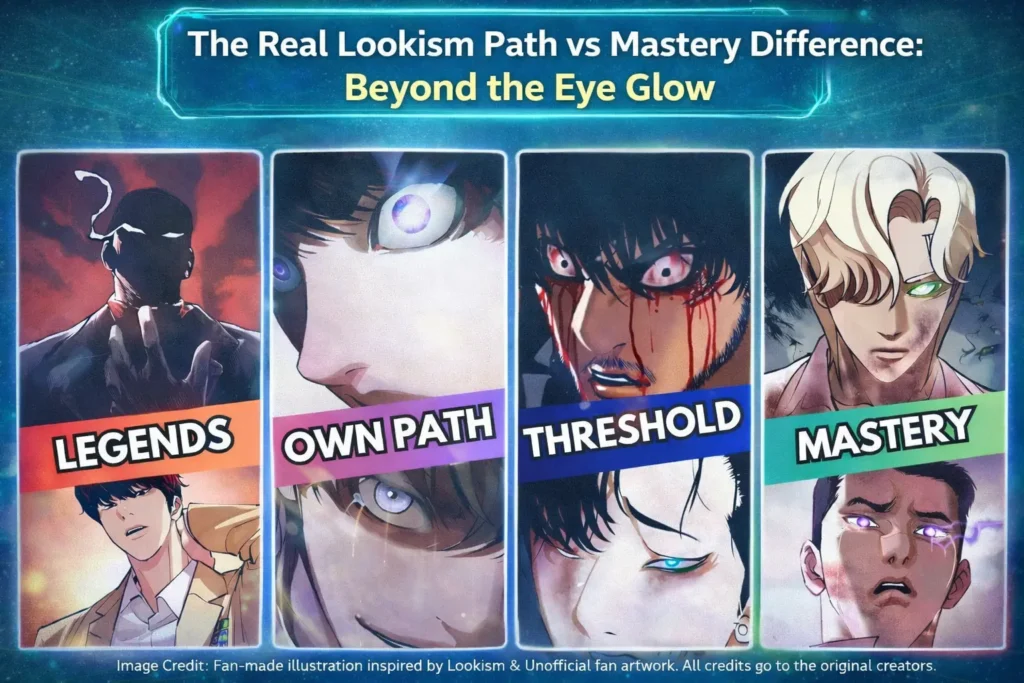
Author note:
This article is written by a long-term reader of Lookism who focuses on narrative combat structure and visual storytelling rather than power-scaling debates.
If you’ve been following Lookism by Park Tae-jun, you’ve probably seen the terms “Mastery” and “Path” thrown around as if they mean the same thing. I’ve looked at countless forums and comment sections, and honestly? Most fans use them interchangeably. But here’s the reality—once you understand the actual Lookism Path vs Mastery difference, you’ll realize they represent two completely distinct levels of power, and confusing them means missing half the depth in PTJ’s storytelling.
They don’t.
On the surface, both look like simple power-ups: glowing eyes, overwhelming pressure, and a sudden shift in the flow of battle. But structurally and philosophically, they represent two completely different ways of growing as a fighter.
This article explains that difference — not just by repeating in-story definitions, but by looking at how fights are actually staged, framed, and paced on the page.
Understanding the Foundation: What Exactly Is Mastery?
Before Path makes any sense, Mastery has to be understood correctly.
Not as “a buff,” but as a very specific kind of breakthrough.
The Definition of Mastery
Mastery (경지, gyeongji) is reached when a single combat attribute crosses a human limit and becomes superhuman.
The key point is focus. A fighter does not become better at everything — they transcend one field.
From a storytelling standpoint, Mastery always appears when a character finally breaks through a clearly defined limitation that has been built up over many chapters.
The Fields of Mastery (Reframed)
Rather than treating these as checklist items, it helps to see them as how a fight is resolved.
Strength Mastery (red)
Battles end because the opponent’s guard, structure, or footing simply collapses under pressure. The narrative emphasizes impact, recoil and physical displacement.
Speed Mastery (blue)
Fights are decided through reaction gaps. The opponent understands what is happening — but cannot respond in time.
Endurance Mastery (green)
Damage loses meaning. The story focuses on failed finishing attempts and the psychological breakdown of the attacker.
Technique Mastery (pink/white)
Combat shifts into micro-decision making. The fight becomes about sequencing, redirection and creating mistakes rather than forcing outcomes.
Overcoming Mastery (purple)
This is framed differently. Instead of physical superiority, the emphasis is on psychological refusal — the character keeps moving forward in situations where defeat should already be final.
How Mastery Is Actually Reached
Across the series, Mastery consistently follows a three-stage narrative structure:
Self-destruction phase
The character trains or fights until their identity as a fighter collapses. They no longer rely on what used to define them.
Wall phase
They confront an opponent who is completely beyond their current level. During this encounter, the story highlights accelerated adaptation.
Breakthrough phase
The character does not win by luck. They win because one specific ability suddenly reorganizes itself into a higher operating state.
The important part is this:
Mastery is accessible.
Different people have different ceilings, but the system itself is open.
The Path: When Individuality Becomes Power
Path is not an upgraded Mastery.
It is built on a completely different logic.
What Makes Path Different?
Path represents a technique structure that is:
- born from the individual’s personal abilities,
- shaped by their convictions and life trajectory,
- and impossible to reproduce through training alone.
In other words, Path is not an optimized attribute.
It is a new combat logic.
Lookism Path vs Mastery Difference – The Visual Difference
From a visual standpoint, the distinction is consistent.
Mastery is framed through eye-focused shots.
The camera zooms in. The glow marks which attribute has broken through.
Path is framed through full-body composition.
The panel pulls back and emphasizes movement routes, spacing and attack flow.
Once this pattern is recognized, the two systems become easy to distinguish at a glance.
How I Identified Path vs Mastery in Actual Panels
When I re-read the Busan arc and the later Johan fight sequence, I tracked two recurring cues in every major clash:
- whether the narration described the character as breaking through a physical or technical limit during the fight, or
- whether the scene focused on a new combat pattern that had never appeared before in any other character’s style.
In scenes where only physical limits were emphasized, the panel rhythm stayed consistent:
reaction → surprise → overpowering result.
However, in scenes involving Johan’s Infinite Technique, the framing changed.
The panels stopped emphasizing raw speed or power and instead focused on attack routing and positional denial.
This contrast is what led me to classify Path not as a higher stat level, but as a structural change in how combat itself is drawn.
Known Path Users and Their Unique Combat Logic
Johan Seong – Infinite Technique
Johan does not win by executing copied techniques better than others.
He wins by reorganizing them into an attack network that removes escape routes.
The opponent is not overwhelmed.
They are trapped inside a continuously branching strike pattern.
This is why his technique remains effective even when his physical condition deteriorates.
Daniel Park – Predictive Copy through Five Senses
Daniel’s Path merges two traits that already existed — copying and sensory sharpness — into a predictive combat system.
Instead of reacting to attacks, he responds to the future position of the opponent’s movement.
This is not an improvement of copying.
It is a transformation of what copying is allowed to do.
Other fighters implied to walk their own Paths
The narrative repeatedly implies that fighters such as Gun Park and figures described as the pinnacle of earlier generations developed combat systems that cannot be reproduced through imitation alone.
Their power is treated as something refined through personal history rather than transferable technique.
My Functional Classification: Power vs Pattern
From a combat-design perspective, the entire Lookism system can be divided into two layers:
- Power amplification systems – mechanisms that increase how strong, fast or durable an existing action is.
- Pattern creation systems – mechanisms that change how actions connect and restrict an opponent’s options.
Mastery belongs to the first layer.
Path belongs to the second.
This explains why Path users feel overwhelmingly difficult to fight even when their raw stats are not visually emphasized. They do not win by overpowering actions, but by removing viable responses.
This “power vs pattern” split does not appear explicitly in the story, but it consistently matches how fights are staged across multiple arcs.
The Philosophical Difference: Why This Matters
Mastery Is a Destination; Path Is a Construction
Mastery is about climbing an existing mountain.
Path is about constructing a new route through the terrain itself.
Mastery completes a predefined problem.
Path changes the problem.
The Copy Limitation
A major narrative statement reinforces this distinction: copying can reproduce techniques, but it cannot reproduce what a fighter gains by polishing their own way.
This establishes a clear boundary.
Imitation works inside the Mastery framework.
Path exists outside it.
Case Study: How Daniel Embodies Both Concepts
Daniel’s original body had copying potential but lacked the physical and experiential foundation to develop it.
His perfect body had extraordinary capacity, but his mindset restricted how aggressively he could apply it.
After training under Gun, his technical ceiling expanded rapidly.
What matters, however, is not what he copied — but what he reorganized.
His predictive structure emerges only when copying and sensory processing are fused into a new combat pattern. This is the moment where his growth stops being transferable.
Practical Examples for Readers
Zack Lee – Speed Mastery
Zack’s battles remain recognizably boxing-based.
The difference is that reaction windows collapse.
He perfects an existing framework.
This is Mastery.
Johan Seong – Path
Johan’s Infinite Technique does not resemble any single martial style.
The attack logic itself becomes the weapon.
This is Path.
Common Misconceptions
“Path is just a higher level of Mastery.”
No. They operate on parallel axes: one amplifies attributes, the other creates patterns.
“Path users must already possess Mastery.”
The story does not clearly confirm this. Some overlap exists, but the systems remain conceptually independent.
“Invisible attacks are only Speed + Technique Mastery.”
Their rarity and framing suggest they are closer to an individualized combat structure than a simple stat combination.
Did Mastery Make Battles Worse?
Some readers argue that Mastery simplified fights into visual archetypes: fast, strong, durable, technical.
That criticism is partially valid in early arcs where Mastery was introduced abruptly.
However, later arcs began embedding each mastery type into distinctive combat flows rather than treating them as interchangeable stat boosts. The improvement becomes noticeable when different mastery types collide and force asymmetric problem-solving rather than direct comparisons.
Why This System Works Even Outside Lookism
The Mastery versus Path structure mirrors real performance development.
Most professionals improve by optimizing known skills — speed, efficiency, precision and consistency. This mirrors Mastery.
Breakthrough figures in competitive fields usually introduce new workflows, tactics or conceptual frameworks. Their advantage is not higher execution alone, but reduced predictability and superior control over interaction.
Path represents this second form of growth.
This is one reason Lookism’s combat progression feels closer to real competitive environments than traditional stat-based power scaling.
Conclusion: The Real Difference Between Path and Mastery
Mastery is the transcendence of an existing attribute.
It perfects what already exists.
Path is the creation of a personal combat structure.
It introduces something that cannot be transferred.
If a character overwhelms you through faster reactions, heavier strikes or superior technique execution, you are seeing Mastery.
If a character defeats you by removing your ability to respond in any meaningful way, you are seeing Path.
Once you start watching for patterns rather than power, the difference becomes unmistakable.
FAQ – Lookism Path vs Mastery
What is the exact difference between Path and Mastery in
Lookism?
Mastery : means pushing an existing combat attribute (speed, strength, endurance, technique) beyond human limits.
Path : means creating a new, personal combat structure that only that individual can use.
Is Path simply a higher level than Mastery?
No.
Path and Mastery are parallel systems, not a vertical progression.
Mastery improves performance.
Path changes how combat itself functions.
Do Path users automatically have Mastery?
The series never clearly confirms this.
Some characters may possess both, but:
Path does not require confirmed Mastery to exist.
They should be treated as independent achievements that can overlap.
Are Invisible Attacks just Speed Mastery plus Technique Mastery?
Probably not.
Because of how rare and narratively emphasized Invisible Attacks are, they are more consistent with an individualized combat structure—something much closer to the idea of Path rather than a simple stat combination.
What exactly is Daniel Park’s Path?
Daniel Park develops a predictive combat structure.
Instead of merely copying techniques, he reads future movement through sensory processing and positions his responses in advance.
This is not a better version of copying—it is a functional transformation of it.
Is Gun Park officially confirmed as a Path user?
Gun Park is not directly labeled as a Path user in dialogue.
However, the narration repeatedly implies that his fighting system cannot be reproduced through copying or conventional training, which places him in the implied Path category.
Is this explanation officially confirmed by the author?
No.
This FAQ reflects analytical interpretation of panel framing, narration, and fight choreography in Lookism.
It is not an official statement by Park Tae-jun.
Editorial Note
This article presents an independent analytical interpretation of combat systems in Lookism by Park Tae-jun.
All observations are based on direct reading of official chapters and visual panel analysis.
Character names, story elements, and terminology belong to their respective rights holders.
This content is intended solely for commentary, criticism, and educational discussion.

Lookism Manhwa vs Manager Kim Manhwa Comparison – Complete PTJ Universe Guide
Dive deep into the Lookism manhwa vs Manager Kim manhwa comparison. Explore themes, characters, fighting styles, and how these two PTJ Universe titles connect. Perfect for fans and newcomers alike.