
Lookism Mastery System Explained: Thresholds, Paths & Power Levels Breakdown
Explore the Lookism mastery system explained in depth. Understand thresholds, paths, glowing eyes, and how power levels truly work in PTJ’s universe.


Beyond Physical Limits in the PTJ Universe — Lookism Mastery System Explained
If you’ve been following Lookism for any length of time, you’ve likely noticed that somewhere around the mid-series episodes, the fights started looking different. Characters’ eyes began glowing in distinct colors—red, blue, green, pink—and suddenly we weren’t just watching street brawls anymore. We were witnessing something far more sophisticated: the formalization of what it truly means to be “strong” in Park Tae-joon’s expanding universe.
This shift is where the lookism mastery system explained itself through action rather than exposition, turning simple brawls into layered battles built around thresholds, transcendence, and identity.
I remember reading Episode 409 when Sinu Han first explained the concept of reaching one’s limit. That moment changed everything. What we once understood as simple determination or fighting spirit was actually the gateway to something far more structured—a power system that separates ordinary fighters from legends.
Today, I want to take you deep into this system. Not just the surface-level explanations you’ll find on fan wikis, but a genuine understanding of how mastery works, who possesses it, and perhaps most importantly, what separates those who merely master thresholds from those who forge their own path entirely.
What Exactly Is Mastery? (The “Gyeongji” Explained)
Let’s start with the basics, though there’s nothing basic about what mastery represents.
In the Korean raw scans, you’ll see the term “경지” (Gyeongji), which translates literally to “realm” or “state of being.” The English version calls it “mastery” or “threshold,” and both terms capture something essential about what’s happening when a fighter transcends normal human limits .
Mastery isn’t simply getting stronger. It’s not about lifting heavier weights or running faster sprints. Mastery represents a fundamental shift in how a fighter interfaces with combat itself. When someone achieves mastery in a particular attribute, they’re no longer just using that attribute—they’ve become one with it in a way that generates observable supernatural phenomena.
The Four Recognized Fields of Mastery
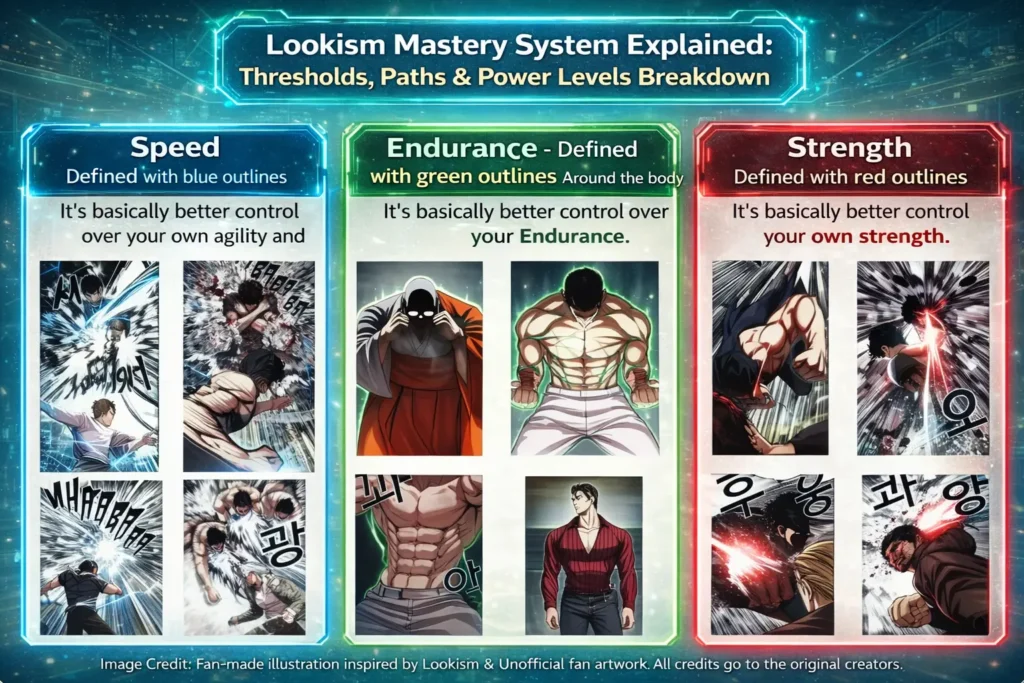
Throughout the series, we’ve seen four distinct types of mastery, each represented by a specific eye glow color:
Strength Mastery (Red)
When Taesoo Ma winds up for that legendary right fist, and you see that crimson flare in his eyes—that’s strength mastery in its purest form. Fighters who achieve this threshold possess raw destructive power that defies physics. We’re talking about people who punch through concrete walls like drywall, who can send grown men flying with grazing blows. But here’s what many readers miss: strength mastery isn’t just about power output. It’s about understanding the mechanics of force at such a deep level that every movement maximizes destructive potential while minimizing wasted energy .
Speed Mastery (Blue)
The blue glow is perhaps the most deceptive. When Zack Lee achieved speed mastery during his training arc, he didn’t just become faster—he entered a state where his perception of time itself seemed to alter. Speed mastery users don’t simply move quickly; they operate in a different temporal dimension relative to their opponents. James Lee’s infamous line says it best: “People are so funny. I’m just fast, yet they say I’ve surpassed mastery or whatever” . That casual dismissal actually reveals the truth—to someone with speed mastery, their velocity feels natural, even as opponents perceive them as teleporting.
Endurance/Tenacity Mastery (Green)
This one’s easy to misunderstand. When you see that green glow in someone’s eyes—think Gongseob Ji or certain members of the 0th Generation—you’re not just looking at someone who can take a punch. Endurance mastery represents a complete transcendence of physical limitation. These fighters can continue fighting at peak capacity long after their bodies should have given out. More importantly, they develop what amounts to damage nullification against attacks that would cripple normal fighters. The green glow signals that this person has made peace with pain and moved beyond it .
Technique Mastery (Pink/White)
The rarest of the four standard masteries, technique mastery manifests as that soft pink or white glow. Users like Sinu Han (before his invisible attacks developed further) operate on a plane of pure combat intelligence. They don’t just execute techniques—they create them in real-time, adapting to any situation with an almost algorithmic precision. Technique mastery allows fighters to dismantle opponents not through overwhelming force, but through perfect mechanical efficiency .
The Evolution: How Mastery Has Been Depicted Over Time
Here’s something fascinating that long-time readers will appreciate. When mastery was first introduced, it was treated as this singular threshold—you either crossed it or you didn’t. But as the series progressed, Park Tae-joon refined the concept significantly.
Early mastery depictions focused purely on stat amplification. You crossed the speed threshold, you got faster. Simple. But by the time we reached the later gangism arcs, mastery had evolved into something more nuanced. Strength mastery became about learning efficient fighting methods. Technique mastery became about enlightenment. The system matured alongside the characters .
What’s particularly clever is how different masteries interact. When you combine speed and technique mastery, you get invisible attacks—those devastating strikes that opponents literally cannot see coming. When strength and endurance combine, you get the kind of overwhelming pressure that Gapryong Kim used to dominate his generation. The compatibility system creates natural rock-paper-scissors dynamics that make fights intellectually engaging, not just spectacles of who has the bigger number .
The Journey to Mastery—It’s Not What You Think
Most readers assume that achieving mastery is simply a matter of training hard enough. You grind, you level up, you get the glow. But if you’ve been paying attention to the actual dialogue in the manhwa, you know it’s far more complicated than that.
The Wall and The Path
Let me take you back to that crucial Episode 409 explanation:
“If you fight, you can meet a much stronger opponent than you. Fighters call it meeting the wall. If you give up in front of the wall, you can’t get anything. But if you are willing to go, you will start to see a new area. However, that is not the state. It is the stage before reaching the state. Conditions are needed to reach that stage. You have to work your body so hard that you forget who you are.”
This passage contains the entire philosophy of mastery in Lookism. Notice what’s being said here. The prerequisite isn’t just effort—it’s self-annihilation. You have to push so far beyond your limits that you lose your sense of identity, your sense of self. Only when you’ve become nothing but pure will, facing an insurmountable wall, can you achieve that breakthrough.
This explains why so many talented fighters never reach mastery. They hit their wall and make peace with it. They rationalize. They tell themselves that this opponent is simply beyond them, and they accept their place in the hierarchy. The ones who become masters are the ones who refuse to accept any hierarchy at all.
The Three Stages of Mastery Attainment
Based on what we’ve seen across multiple character arcs, the process breaks down into three distinct phases:
Phase 1: The Path (Road to the Realm)
This is the preliminary stage. The fighter has encountered their wall and refused to back down. They enter a state of accelerated growth where every moment of combat pushes them further. We saw this with Eli Jang and Samuel Seo during the Seokdu Wang fight. They weren’t at mastery level yet, but they were growing in real-time, adapting, evolving .
Phase 2: Surpassing the Wall
The actual breakthrough moment. This isn’t gradual—it’s a violent eruption of potential. The fighter’s eyes ignite with their mastery color, and suddenly they’re operating on an entirely different level. Think of Zack Lee when he finally broke through during his training arc, or Vasco when his conviction aligned with his physical limits. The wall doesn’t crumble; it explodes .
Phase 3: Achieving Mastery
The stabilization of that breakthrough. This is where the fighter can now access their threshold state at will, integrating it into their fundamental fighting style. Most first-generation kings operate at this level consistently.
The Talent Paradox: Why Some Never Need a Wall
Here’s where things get philosophically interesting. Lee Ji-hoon (James Lee) and Yook Sung-ji represent a fascinating anomaly in the mastery system. As the Namu Wiki notes, these individuals never seemed to encounter walls at all. They simply… surpassed thresholds naturally, without the existential crisis that defines mastery for everyone else .
James Lee’s comment about being “just fast” while others called it mastery reveals something profound about the nature of talent in the PTJ universe. For some individuals, what requires traumatic breakthrough for others is simply their baseline. They don’t need to forget who they are because their natural state already operates beyond normal human limitations.
This creates an interesting hierarchy: those who achieve mastery through suffering, those who achieve it through talent, and then… those who never need mastery at all because they’ve become the wall themselves.
Who Possesses Which Masteries? A Comprehensive Breakdown
Let’s get into the specific roster. Based on confirmed feats and contextual evidence from the series, here’s how the mastery distribution breaks down.
Confirmed Lookism Mastery Holders
The Speed Masters (Blue)
- James Lee: The pinnacle of speed mastery. His invisible attacks represent the highest refinement of this threshold.
- Zack Lee: Achieved speed mastery through focused boxing training. His growth in this area has been remarkable.
- Sinu Han: Combines speed with technique mastery to create his invisible attack style.
- Jake Kim: His latent potential suggests speed mastery, though his style incorporates other elements.
The Strength Masters (Red)
- Taesoo Ma: The archetypal strength mastery user. His entire fighting philosophy revolves around the “one punch” ideal.
- Gun Park: Possesses overwhelming strength mastery, though his actual capabilities extend far beyond any single threshold.
- Jerry Kwon: Underrated but confirmed to operate at strength mastery levels.
- Warren Chae: His CQC development has pushed him into strength mastery territory.
The Endurance Masters (Green)
- Gongseob Ji: The definitive endurance mastery user. His ability to withstand punishment while delivering counter-attacks is legendary.
- Vin Jin: His Ssireum background and physical conditioning suggest endurance mastery.
- Seokdu Wang: Despite his defeat, his resilience clearly operated at mastery level.
The Technique Masters (Pink/White)
- Sinu Han: His invisible attacks require technique mastery as a foundation.
- Daniel Park (Perfect Body): His copy ability combined with UI suggests technique mastery.
- Johan Seong: Before his path diverged, his copy ability required technique mastery.
Lookism Characters Who Multiple Mastery Holders
Some fighters have achieved mastery in multiple fields. These are the true elites:
- James Lee: Speed + Technique (demonstrated through invisible attacks)
- Gun Park: Strength + Endurance + Technique (implied through his overwhelming dominance)
- Sinu Han: Speed + Technique (the invisible attack combination)
- Daniel Park (Perfect Body): All four, potentially, given his UI state
The “No Mastery But Still Elite Characters In Lookism” Category
Here’s something the power-scaling communities often miss. Not having a visible mastery doesn’t mean someone isn’t strong. Tom Lee, for instance, operates without clear mastery manifestations but would destroy most mastery users. Why? Because as Gun Park explained, some individuals are the wall. They don’t need to overcome thresholds—they exist beyond them .
The Unique Path—Where Legends Separate Themselves
Now we arrive at the true heart of the Lookism power system. If mastery is about transcending human limits in specific attributes, the “path” is about something far more profound: individual identity expressed through combat.
What Is a Path?
Gun Park’s explanation in Episode 557 is definitive:
“It is different from the state. Your own way is literally a special one that can only walk. Unlike the state that anyone can cross, no one can realize his own path.”
This distinction is crucial. Mastery is a destination—a threshold that multiple people can reach. Multiple characters can achieve speed mastery. Multiple characters can achieve strength mastery. But a path? A path is unique to the individual. No one else can walk it. No one else can copy it.
Tom Lee put it even more poetically: “The guy who walks his own path is different. The guys standing on the road are different.”
The Known Lookism Manhwa Path Users and Their Unique Abilities
Johan Seong — The Infinite Technique
Johan’s path manifested as something terrifying. His copy ability evolved beyond mere imitation into a state where he can hit any target through any defense. The “infinite technique” or “strike arc of infinity” represents his complete mastery of combat prediction and execution. When Johan walks his path, he doesn’t just copy techniques—he understands their fundamental nature so completely that he can generate infinite variations .
Daniel Park — Countless Copying and Maximized Five Senses
Daniel’s path combines his innate copy talent with his body’s refined sensory capabilities. When Daniel walks his path, he develops a form of combat precognition—he can see the trajectory of attacks before they launch, predict defensive patterns before they form. It’s not quite future sight, but it’s the closest thing the Lookism universe has to genuine prediction .
Gapryong Kim — The Path to Pinnacle
The legendary Gapryong Kim walked what’s called the “Path to Pinnacle.” This represents the highest tier of path attainment—a journey so complete that it defines an entire generation. Gapryong’s path wasn’t about a specific technique but about an entire philosophy of overwhelming presence. When he walked his path, opponents didn’t just lose—they understood, on a fundamental level, that they were witnessing something beyond combat .
Shingen — The Completed Path
Shingen represents the other side of the pinnacle path. Both he and Gapryong completed their journeys, yet they weren’t equal. This reveals something crucial about paths: completion doesn’t mean supremacy. A completed path elevates you to your personal peak, but your peak might still be lower than someone else’s .
The Critical Difference of Lookism Mastery vs. Path
Let me make this absolutely clear:
Mastery is about what you can do. Speed. Strength. Endurance. Technique. These are attributes that can be measured, compared, and potentially replicated. Multiple people can share the same mastery type.
Path is about who you are when you fight. It’s the expression of your individual nature through combat. No two paths are identical because no two people are identical.
Manager Kim explained this perfectly: “Copy is not invincible. I can’t copy the things I gained by polishing my own way, such as Gun Park’s body and my gift. That’s why the pinnacle of a generation has been the pinnacle of Gapryong Kim and Lee Ji-hoon.”
This is why copy abilities have limits. Johan can copy techniques, but he can’t copy someone’s path—because a path isn’t a technique. It’s a soul expressed through violence.
The Genius of Nurturing—Gun Park’s Unique Position
Before we wrap up, we need to discuss someone who defies easy categorization: Gun Park.
Gun isn’t just a fighter. He’s a “genius of nurturing”—someone whose true gift lies not in his own combat ability (though that’s considerable) but in his capacity to develop others .
Think about his track record:
- Jake Kim: Trained under Gun, became a crew head
- Samuel Seo: His development under Gun was transformative
- Eli Jang: Gun recognized and cultivated his potential
- Daniel Park (Original Body): Gun’s masterpiece, the ultimate expression of his nurturing ability
What makes Gun unique is that he can guide others toward their own paths. He doesn’t just teach techniques—he helps people discover who they are as fighters. His comment about Daniel being his “masterpiece” wasn’t arrogance; it was recognition that he had successfully helped someone find their unique expression .
This nurturing ability extends to himself as well. As Choi Dong-soo noted, Gun applies his developmental genius to his own growth constantly. He’s not a static being—he’s always evolving, always refining .
Why the Lookism Manhwa System Works (And Why Some Fans Criticize It)
I’ll be honest with you—the mastery system hasn’t been universally beloved. Some long-time readers feel that the introduction of thresholds and paths made fights less interesting, not more.
The Criticism
The main complaint? That mastery reduces complex characters to simple stat checks. A speed mastery user just needs to be fast. A strength mastery user just needs to hit hard. Technique mastery users become one-note in their precision. Overcoming mastery (that purple glow we’ve seen occasionally) sometimes feels indistinguishable from regular strength mastery .
There’s validity to this criticism. In the early days of Lookism, fights were about strategy, environment, and character. When Daniel fought using his wits against stronger opponents, those battles felt more engaging than later conflicts where the outcome often came down to “my mastery color beats your mastery color.”
The Redemption
However—and this is important—the system has evolved significantly since its introduction. Starting with the Busan arcs, Park Tae-joon began addressing these shortcomings. Masteries started interacting in more complex ways. Fighters began combining thresholds creatively. The “invisible attack” combination of speed and technique mastery showed that the system had depth that wasn’t initially apparent .
More importantly, the introduction of “paths” provided an escape hatch from the stat-check problem. Path users operate outside the normal mastery hierarchy entirely. They’re not playing the same game.
Practical Implications Lookism Manhwa How to Understand Fights Going Forward
So how should you, as a reader, evaluate fights in current and future Lookism chapters? Here’s my framework:
Step 1: Identify Mastery Types
Look for the eye glows. Red = strength, blue = speed, green = endurance, pink/white = technique. Purple represents combinations or overcoming states .
Step 2: Count the Masteries
Generally speaking, more masteries = higher baseline capability. A fighter with three masteries should theoretically defeat a fighter with one, assuming equivalent refinement levels.
Step 3: Check for Path Status
If a fighter is walking their own path, mastery counts become less relevant. Path users operate on a different axis entirely. Johan with his infinite technique can defeat opponents with more masteries because his path transcends simple attribute comparison.
Step 4: Consider the “Wall” Dynamic
Remember that some fighters are the wall. Tom Lee, certain 0th generation legends, and perhaps Gun Park at full power don’t fit neatly into the mastery system. They’re not overcoming thresholds—they’re the thresholds others must overcome .
Step 5: Factor in Nurturing
If Gun Park trained someone, assume they have hidden depths. His students consistently outperform expectations because he develops their fundamental nature, not just their techniques .
Conclusion: The Living System Of Lookism Manhwa
What makes Lookism’s power system special isn’t its internal consistency—it’s that the system evolves alongside the characters. The mastery thresholds that felt artificial when first introduced have become integrated into the story’s DNA. The paths that seemed like vague concepts now define the series’ most memorable moments.
When you watch James Lee move at impossible speeds, you’re not just seeing an animation choice. You’re seeing the visible manifestation of a threshold crossed. When you witness Johan’s infinite technique, you’re not just watching a cool move—you’re watching someone’s unique identity expressed through combat.
The mastery system works because it’s not really about power at all. It’s about identity. It’s about the walls we face and whether we climb them or let them define us. It’s about the difference between standing on a road that others have walked and forging your own path through untamed territory.
In that sense, Lookism isn’t just a fighting webtoon with a power system. It’s a meditation on what it means to become yourself—violently, beautifully, and without compromise.
What do you think? Have I missed any mastery holders? Do you have a different interpretation of how paths work? Drop your thoughts in the comments—I read every response and I’m always looking to refine my understanding of this fascinating system.
What is the Lookism Mastery System?
The Lookism Mastery System is the structured power framework introduced in the mid to later arcs of the series. It explains how characters surpass normal limits through thresholds, specialization paths, and awakening phases. Instead of simple street fighting, the system formalizes how strength, technique, and mentality evolve.
How do thresholds work in the Lookism Mastery System?
In the Lookism Mastery System, a threshold represents a physical or mental limit a character must break to reach a higher combat level. Once crossed, fighters gain sharper perception, enhanced reflexes, or increased attack power. Thresholds mark the transition from raw talent to refined mastery.
What are paths in the Lookism Mastery System?
Paths refer to the specialization route a character follows after breaking a threshold. Some fighters focus on overwhelming power, others on speed, technique, or battle IQ. The Lookism Mastery System allows different characters to grow uniquely rather than following a single strength model
Who has achieved mastery in Lookism?
Several top-tier characters demonstrate advanced stages of the Lookism Mastery System. These fighters show full control over their abilities, refined combat awareness, and consistent dominance in high-level battles. Mastery is usually visible through intense aura shifts and heightened combat precision.
Why was the Lookism Mastery System introduced?
The Lookism Mastery System was introduced to create a structured explanation for the escalating power levels in the series. As fights became more strategic and complex, the system provided narrative logic behind character growth and power scalin
Editorial Disclaimer
This website provides independent commentary, analysis, and educational breakdowns related to the Lookism series and the PTJ Universe. We are not affiliated with the original creators, publishers, or official platforms. All trademarks, character names, and series references remain the property of their respective owners. Any images used are AI-generated or concept-based illustrations created for representational purposes only.

The Real Lookism Path vs Mastery Difference: Beyond the Eye Glow
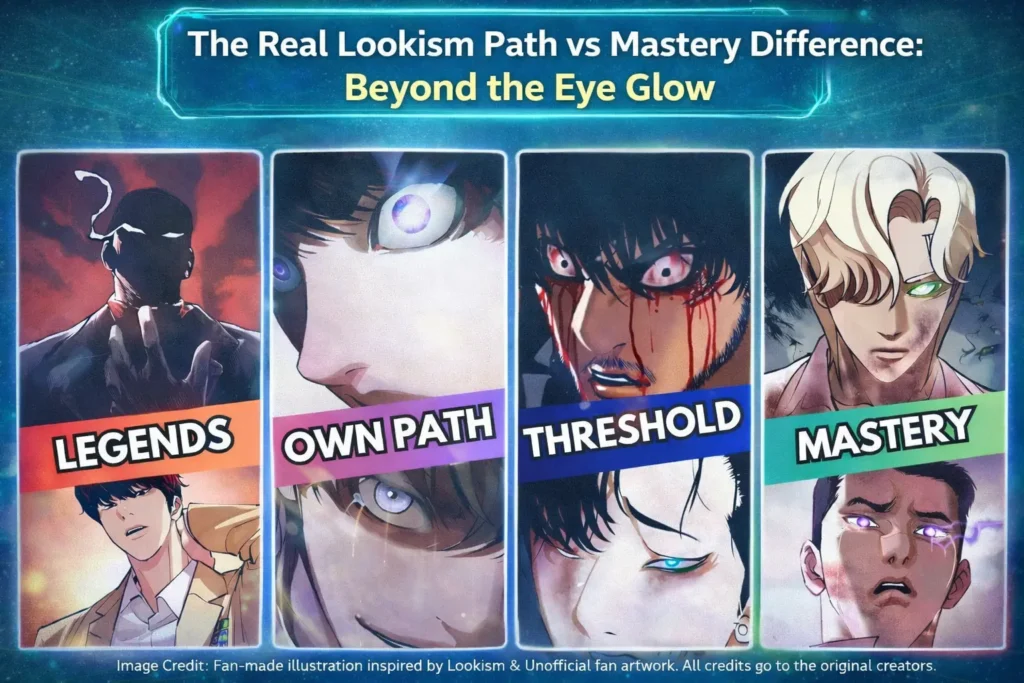
What is the real Lookism Path vs Mastery difference? We break down the mechanical and philosophical distinctions, eye colors, and unique users in this deep dive.