
Lookism Anime vs Lookism Manhwa Comparison – Netflix vs Original Review
A detailed Lookism Anime vs Lookism Manhwa comparison exploring story depth, pacing, characters, and social themes in Netflix’s adaptation and Park Tae-joon’s original manhwa.


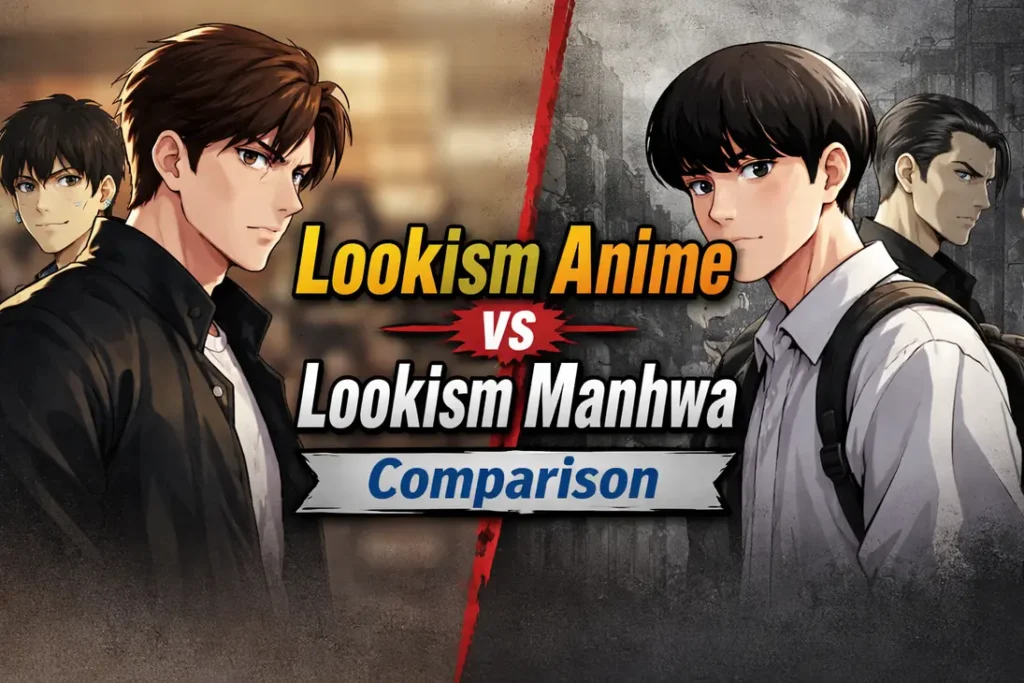
In the sprawling world of modern storytelling, few works have captured the raw, uncomfortable conversation about beauty, class, and identity quite like Lookism. Park Tae-joon’s creation grew from a South Korean webtoon into a global phenomenon, and its Netflix anime adaptation introduced the story to an even wider audience.
This article presents a focused and in-depth Lookism Anime vs lookism Manhwa comparison, examining how each version handles storytelling, character depth, pacing, and social themes.
This article compares the Netflix Lookism anime adaptation with Park Tae-joon’s original manhwa from a storytelling, pacing, and thematic perspective.
Rather than asking a simple “which is better?”, this review explores how the medium itself reshapes the experience—and why both versions ultimately tell the same story in very different ways.
Lookism Manhwa Review – The Unfiltered Grit of the Original Story
To understand any meaningful Lookism anime vs manhwa comparison, the foundation must begin with the original work.
The Lookism manhwa is massive, running across hundreds of episodes and continuing to expand its universe. Its greatest strength lies in its patience. The story unfolds slowly, allowing its characters and social themes to grow naturally.
Art style and evolution
The art in the manhwa begins simply but evolves dramatically over time. It gradually becomes rougher, sharper, and more expressive—perfectly matching the darker tone of later arcs. Fight scenes rely heavily on panel composition to create impact and motion, while character designs grow increasingly distinctive. Figures such as Gun, Goo, and Johan become instantly recognizable, not only because of their appearances but also because of how their personalities are visually reflected.
This artistic growth mirrors the emotional growth of the cast and creates a strong bond between the reader and the story.
Pacing and world-building
One of the most important strengths in any Lookism manhwa review is its long-form storytelling. Daniel Park may be the main character, but the narrative quickly becomes an ensemble drama.
Characters such as Vasco, Zack, Jay, Johan, and Eli Jang receive extensive backstories. Entire arcs—most notably the Hostel Arc and the Runaway Family Arc—focus deeply on trauma, poverty, broken families, and systemic neglect. The manhwa does not rush these stories. It allows discomfort, emotional weight, and social critique to sit with the reader.
The series also gradually introduces multiple crews, underground networks, and generational conflicts, forming a layered criminal and social ecosystem beneath the school setting.
Tone and emotional range
The manhwa excels at tonal flexibility. It shifts between school comedy, violent street fights, and emotional drama without losing coherence. Humor often appears immediately before or after devastating scenes, which enhances the realism and unpredictability of the world.
In the broader Lookism anime vs manhwa debate, this tonal complexity is one of the original version’s defining advantages.
Lookism Anime Review – Netflix’s Polished and Condensed Adaptation
The Netflix adaptation, produced by Studio Mir, faced a difficult task. Condensing roughly the first forty-five chapters of the manhwa into a limited season required major restructuring.
This decision fundamentally shapes the Lookism anime experience.
Visual polish and action choreography
The anime’s strongest asset is its animation quality. Fight scenes are fluid, fast, and cinematic. Camera movement, sound design, and choreography amplify the intensity of brawls that were previously confined to panels.
For viewers seeking a visually striking action series, the Lookism anime delivers a clean and accessible presentation.
Condensed narrative and faster pacing
In this Lookism anime review, pacing becomes the most important talking point. Subplots are shortened, merged, or removed entirely. Character development that originally unfolded over multiple chapters is compressed into short scenes or brief flashbacks.
As a result, the anime focuses more heavily on the supernatural premise of Daniel’s two bodies and the central school conflict, while the broader social commentary becomes more subtle.
This is a major structural difference within any honest Lookism Anime vs lookism Manhwa comparison.
Tonal shift toward action and mystery
The anime leans more strongly into thriller and action storytelling. While emotional moments still exist, they are framed primarily to support momentum. The result is a smoother, more streamlined viewing experience that sacrifices some emotional layering for narrative efficiency.
Side-by-Side Comparison – Key Differences Between Anime and Manhwa
Daniel Park’s character arc
In the manhwa, Daniel’s personal growth in his original body is slow, uncomfortable, and deeply psychological. His insecurity and search for self-worth remain central to the narrative.
In the anime, Daniel’s arc focuses more on managing his dual identity and navigating conflicts. The emotional struggle is still present, but it plays a secondary role to the central plot mechanics.
The Hostel Arc
The Hostel storyline highlights the clearest difference between the two formats. In the manhwa, Eli Jang’s past unfolds through multiple chapters, offering a devastating look at abandonment and survival.
In the anime, the same storyline is condensed into a brief flashback. While emotionally effective, it lacks the depth and prolonged tension of the original arc.
World scale and future setup
By the same point in the story, the manhwa has already begun laying groundwork for larger power structures, legendary fighters such as Gapryong Kim, and complex historical rivalries.
The anime primarily sets up the conflict with Hostel and introduces Charles Choi as a mysterious figure, keeping the world smaller and more focused for accessibility.
Final Verdict – Lookism Anime vs Lookism Manhwa Comparison
Trying to declare a single winner in the Lookism anime vs lookism Manhwa comparison ultimately misses the point. These two versions serve different audiences and different storytelling goals.
The manhwa is the definitive experience
For readers seeking:
- deep character development
- long-term emotional investment
- detailed social commentary
- and layered world-building
the Lookism manhwa remains the most complete and authentic version of the story.
The anime is the ideal entry point
For viewers looking for:
- polished animation
- tightly paced storytelling
- visually dynamic action scenes
- and an easy introduction to the premise
the Netflix anime functions as an effective and engaging gateway.
In simple terms, the anime delivers the spectacle.
The manhwa delivers the substance behind every punch, decision, and emotional breakdown.
Conclusion – Two Bodies, One Story
The ongoing discussion around Lookism adaptation quality ultimately reflects the strength of Park Tae-joon’s original concept. The anime does not replace the manhwa. Instead, it curates the most cinematic elements of the story and reshapes them for a global streaming audience.
For a complete understanding of Lookism’s commentary on beauty, class, violence, and self-worth, the manhwa remains unmatched. But for a fast-paced and visually powerful introduction, the anime stands as a respectable and well-produced adaptation.
In the end, both versions hold up different mirrors to the same reality—each revealing a different angle of the same uncomfortable truth about appearance and identity.
FAQ – Lookism Anime vs Lookism Manhwa Comparison
Is the Lookism anime faithful to the manhwa?
The anime follows the main storyline but condenses several character arcs and reduces the depth of social themes in order to maintain a faster pace.
Should new fans start with the anime or the manhwa?
The anime works well as an introduction, but readers who want a deeper and more emotionally complex story should continue with the manhwa.
Editorial Disclaimer
This article is an independent editorial review and comparison. It is not affiliated with, endorsed by, or sponsored by Netflix, Park Tae-joon, or any official Lookism publishers.