
Anime Production Process Explained: Why Anime Takes So Long to Make
Learn how the anime production process works, including real production timelines, studio workflows, and business factors that explain why anime series take so long to produce.


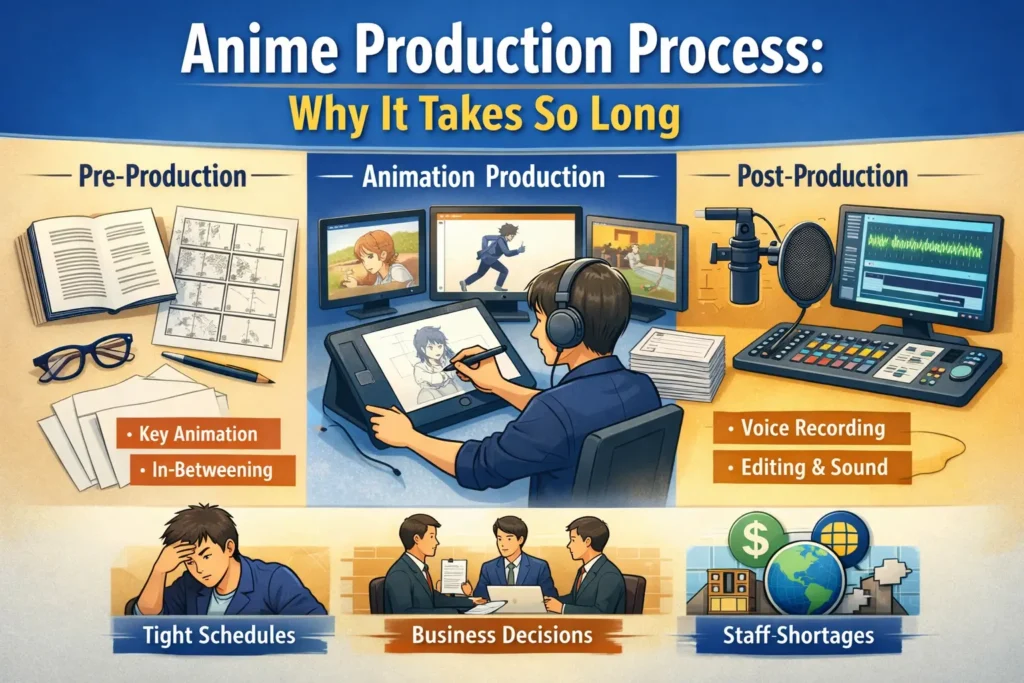
Most viewers experience anime as a finished product—22 minutes of polished animation every week.
Behind that short runtime, however, is a production pipeline that operates under tight schedules, limited skilled manpower, and complex business coordination.
This article explains why anime production process timelines stretch across months or even years, based on real industry workflows, labor constraints, and studio scheduling models.
How an Anime Series Is Actually Produced
Anime production follows a multi-stage workflow. Each stage is handled by different specialized teams, and delays in one step immediately affect the entire schedule.
Core production stages
Pre-production :
- Script development and series composition
- Character and background design
- Storyboarding for every episode
- Art direction and color design
This phase usually takes several months and determines the visual and narrative consistency of the entire project.
Animation production :
- Layout and key animation
- In-between animation
- Background painting
- Digital coloring and compositing
Post-production :
- Voice recording
- Sound design
- Music composition
- Final editing and broadcast formatting
Unlike Western animation pipelines, Japanese TV anime production is often carried out under a concurrent schedule, meaning multiple episodes are produced simultaneously while earlier episodes are already airing.
Realistic Time Required Per Episode – Anime Production Process
Based on standard industry workflow shared by Japanese studios and production staff interviews, a single television episode typically requires:
| Stage | Typical timeline |
|---|---|
| Storyboarding & direction | 1–2 weeks |
| Key animation & layouts | 3–4 weeks |
| In-between & finishing | 2–3 weeks |
| Compositing & post-production | 1–2 weeks |
Total realistic production time per episode: 7–10 weeks
This is why studios rely on overlapping schedules instead of finishing an entire season before broadcast.
The Real Bottleneck: Skilled Animator Availability
The largest production constraint is not software or hardware.
It is experienced human labor.
The Japanese Animation Creators Association (JAniCA) has repeatedly highlighted long-standing structural issues in the anime labor market, including:
- low entry-level compensation
- high turnover of junior animators
- shortage of experienced key animators and animation directors
A widely cited survey by the Japanese Animation Creators Association (JAniCA) highlights ongoing industry labor conditions and animator work patterns.
Source:
Japanese Animation Creators Association – Animator Working Conditions Survey
Lack of skilled staff forces studios to:
- outsource in-between work to overseas subcontractors
- rely on freelancers who are often booked months in advance
This creates coordination overhead and quality control challenges.
Why Even Large Studios Cannot Release Faster
High-profile studios such as MAPPA, Ufotable, and Kyoto Animation operate under long-term production calendars.
A studio does not simply work on one title at a time.
It must allocate:
- animation directors
- key animators
- compositing teams
- production managers
across multiple overlapping projects.
As a result, scheduling a new season often depends on:
- when senior staff become available
- whether the original director and series composer can return
- whether subcontracting capacity exists for peak workloads
This is one of the main reasons sequels frequently require long waiting periods even when a series is commercially successful.
Source Material and Story Planning Constraints
Most TV anime adaptations are based on:
- manga
- light novels
- visual novel franchises
Producing an adaptation too close to the source material creates serious risks:
- incomplete story arcs
- forced original endings
- inconsistent pacing
Production committees therefore often delay greenlighting a sequel until sufficient source material has accumulated.
This planning strategy reduces long-term franchise risk but extends release timelines.
The Production Committee Business Model
Anime projects are usually financed by a production committee composed of:
- publishers
- broadcasters
- music labels
- merchandising companies
- streaming platforms
Before a new season is approved, the committee evaluates:
- projected Blu-ray and streaming revenue
- international licensing demand
- merchandising potential
- scheduling alignment with marketing campaigns
Even if a studio is technically ready, business approval can significantly delay production start.
Why “Split-Cour” Releases Are Increasing
A growing number of modern anime projects adopt a split-cour model:
- first broadcast block (12–13 episodes)
- planned break
- second broadcast block
This structure allows studios to:
- continue production with reduced schedule pressure
- stabilize staffing
- maintain animation quality
From an operational perspective, split-cour scheduling is increasingly used as a quality-preservation strategy rather than a marketing tactic.
Case Comparison: Continuous vs High-Density Production
Long-running weekly broadcast model
- continuous output
- heavy pacing adjustments
- frequent recap and filler techniques
- lower per-episode production density
Seasonal high-density production model
- higher animation complexity
- heavier director involvement per episode
- stricter schedule sensitivity
- longer total development cycles
The industry has largely shifted toward the second model to meet modern audience expectations for visual quality.
Is the Industry Improving?
Several structural changes are gradually reshaping production:
- greater direct investment from international streaming platforms
- longer pre-production windows for high-profile projects
- improved digital production tools
- stronger visibility of labor reform discussions within the industry
However, animator supply and long-term workforce sustainability remain unresolved challenges.
Conclusion
Anime production timelines are not driven by inefficiency or lack of demand.
They are the result of:
- complex multi-studio workflows
- chronic shortages of skilled animators
- tightly scheduled creative leadership
- and a business approval structure that coordinates multiple stakeholders.
Long waiting periods between seasons are therefore a structural outcome of how the modern anime industry operates.
FAQ – Anime Production Timelines
How long does it take to produce a full 12-episode anime season?
A typical 12-episode series requires several months of pre-production followed by overlapping episode production, resulting in a total development cycle that often exceeds one year.
Why can’t studios simply hire more animators?
Training animators to reach professional key-animation and supervision levels requires years of experience. The main shortage is in senior and supervisory roles rather than entry-level labor.
Does streaming money make anime production faster?
Streaming investment can improve schedules and budgets, but it does not instantly solve skilled labor shortages or production coordination complexity.
Editorial Disclaimer
This article is published for informational and educational purposes only.
The analysis and explanations are based on publicly available industry reports, interviews, and general production practices within the Japanese animation industry.
We do not represent, partner with, or officially endorse any anime studio, production committee, streaming platform, or brand mentioned in this article.
All trademarks, series names, and company references are used strictly for editorial and informational context.
— Editorial Team, Himanshu Upadhyay

Buddhism in Anime: How Buddhist Philosophy Shapes Popular Anime

Discover how Buddhism in anime influences storytelling, characters, and themes like suffering, identity, and enlightenment across popular series.