
The Dharma of Curses: How Buddhism Fuels the Power System of Jujutsu Kaisen
Discover the deep Buddhist roots of Jujutsu Kaisen's power system. Learn how Cursed Energy, Domain Expansion, and techniques like Hollow Purple are based on real Buddhist philosophy.


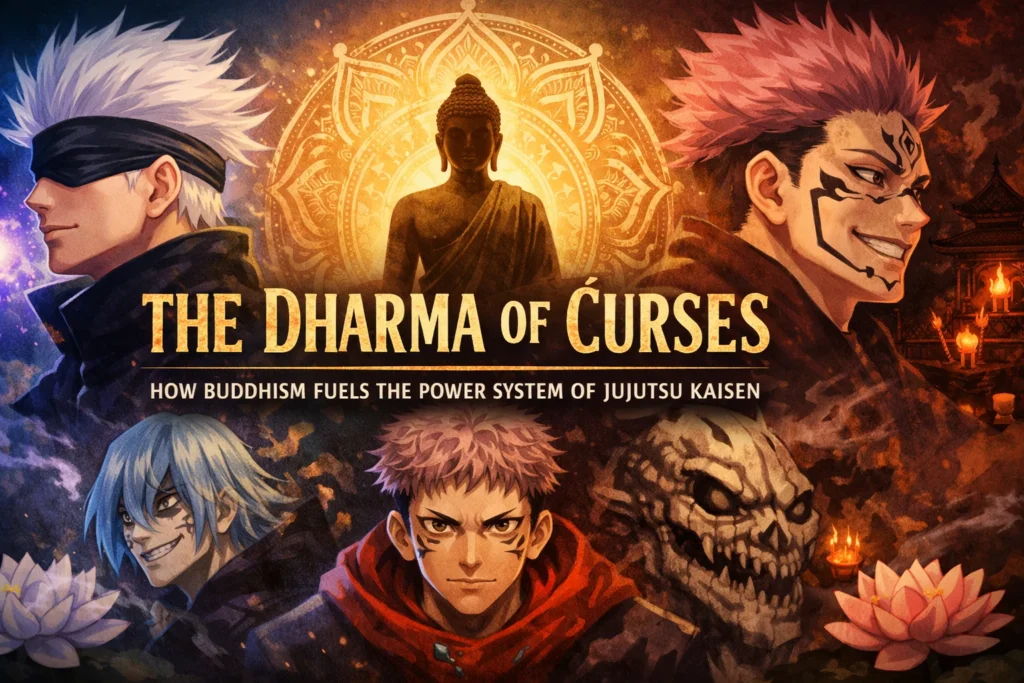
At first glance, Jujutsu Kaisen is a bombastic shonen spectacle—a world of explosive fights, terrifying monsters, and teenagers throwing hands with supernatural flair. But beneath the surface of cursed energy and domain expansions lies a profound and meticulously crafted philosophical engine: the core tenets of Buddhism. This isn’t just window dressing; the show’s entire power system, character motivations, and cosmic hierarchy are deeply rooted in Buddhist thought. Understanding these references doesn’t just make you a better fan—it unlocks a richer, more tragic, and intellectually satisfying layer to the story Gege Akutami is telling.
Let’s pull back the curtain and explore how the teachings of the Buddha form the very foundation of jujutsu sorcery.
Cursed Energy: The Engine of Suffering
The most fundamental concept in Jujutsu Kaisen is also the most Buddhist: Cursed Energy.
In Buddhism, the root of all suffering (dukkha) is desire, attachment, and negative emotions—craving, hatred, ignorance, and fear. These mental states bind us to the cycle of rebirth and pain. In JJK, this is made literal. Cursed energy leaks from every non-sorcerer as a direct byproduct of their negative emotions. The anxiety of a commute, the sting of a rude comment, the deep-seated fear of death—it all coalesces into the malignant mist that powers curses.
Think of it this way: In Buddhism, our karma (intentional actions) is shaped by these mental defilements. In JJK, that karma becomes tangible, manifesting as the curses that haunt humanity. The sorcerer’s role is inherently aligned with the Buddhist path: they must skillfully engage with this suffering, not to eliminate humanity (the source), but to manage its toxic output and protect the ignorant from its manifestations.
Domain Expansion: The Ultimate Inner World
The pinnacle of a jujutsu sorcerer’s technique is the Domain Expansion. This is a direct parallel to the Buddhist concept of a mandala.
A mandala is a complex, geometric diagram representing the universe, a sacred space, or a deity’s pure land. It’s a map of cosmic order and spiritual reality. Similarly, a Domain Expansion projects the sorcerer’s inner world—their innate domain, shaped by their psyche, technique, and understanding—onto reality. It creates a space where their rule is absolute.
But here’s the Buddhist twist: the nature of these domains often reflects the wielder’s spiritual state or deepest attachments.
- Mahito’s Self-Embodiment of Perfection: Mahito, a curse born from human hatred for each other, creates a domain filled with swirling, grasping hands. This viscerally represents the Buddhist idea of papanca (mental proliferation)—the tangled, ego-driven conceptual thinking that leads to suffering and separation.
- Sukuna’s Malevolent Shrine: His domain, with its ominous shrine and devastating cleave/dismantle attacks, reflects a being utterly enslaved by his own desires and dominion—a dark parody of a wrathful deity’s pure land, representing not enlightenment, but absolute hegemony over a world of suffering.
Mastering a Domain is akin to achieving a profound, if often warped, spiritual realization and forcing it upon the world.
Techniques as Spiritual Concepts
Many specific techniques are named after, and operate on, Buddhist principles.
- Hollow Technique: Purple (Gojo Satoru): This isn’t just a fancy energy blast. It’s described as the convergence of “Infinity” (Blue) and its reversal (Red) to create “imaginary mass,” erasing what it touches. This mirrors the Buddhist concept of Sunyata, often translated as “emptiness” or “void.” It’s not nihilism, but the understanding that all phenomena are empty of inherent, independent existence. Purple represents the ultimate technique of “emptying” something from reality itself.
- Reverse Cursed Technique: To heal with cursed energy, a sorcerer must multiply the negative energy of a curse by itself, creating positive energy. This is a brilliant narrative metaphor for a core Buddhist practice: transmutation. On the path, a practitioner doesn’t destroy negative emotions like anger or ignorance; they acknowledge and transform their energy into wisdom and compassion. The poison becomes the medicine.
- The Six Eyes (Gojo Satoru): This hereditary trait allows Gojo to perceive cursed energy at an atomic level, reducing the cost of his techniques to “virtually zero.” This mirrors the Buddhist idea of penetrative insight—seeing the true nature of reality (dharmata) without distortion. His perception cuts through illusion, allowing for effortless, spontaneous action, much like an enlightened being.
The Cursed Object & Reincarnation Cycle: A Dark Samsara
The saga of Sukuna, the King of Curses, is a dark reflection of Buddhist cosmology. His existence as 20 indestructible Cursed Objects—fingers—that persist through the ages is a grotesque take on the cycle of Samsara (rebirth) and the persistence of karma.
Sukuna is a being of such immense negative karma and will that he cannot be destroyed, only contained. His fingers, when consumed, force a reincarnation of his consciousness into a vessel (like Yuji). This is a literal, forced Samsara. The goal of the jujutsu world is not to grant him enlightenment or liberation (Nirvana), but to end his cycle permanently—to achieve the cessation of this one, particular stream of supreme suffering.
Conclusion: More Than Just Cool Names
The Buddhist references in Jujutsu Kaisen are not merely aesthetic. They provide the philosophical bedrock for the entire conflict. The world of JJK is one where the fundamental truths of Buddhism—that suffering arises from the mind, that attachment leads to bondage, that perception shapes reality—are physical laws.
This framework elevates the story from a simple battle between good and evil to a tragic drama about managing the inescapable pain of existence. The sorcerers aren’t just fighters; they are reluctant monks on a battlefield, using distorted spiritual powers to navigate a world drowning in its own negative karma. The next time you watch Gojo unleash Hollow Purple or hear talk of “cursed energy from negative emotions,” remember—you’re not just seeing a cool power-up. You’re witnessing a centuries-old spiritual dialogue play out in one of the most inventive battle systems in modern manga. The true “jujutsu” (magical technique) is Gege Akutami’s skillful weaving of Dharma into every strand of the story’s DNA.

That Time I Got Reincarnated as a Slime Season 3 Explained: Political Shift, Demon Lord Alliances and Rimuru’s New Role
Explore That Time I Got Reincarnated as a Slime Season 3 Explained, Rimuru's rise as a leader, political strategy, alliances with Demon Lords, and Tempest's growth.