
How Shark Tank Deals Actually Work After the Cameras Stop
Learn how Shark Tank deals work after the show, including due diligence, negotiations, paperwork, deal closures, failed deals and what happens next.


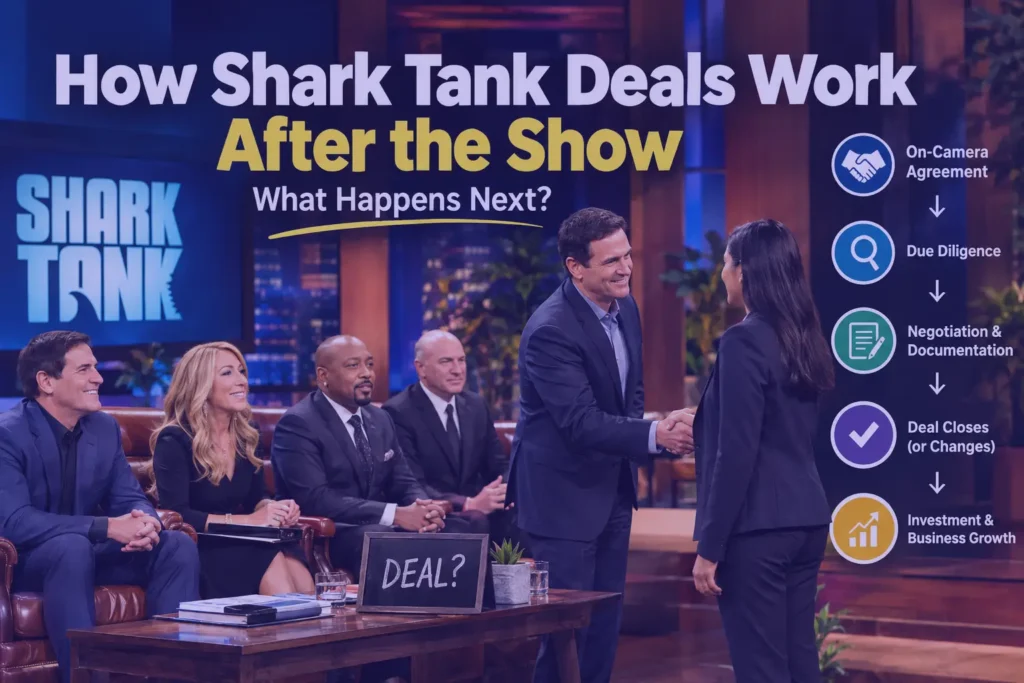
When an entrepreneur shakes hands with a Shark on Shark Tank, it looks like the biggest moment of the pitch is over. On television, the sequence is simple: the entrepreneur asks for money, a Shark makes an offer, both sides negotiate, and they agree on a deal.
But there is an important part of the process that viewers do not see.
A deal made in the Tank is not necessarily the same thing as a completed investment.
After filming, the entrepreneur and the Shark still have to work through due diligence, documentation, financial checks, legal details and, in some cases, further negotiations. Some deals close. Some change. Others never happen.
That distinction is important because a handshake makes for a great television ending, but an investment only becomes real when the underlying transaction is actually completed.
ABC itself has described Beyond the Tank as a look at what happens after entrepreneurs make or fail to make deals with the Sharks, including the work involved in helping businesses grow after the cameras are gone.
So what really happens after a Shark says, “You’re in”?
What happens after a Shark Tank deal is made?
The post-show process generally looks something like this:
On-camera offer → due diligence → negotiation and documentation → final decision → closing → investment and business relationship
The exact process can vary from one deal to another, and the details are not always publicly disclosed. But the basic idea is straightforward: the televised agreement starts the investment process; it does not automatically finish it.
Here’s what happens at each stage.
The entrepreneur accepts the offer on camera
The first step is the moment viewers know well.
An entrepreneur might enter the Tank asking for:
$200,000 for 10% of the company
A Shark might counter with:
$200,000 for 20%
The entrepreneur can negotiate, accept, reject the offer or sometimes receive competing offers from multiple Sharks.
If both sides agree, they shake hands.
That is the dramatic television moment — but there is still work to do.
The reason is simple: an investor cannot reasonably transfer a large amount of money into a business based only on what was said during a televised pitch.
The Shark and their team need to verify the business first.
Due diligence begins
This is arguably the most important part of what happens after the cameras stop.
Due diligence means checking whether the business is actually what the entrepreneur presented it as being.
During the pitch, an entrepreneur may discuss:
- Revenue
- Profit
- Sales growth
- Manufacturing costs
- Margins
- Inventory
- Debt
- Ownership
- Intellectual property
- Customers
- Suppliers
- Business valuation
After filming, those claims can be examined in much greater detail.
Lori Greiner has explained that her team conducts due diligence after a deal to verify the business and the information presented by the entrepreneur. Mark Cuban has similarly explained that issues uncovered during due diligence can cause a deal to fall through.
This is not unusual in business investing.
A Shark may want to know whether the company’s financial statements match the numbers presented on television, whether there are outstanding obligations, who actually owns the business and whether there are legal or operational problems that could affect the investment.
What might a Shark check?
Depending on the business, due diligence can involve questions such as:
- Are the reported sales accurate?
- How much profit does the company actually make?
- Does the company have outstanding debt?
- Are taxes properly handled?
- Who owns the trademarks or patents?
- Are there disputes with suppliers or customers?
- How much inventory is available?
- Are manufacturing costs realistic?
- Does the company have other investors?
- Are there undisclosed obligations?
- Is the valuation supported by the company’s financial performance?
This is one reason why a deal can look certain on television and still fail later.
The deal may be renegotiated
This is the part many casual viewers don’t realise.
The terms announced during the pitch may not necessarily survive unchanged through the entire process.
For example, imagine an entrepreneur agrees on television to:
$500,000 for 10% equity.
During due diligence, the Shark discovers that the company’s financial position is materially different from what was understood during the pitch.
The Shark may decide to:
- Change the investment amount
- Request a different percentage
- Add conditions
- Structure the investment differently
- Negotiate additional rights
- Walk away
The entrepreneur also has the ability to decide whether the revised terms still make sense for the company.
Historical reporting has found that many on-camera deals did not ultimately close on exactly the same terms. A Forbes analysis of early Shark Tank deals found that a substantial share of entrepreneurs did not end up with the exact deal originally agreed to on television.
That does not mean every Shark Tank deal changes.
It means viewers should understand the difference between an on-camera agreement and a completed investment transaction.
Lawyers and paperwork enter the picture
Television has limited time.
Real investment transactions do not.
Once the basic business terms have been agreed upon, lawyers and financial professionals may become involved in documenting the transaction.
The paperwork can establish things such as:
- How much money is being invested
- What percentage of the company is being transferred
- What type of ownership the investor receives
- Whether the investment has conditions
- What rights the investor receives
- How future decisions are handled
- What happens if certain conditions are not met
This is why the simple equation viewers hear on the show — “$X for Y%” — does not necessarily describe every important detail of the final transaction.
The percentage and investment amount may be the headline terms, but the legal documents determine what the parties have actually agreed to.
The Shark and entrepreneur decide whether to continue
At this point, both sides have a choice.
The Shark can decide:
“I still want to invest.”
The entrepreneur can decide:
“I still want this Shark as my investor.”
That second point matters.
Getting an offer from a Shark is not automatically the best outcome for every business.
An entrepreneur might decide that giving up a particular percentage of the company is too expensive, that the investor’s involvement does not fit the company’s strategy, or that another funding option makes more sense.
A deal can therefore disappear even when both parties were enthusiastic during filming.
One example reported by the Washington Post involved a Shark Tank entrepreneur whose on-camera agreement later changed, illustrating that the television version of a deal is not necessarily its final form.
If everything works, the deal closes
If due diligence is satisfactory, both sides agree on the final terms and the legal documentation is completed, the transaction can close.
This is the point that matters most financially.
The entrepreneur now has an actual investment relationship with the Shark rather than simply an on-screen agreement.
Depending on the deal, the investor’s contribution may be used for areas such as:
- Inventory
- Marketing
- Hiring
- Manufacturing
- Retail expansion
- Technology
- Distribution
- Working capital
The Shark may also contribute something that isn’t simply cash.
That can include:
- Industry contacts
- Retail relationships
- Marketing expertise
- Manufacturing connections
- Strategic advice
- Brand exposure
- Negotiation experience
ABC’s Beyond the Tank concept specifically focused on what happens when Sharks become involved in the businesses after the televised pitch, including the challenges of helping companies grow and become profitable.
The Shark’s involvement can become more important than the cheque
This is one of the most interesting parts of a successful Shark Tank deal.
An entrepreneur may initially think:
“I need $250,000.”
But the bigger question can become:
“What can this particular investor do for my business?”
Suppose a consumer product company needs help getting into major retail stores.
An investor with strong retail relationships could potentially be more valuable than an investor who simply offers the highest amount of money.
The same principle applies to:
- Manufacturing
- Branding
- Licensing
- Distribution
- E-commerce
- Advertising
- Operations
That’s why Shark Tank negotiations are not purely about who offers the most cash.
The entrepreneur is effectively choosing a business partner, not just a bank account.
Why do Shark Tank deals fall through?
There isn’t one universal reason.
Common possibilities include problems discovered during due diligence, disagreements over final terms, differences in business strategy, or the investor and entrepreneur deciding that the partnership no longer makes sense.
Mark Cuban has publicly described due diligence issues that caused deals to fall apart, including situations involving taxes, financial reporting and information presented during the pitch.
Another reason can simply be misalignment.
An entrepreneur may want rapid expansion while an investor may prefer a different strategy.
Or the entrepreneur may decide that giving up the negotiated equity is no longer worthwhile after the publicity from the episode creates other opportunities.
A recent example reported by Forbes involved REMplenish, which agreed to an on-camera offer but ultimately did not close the deal after subsequent due diligence and negotiations.
Does appearing on Shark Tank still help if the deal fails?
Yes and this is where the show becomes more interesting than simply “get a Shark or go home.”
A company can receive significant exposure from appearing on the programme even without completing a deal.
The exposure can potentially lead to:
- New customers
- Increased website traffic
- Retail interest
- Media coverage
- New investors
- Partnerships
- Higher brand recognition
MarketWatch reported examples of entrepreneurs who did not receive a Shark deal but still benefited substantially from the exposure generated by appearing on the show.
In other words:
No Shark does not necessarily mean no value.
For some businesses, the publicity itself can become one of the biggest outcomes of the appearance.
What happens if a Shark says “I’m out”?
If an entrepreneur loses an offer, the business doesn’t automatically disappear.
The founder still owns the company unless they have agreed to another transaction.
They can potentially:
- Continue operating independently
- Raise money elsewhere
- Approach angel investors
- Seek venture capital
- Expand using their own profits
- Find strategic partners
- Use the publicity from the show to acquire customers
That is why a Shark Tank appearance should not be viewed solely as a pass-or-fail investment test.
The company is still a business after the episode ends.
Shark Tank USA vs Shark Tank India: Is the process the same?
The broad principle is similar:
An on-camera agreement still needs to move through post-pitch checks and documentation before it becomes a completed investment.
However, viewers should not assume that the US and Indian versions use identical contracts, timelines or legal procedures.
The Indian version has its own investors, production structure and business environment.
In a 2025 interview with Moneycontrol, Shark Tank India investors discussed due diligence as the stage after a pitch agreement, with Aman Gupta describing it as a process in which the Sharks check the company’s stage, ethics and whether the sales numbers are genuine.
That makes one thing clear for viewers of both versions:
The televised handshake is not the entire investment process.
How long does a Shark Tank deal take to close?
There is no single answer.
Some deals can move relatively quickly, while others can take considerably longer depending on the complexity of the company, the due-diligence process, negotiations and legal documentation.
A useful real-world example is the Richualist deal involving entrepreneur Dawn Myers. Forbes reported that the episode was filmed in 2023 and that the eventual deal closed after months of due diligence and negotiations.
So if you are wondering why a Shark Tank episode may air months after it was filmed, or why a company does not immediately announce that its investment has closed, the answer is that television production and investment closing operate on different timelines.
Does every Shark Tank handshake mean the entrepreneur received the money?
No.
This is probably the most important answer in the entire article.
A deal shown on television should be understood as an agreement reached during the pitch, subject to the subsequent process required to complete the transaction.
The entrepreneur may ultimately receive the investment.
The terms may change.
Or the deal may not close.
That is why statements such as “this entrepreneur got $500,000 from Shark X” should be treated carefully unless there is reliable evidence that the investment actually closed.
ABC also maintains an official list of products that have appeared on Shark Tank, while warning consumers that websites and advertisements sometimes falsely claim that products were endorsed by the show or its Sharks.
What entrepreneurs should understand before accepting a Shark Tank deal
For a founder, the biggest lesson is not simply to celebrate the handshake.
Before relying on the investment, the entrepreneur needs to understand:
The headline number is not everything
$500,000 sounds better than $300,000, but the percentage of ownership and other terms matter.
Due diligence can change the conversation
Every number presented during the pitch needs to stand up to scrutiny.
The right Shark can matter more than the highest offer
Connections, expertise and strategic help can have significant value.
Don’t build your entire business plan around an unclosed deal
Until the investment is actually completed, it should not be treated as guaranteed cash.
Publicity has value even without an investment
An entrepreneur can still gain customers, media attention and new business opportunities from appearing on the show.
The simplest way to understand a Shark Tank deal
Think of the process as two separate moments.
Moment one: Television
The entrepreneur pitches.
A Shark makes an offer.
Both sides agree.
The cameras capture the handshake.
Moment two: Business
The Shark’s team investigates the company.
Financial and legal information is reviewed.
The parties negotiate the final terms.
Documents are prepared.
The transaction either closes, changes or falls apart.
That second stage is where the “deal” becomes a real investment.
Final takeaway
A Shark Tank deal does not really end when the entrepreneur walks out of the Tank.
In many ways, that’s when the serious work starts.
The televised pitch is designed to show the negotiation and the excitement of reaching an agreement. The less visible process involves due diligence, financial verification, legal documentation, further negotiations and deciding whether the partnership makes sense for both sides.
Some entrepreneurs eventually close the deal they negotiated on television. Others agree to different terms, while some deals never reach the finish line.
And even when there is no completed investment, the exposure from appearing on Shark Tank can create opportunities that have nothing to do with receiving a cheque from a Shark.
So the next time an entrepreneur says, “Deal!” and walks out of the Tank celebrating, remember:
The handshake may be the end of the episode — but it can be the beginning of the real deal.
Sources and editorial note
This article explains the general post-pitch process using publicly available information from ABC, interviews with Sharks and reporting on individual Shark Tank businesses. Deal structures, due-diligence procedures and closing timelines can differ between businesses, seasons and the US and Indian versions of the programme. Specific deal terms should therefore be verified from reliable reporting or the companies themselves rather than assumed from what was shown on television.