Best Hindi TV Serials Of All Time : From Ramayan to OTT Hits – Complete Evolution of Indian Television
Explore the Best Hindi TV Serials from Ramayan to Kyunki Saas Bhi Kabhi Bahu Thi and modern OTT hits. A complete guide to India’s most iconic shows.


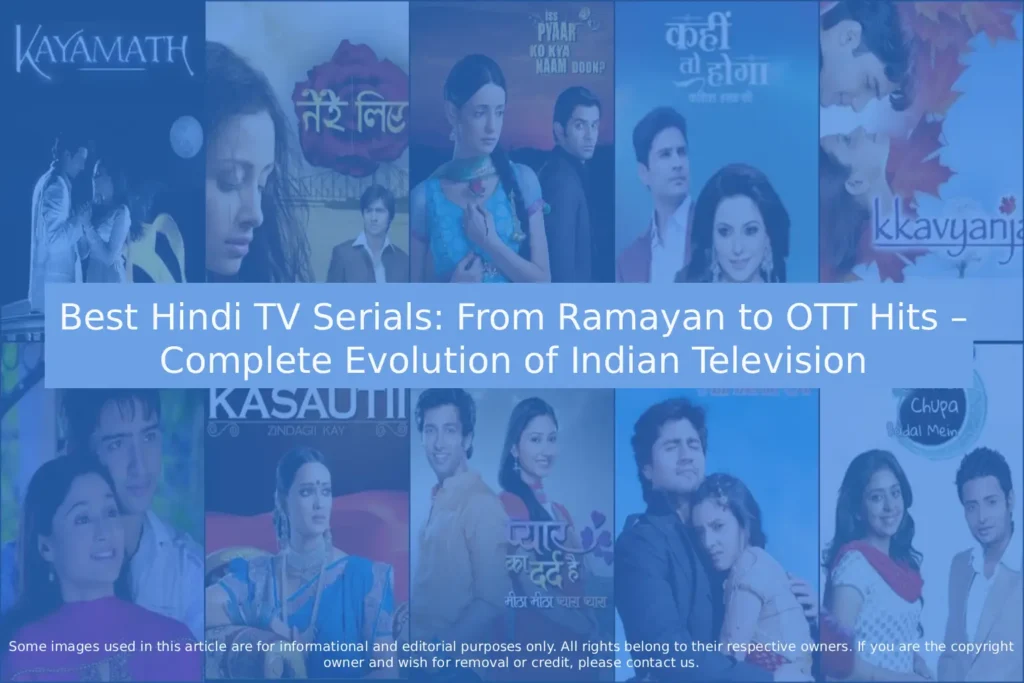
Do you remember the sound of the Doordarshan chime signaling that Sunday was about to get a whole lot better? Or the tense background score that meant a new episode of Kyunki Saas Bhi Kabhi Bahu Thi was starting, a cue for the entire household to drop everything and gather around the screen? More than just a source of entertainment, Best Hindi TV serials have, for decades, been the shared heartbeat of millions of Indian homes. They’ve been our moral theatre, our family’s late-night debate club, and the source of countless inside jokes.
This isn’t just a listicle about which show had the highest TRP (though we’ll get to those astonishing numbers). It’s an in-depth journey through the evolution of Indian television—from the mythological epics that united a nation to the high-budget web series that are redefining storytelling today. We’ll uncover the hidden details that made these shows iconic, the foreshadowing that kept us hooked, and the behind-the-scenes drama that was often more intense than what played out on screen. Get ready for a deep dive into the heart of Hindi entertainment.
Popular Old Best Hindi TV Serials (1980s–1990s Doordarshan Era)
The late 1980s and early 90s weren’t just a phase; they were a cultural event. With only one state-run channel, Doordarshan (DD), the nation was a captive audience, and the shows aired on it became a shared, sacred ritual. This was the era of quality over quantity, where limited episodes and powerful storytelling created a profound impact.
Ramayan and Mahabharat: Most Watched Hindi Mythological TV Serials Ever
You can’t talk about Indian TV history without starting here. Ramanand Sagar’s Ramayan (1987-1988) and B.R. Chopra’s Mahabharat (1988-1990) are not just shows; they are landmarks that defined a generation. They were a phenomenon that literally brought the country to a standstill.
- The Numbers: When Ramayan first aired, streets would empty, and families would gather around the TV like it was a temple. A BBC report estimated that the show was watched by 650 million (65 crore) people during its initial run and re-runs, making it one of the most-watched shows in global television history. A 2020 re-run episode drew 77 million impressions, according to BARC India data. In comparison, Mahabharat‘s peak TRP was 22.9, as recorded by TAM Media Research at the time. Kyunki Saas Bhi Kabhi Bahu Thi, with a widely cited peak of 22.4, is the only 21st-century show to crack the top five.
- A Quiet Revolution: Beyond the numbers, there’s a fascinating hidden detail. A 2025 NBER working paper (National Bureau of Economic Research) co-authored by economists from the University of Michigan analyzed the long-term impacts of mass media exposure to Ramayan. The study found that areas with higher TV signal strength when the show aired experienced significant cultural shifts: parents became more likely to give newborns traditional Hindu names, households increased adherence to vegetarian diets, and there was a persistent electoral gain for the Hindu nationalist BJP. As the researchers note, “media portrayal of religious narratives can have lasting effects on cultural identity, intergroup violence, and electoral outcomes”. You can read the full paper on the NBER website.
- The Cost of Fame: The show created household names like Arun Govil (Ram) and Deepika Chikhalia (Sita), but it also trapped them. Both have openly spoken about how their on-screen roles as deities stalled their film careers. In a The Indian Express interview, Arun Govil said, “After Ramayan, no one wanted to see me as a villain or even a common man. I was Ram forever.” Mahabharat similarly enshrined actors like Nitish Bharadwaj (Krishna) and Mukesh Khanna (Bhishma) in the public imagination forever. Mukesh Khanna later told Times of India that he still gets calls for blessings from fans who believe he is Bhishma Pitamah.
Best Doordarshan Shows in India Apart from Mythological Serials
While the epics dominated Sundays, the rest of the week was filled with shows that pushed creative boundaries, often on shoestring budgets.
- Hum Log (1984): India’s first television soap opera. It marked the beginning of the serial format, but more importantly, it was one of the first shows to integrate social messaging, even ending episodes with a note from a psychologist. Doordarshan’s archives note that the show received over 4,000 letters per week from viewers.
- Buniyaad (1987): A powerful saga about the Partition of India, directed by Ramesh Sippy (Sholay) and starring Alok Nath (long before he became a meme). It brought the trauma of a nation’s birth into living rooms. The Film Companion retrospective called it “India’s first prestige TV drama.”
- Malgudi Days (1986): R.K. Narayan’s fictional town came to life with a simplicity and charm that is almost impossible to replicate today. The opening theme by L. Vaidyanathan remains one of the most evocative pieces of music ever on Indian TV. The Hindu wrote that the show “taught an entire generation the meaning of gentle storytelling.”
- Byomkesh Bakshi (1993-1997): Starring Rajit Kapur, this detective series based on the stories of Sharadindu Bandyopadhyay was a masterclass in moody, intelligent storytelling—light years ahead of its time. Scroll.in ranked it as one of the top 10 Indian detective shows ever made.
- Low-Budget Genius: A perfect example of the era’s ingenuity is Vikram Aur Betaal (1985). It was shot on a tight budget of just one lakh rupees per episode in director Ramanand Sagar’s own bungalow, Sagar Villa, as noted in a The Quint feature on Doordarshan classics. With no computer effects, they had to create illusions physically—Betaal’s floating effect was achieved by having the actor lie on a black-painted trolley while a mirror trick hid the wheels.
- Foreshadowing in the Doordarshan Era: Unlike today’s dramatic background scores, foreshadowing back then was subtle. In Byomkesh Bakshi, a seemingly innocent shot of a tea cup with an extra spoon would later become the clue. In Malgudi Days, the rustle of a tamarind tree often meant trouble was coming. Viewers had to pay attention—no loud “twist music” gave it away.
Ekta Kapoor Hindi Serials That Changed Indian Television (2000s)
The mid-90s saw the arrival of cable TV, fragmenting the audience. But one person brought it back together: Ekta Kapoor. Her production house, Balaji Telefilms, unleashed a tidal wave of daily soaps that changed the grammar of Indian television forever.
The launch of Kyunki Saas Bhi Kabhi Bahu Thi on Star Plus in 2000 was a watershed moment. It introduced a formula that would dominate for a decade: the perfect bahu (daughter-in-law), Tulsi (Smriti Irani), who was noble, suffering, and always right. Her daily struggles with her scheming mother-in-law resonated so deeply that the show became a cultural phenomenon.
- The Numbers: Kyunki reportedly peaked at a TRP of 22.4 after the return of the Mihir character. This figure is widely cited in Indian media, including a Rediff retrospective that called it “the highest TRP any daily soap ever achieved.” Its sister show, Kahaani Ghar Ghar Kii, according to TAM Media Research data from November 2006, garnered a TVR (Television Rating) of 15.34 for its generation-leap episode, reaching more than 12 million viewers—a high Star Plus hadn’t seen in a while. (The often-cited 40.6 figure appears to be an unverified fan claim; no contemporary TAM or BARC source supports it. A News18 fact-check noted that such a rating would have been impossible under the measurement system of that time.)
- The “Balaji Twist”: The era was defined by its tropes. The iconic kaan phunkna (whispering into someone’s ear) and elaborate puja sequences were not just filler; they were narrative devices. Foreshadowing was achieved through dramatic background scores and extreme close-ups of a character’s widening eyes. A sudden zoom on Tulsi’s face with a dhak-dhak sound meant a betrayal was coming. A shot of aarti thali with a tilted lamp meant someone would die. This created a unique visual language that viewers instantly understood. In fact, a BBC article on Indian soap operas noted that Balaji’s style was so influential that “even people who hated the shows could mimic the sound effects.”
- The Real Power: These shows weren’t just about family drama; they were a vehicle for massive social influence. In a famous episode of Kyunki, Bill Gates made a cameo to discuss maternal and child health with Smriti Irani’s character. Critics called it “cringe-worthy,” but the Statesman pointed out the genius: “In a patriarchal society where women’s health concerns are often sidelined, even symbolic moments of visibility can normalise new norms”. The show was a Trojan horse for social messaging.
- Hidden Detail – The Mihir Death Track: When the actor who played Mihir (Amar Upadhyay) wanted to leave, the show killed his character. The episode where Mihir dies in a car accident after saying “Main hoon na, Tulsi, hamesha rahunga” (I’m here, Tulsi, I’ll always be here) became one of the most-watched episodes in Indian TV history. But here’s the foreshadowing you might have missed: for two weeks before the death, Mihir’s dialogue was filled with “last time” references. “Yeh aakhri baar hai” (This is the last time). Viewers who re-watch notice it immediately. It was masterful writing.
Other hits like Kasautii Zindagii Kay (with its iconic lovers Anurag and Prerna) and Pavitra Rishta (which launched Sushant Singh Rajput‘s career) solidified Balaji’s dominance. Interestingly, Pavitra Rishta had a hidden detail: the title sequence showed a clock whose hands moved backwards every episode—foreshadowing the show’s many time leaps and flashbacks. Fans only noticed this years later.
Best Hindi Comedy TV Shows and Sitcoms in India
In the midst of all the melodrama, a parallel universe of pure, unadulterated comedy emerged, proving that laughter was the best antidote to heavy plots.
The Cult Icons
- Sarabhai vs Sarabhai (2004-2017): The show was a masterstroke of witty writing. It pitted the ultra-sophisticated, high-society Sarabhai family (Satish Shah, Ratna Pathak Shah) against their “middle-class” daughter-in-law. The dialogue was sharp, the performances legendary, and its cult following grew so massive that it was revived for a second season years later. IMDb users rate it 8.8/10, and a Film Companion poll named it the greatest Indian sitcom of all time. Hidden detail: In every episode, Monisha (Rupali Ganguly) wears a different quirky t-shirt with an English idiom—”Brevity is… wit,” “I’m not crazy, my reality is just different.” It was a running visual joke.
- Office Office (2001-2004): Pankaj Kapur as the perpetually harassed common man, Mussadilal, was a satire so sharp it hurt. It captured the absurdity of Indian bureaucracy with a realism that was both hilarious and depressing. The Times of India called it “the most accurate depiction of the common man’s struggle.”
- The King of Longevity: Taarak Mehta Ka Ooltah Chashmah (2008–present) is in a league of its own. With over 3,000 episodes, it’s one of the longest-running sitcoms in the world. Senior EVP Anooj Kapoor credited its success to its strong script in an Indian Express interview: “In an era where shows are going off air in a span of six months… the core concept has not changed, nor have the main characters. No fantasy elements have been introduced, there have been no time leaps”. It’s a clean, feel-good show that has become a safe, reliable anchor for families across the country. BARC India consistently ranks it in the top 5 most-watched Hindi shows despite its age.
Top Hindi Web Series in India (OTT Platforms Like Netflix & Prime)
Just as the saas-bahu sagas began to feel stale, a new player entered the field: Over-The-Top (OTT) platforms like Netflix, Amazon Prime, and Disney+ Hotstar. This was a creative revolution, freeing storytellers from the tyranny of daily TRP ratings.
- Binge-Worthy Writing: OTT shows brought the focus back to quality. They were finite, with tight scripts and complex characters. No more “flashback within a flashback” to pad runtime. No more 15-minute opening recap.
- The New Titans: Manoj Bajpayee’s Srikant Tiwari in The Family Man is arguably the most beloved character of this era—a middle-class government spy who struggles with terrorists and parent-teacher meetings with equal intensity. Panchayat, a show about a young engineering graduate stuck in a rural village, became a sleeper hit, proving that small-town stories have universal appeal. The Hollywood Reporter called Panchayat “India’s answer to The Office—but with more heart.”
- Record-Breaking Numbers: The shift in viewership is undeniable. According to Ormax Media‘s annual report, the most-watched Hindi web series of 2024 was Mirzapur season 3 on Amazon Prime Video, with 30.8 million views, followed by Panchayat season 3 with 28.2 million. In the first half of 2025, Ormax Media reported that Criminal Justice: A Family Matter on JioHotstar attracted 27.7 million viewers. These numbers would have been unthinkable for a streaming show just five years ago.
- Hidden Detail – The Mirzapur Title Card: In Mirzapur, every season’s title card has a hidden change. In season 1, the background is a clear sky. In season 2, storm clouds gather. In season 3, the sky is blood red. Fans on Reddit have decoded these as metaphors for the show’s escalating violence. That’s the level of detail OTT allows.
- The Dark Side of the Boom: Not everything is rosy in the world of big budgets. In 2024, Bloomberg reported that Netflix cancelled a series after spending ₹300 crore, without releasing a single episode. The show, reportedly a fantasy epic, was scrapped over “creative differences.” It’s a stark reminder that high budgets don’t guarantee creative success.
Most Watched Hindi TV Serials of All Time (TRP Records)
Let’s get into the numbers that matter. These are the shows that didn’t just win ratings—they dominated the national conversation.
| Serial Name | Channel | Peak Viewership / Rating | Source / Year |
|---|---|---|---|
| Ramayan (1987) | Doordarshan | ~650 million viewers | BBC, 2020 retrospective |
| Mahabharat (1988) | Doordarshan | 22.9 TRP | TAM Media Research (historical), cited by Indian Express |
| Kyunki Saas Bhi Kabhi Bahu Thi | Star Plus | 22.4 TRP | Rediff.com, 2005 |
| Kahaani Ghar Ghar Kii | Star Plus | 15.34 TVR (12M+ viewers) | TAM Media Research (November 2006) |
| Taarak Mehta Ka Ooltah Chashmah | SAB TV | 8.0+ (sustained) | BARC India weekly ratings, 2020-2024 |
Note: TRP calculation changed after 2015 (BARC replaced TAM), so direct comparisons are tricky. The 40.6 figure for Kahaani Ghar Ghar Kii, sometimes cited online, is a widely repeated but unverified claim from fan forums. A News18 analysis found no TAM or BARC record supporting it. Contemporary TAM data from 2006 shows a peak TVR of 15.34. For the most current weekly TRP data, visit the official BARC India website or refer to media outlets like News18 which regularly publish BARC ratings.
Expert Insight: Media analyst Karan Taurani of Elara Capital told Financial Express: “The Doordarshan era had massive reach because of limited competition. Today, a 3.0 TRP is considered a hit. The game has completely changed.”
Best Hindi TV Shows List You Must Watch in 2025
Based on current critical acclaim, audience ratings (IMDb and Rotten Tomatoes), and cultural buzz, here’s your curated watchlist for 2025. These are shows that stand the test of time.
All-Time Essentials (Any List Must Include)
- Ramayan (1987) – The original phenomenon. Still available on YouTube via Rajshri.
- Mahabharat (1988) – Better production value, philosophical depth.
- Sarabhai vs Sarabhai (2004) – The gold standard of Indian comedy. Streaming on Disney+ Hotstar.
- The Family Man (2019–present) – Manoj Bajpayee at his finest. Amazon Prime Video.
- Panchayat (2020–present) – Heartwarming, real, and brilliantly written. Amazon Prime Video.
Hidden Gems (Most People Haven’t Seen, But Should)
- Gullak (2019–present) – A nostalgic slice of small-town middle-class life. Each episode feels like a warm hug. Streaming on Sony LIV.
- Rocket Boys (2022) – The story of Homi Bhabha and Vikram Sarabhai. Top-tier acting and period detail. Sony LIV.
- Yeh Meri Family (2018) – Set in the 90s, it’s pure childhood nostalgia. Only 1 season but perfect. Now on YouTube via TVF.
- Mithya (2022) – A psychological thriller that got lost in the OTT clutter but is worth your weekend. ZEE5.
What to Avoid (Honest Opinion)
Some shows ride on star power but disappoint. The Empire (2021) on Hotstar had a huge budget but was criticised for weak storytelling and historical inaccuracies. The Quint called it “a grand spectacle with an empty heart.” Similarly, A Suitable Boy (2020) on Netflix had great production but felt too slow for many viewers; Rotten Tomatoes audience score is only 56%.
Impact of Hindi TV Serials on Indian Society and Culture
Throughout this journey, one thing becomes clear: Hindi TV serials have always been a reflection and shaper of Indian society.
- A Moral Compass: From the clear good vs. evil of Ramayan to the family values of Yeh Rishta Kya Kehlata Hai, television has served as a moral theatre. It defines what a “good” daughter-in-law, a “brave” son, and a “loving” family look like.
- Driving Social Change: Shows like Balika Vadhu (2008-2016) brought the horrors of child marriage into the spotlight, sparking national conversations. Variety quoted Colors CEO Rajesh Kamat: “Viewers say these things happen — they may not happen in our house, but they certainly happen,” and that connection was what worked for the channel. Diya Aur Baati Hum (2011-2016) broke stereotypes by showing a husband who supports his wife’s dream of becoming an IPS officer. The show was so popular that the lead actress, Deepika Singh, received letters from young girls who said they decided to pursue civil services after watching.
- A Mirror to Modern India: The transition from Doordarshan’s single channel to the fragmented OTT space mirrors the country’s own journey from a singular, state-led identity to a diverse, multi-voiced, and aspirational society.
Case Study – The Power of a Single Episode: The first episode of Satyamev Jayate (hosted by Aamir Khan) on female foeticide didn’t just stir emotions—it led to concrete action. According to India Today, within a week of the episode airing in 2012:
- The Rajasthan Chief Minister called an emergency meeting.
- The High Court approved setting up a Fast Track Court for foeticide cases.
- The government carried out sting operations that led to license cancellations of 150 medical centers.
- The Child Helpline 1098 received a 25% spike in calls.
That’s the real power of the medium. As Aamir Khan told The Hindu: “Television is not just entertainment. It’s a tool.”
Evolution of Hindi TV Shows: From Doordarshan to OTT Platforms
From the entire nation holding its breath for a glimpse of Ram’s arrow to the collective gasp when Tulsi from Kyunki Saas Bhi Kabhi Bahu Thi discovered a new betrayal; from the laugh-out-loud antics of the Sarabhai family to the nail-biting suspense of The Family Man, the journey of Hindi TV serials is the story of modern India.
It’s a story of immense reach—where a single show could be seen by 65 crore people. It’s a story of raw power—where a narrative could shape elections and influence social norms. And now, it’s a story of creative liberation, where writers are finally free to tell the stories they’ve always wanted to, without the constraints of daily ratings. The screen may have changed, from the bulky CRT to the sleek smartphone, but the need for a great story remains eternal.
What was the first TV show that you remember becoming completely obsessed with? Share your memories in the comments below—I’d love to hear about your own TV journey.
Frequently Asked Questions (FAQs) About Hindi TV Serials
Which is the No. 1 Hindi TV serial of all time?
Based on raw viewership numbers, Ramayan (1987) is the undisputed No. 1, with an estimated 65 crore viewers, according to the BBC. In the modern TRP era, Kyunki Saas Bhi Kabhi Bahu Thi holds the highest widely cited rating (22.4), per Rediff.com.
What are the best Hindi TV serials on YouTube?
Many old Doordarshan classics are officially available on the Rajshri and Shemaroo YouTube channels. Ramayan, Mahabharat, Byomkesh Bakshi, and Malgudi Days are all free to watch.
Which is the longest-running Hindi TV serial?
Taarak Mehta Ka Ooltah Chashmah (since 2008, 3000+ episodes). It overtook Yeh Rishta Kya Kehlata Hai (which started in 2009) in total episode count. Guinness World Records does not track Indian TV specifically, but Indian media widely acknowledges TMKOC as the longest-running sitcom.
Are Hindi web series better than TV serials?
It depends on what you value. TV serials offer daily, family-friendly, familiar entertainment. Web series offer higher production quality, finite stories, and mature themes. Both have their place. According to Ormax Media’s 2024 survey, 58% of urban Indian viewers prefer OTT for “story depth,” while 42% still prefer TV for “daily routine and family time.”
How do I find the TRP of any Hindi serial?
TRP data is released weekly by BARC (Broadcast Audience Research Council) India. You can find it on their official website or in entertainment news portals like News18, which regularly publishes BARC ratings.
Which Hindi TV serial has the highest IMDb rating?
Among all Hindi TV shows (including web series), Panchayat (seasons 1–3) consistently rates above 9.0 on IMDb. Sarabhai vs Sarabhai has an 8.8. Ramayan sits at 8.5.
Why did old Doordarshan shows look so “stage-like”?
Because they were shot on multi-camera setups in studio with limited sets, often live or with minimal retakes. As The Quint explained, “Budgets were tiny, but writing was king.”
Is the 40.6 TRP for Kahaani Ghar Ghar Kii real?
No. News18 and other fact-checking outlets have found no contemporary evidence. The number appears to have originated from fan forums in the late 2000s and was repeated without verification. The actual peak, according to TAM Media Research from 2006, was 15.34 TVR.
Editorial Disclaimer
This article on Best Hindi TV Serials is published for informational and entertainment purposes. All information is based on publicly available sources and industry insights, and we strive for accuracy but do not guarantee completeness. All trademarks, show names, and related content belong to their respective owners. Images are used strictly for editorial purposes, and full rights remain with the original copyright holders. If any content or image requires correction or removal, please contact us.