
Reality Quest vs Questism Comparison: Full System Breakdown, Characters, and Key Differences
Reality Quest vs Questism Comparison: Explore key differences in power systems, story, characters, and gameplay mechanics. Find out which manhwa is better for you.


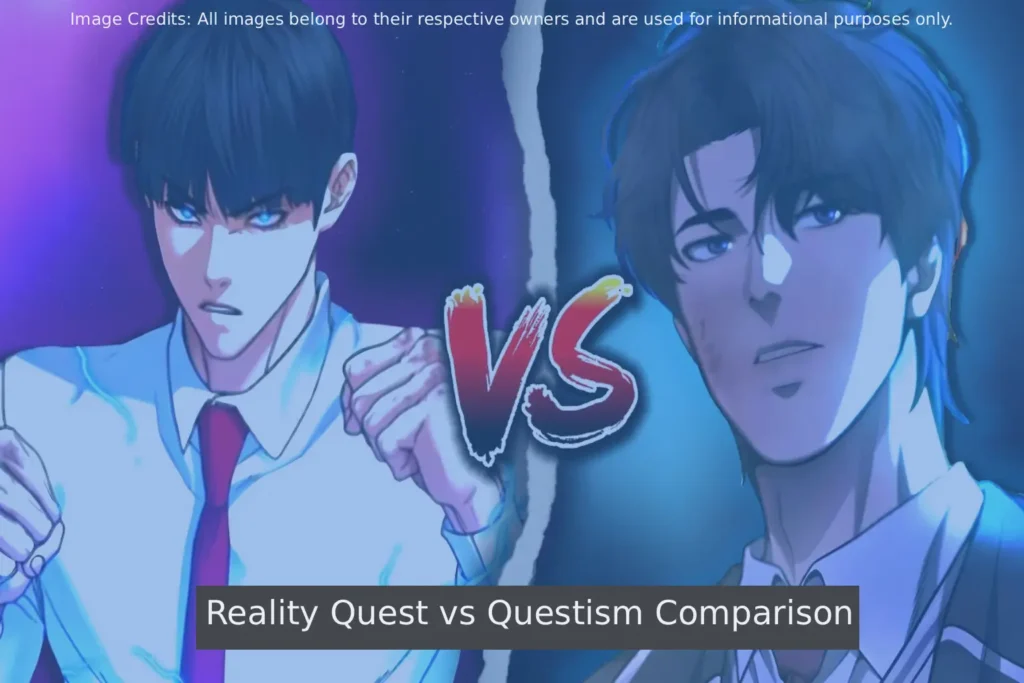
Reality Quest vs Questism Comparison shows how two similar manhwa use completely different power systems, storytelling styles, and character growth approaches. If you’ve spent any time browsing webtoon platforms or manhwa recommendation threads, you’ve likely encountered two titles that seem designed to be compared: Reality Quest and Questism . Both launched around the same time, both feature bullied high school protagonists who suddenly gain video game interfaces, and both involve climbing the ranks of school hierarchies. On the surface, they look like mirror images.
But anyone who’s read both knows the truth: these are very different stories wearing similar skins.
I’ve followed both series from their early chapters, watched their fanbases grow, and seen the discourse evolve from “wait, are these the same?” to passionate debates about which one handles the “gamified real life” concept better. After digging deep into their power systems, narrative structures, character arcs, and even their places in larger publishing universes, I’m here to break down what truly sets them apart.
The Core Premise: Two Sides of the Same Coin
Let’s start with what brought these two into the same conversation.
Questism (also known as Quest Supremacy) introduces Kim Suhyeon, a student who has long been at the bottom of the social ladder. In a moment of frustration, he says “Open Quest Log”—and to his shock, a system window actually appears. The interface offers him a tutorial quest: apologize to his mother. The reward? A gold card granting a supernatural ability. The catch? If he ever fails a quest, everything he’s gained disappears.
Reality Quest takes a different starting point. Dowan Ha is a dedicated gamer whose skills are exploited by others. After an incident where he pushes himself to exhaustion, he finds himself back in his classroom a week earlier—now equipped with a system interface that lets him apply skills he mastered in games to real life. It’s a second chance, but the system comes with its own demands.
Both protagonists are passionate gamers who receive life-changing systems. But the how and why of their transformations—and the tone of their journeys—couldn’t be more different.
Where the Power Comes From: Different System Philosophies
This is where the comparison gets especially interesting. The mechanics of each system reveal a lot about what each series values.
Questism’s Card-Based System: Strategic Collection
Questism operates on a “card collection” model. Suhyeon earns cards of varying rarities (bronze, silver, gold) that grant specific abilities. Some are combat-focused, while others offer utility—like the “Peek At You!” card, which lets him view other people’s stats. For a deep dive into the card system, the Questism Wiki catalogs every card and ability.
Stats follow an alphabetical ranking system: F, E, D, C, B, A, S, and then it scales up through SS, SSS, SR, SSR, UR, LR, MR, and eventually X, XX, XXX, EX, and DX. Yes, it reaches extreme levels, and the series is aware of how exaggerated this gets.
What’s fascinating is what the system doesn’t measure. Stats cover Strength, Speed, Endurance, Intelligence, and Potential—but nothing social. No charisma stat, no leadership rating. This absence reflects Suhyeon’s initial belief that only physical power matters.
The three stages of potential—Awakening, Ascension, and Transcendence—add another layer. When characters are pushed to their emotional or physical limits, they can unlock these stages, gaining significant stat boosts and unique abilities that even the system’s copying mechanics can’t fully replicate.
Reality Quest’s Skill Unlock System: Earning What You Already Earned
Reality Quest approaches progression differently. Dowan’s abilities are locked behind “keys” (again bronze, silver, gold), but these keys unlock skills he technically already mastered through gaming. The system doesn’t give him anything new—it just lets him apply his existing experience to reality. When he unlocks a martial arts skill, it’s because he mastered it in a game first. The power fantasy isn’t about becoming someone new; it’s about having your existing efforts finally count. The Reality Quest Wiki offers a detailed breakdown of all skills and key types.
The penalties for failure also differ. Questism threatens to take everything away if Suhyeon gives up—a high-stakes reset that creates constant tension. Reality Quest’s system, by contrast, applies pressure through escalating quest demands, pushing Dowan to grow without relying on fear of total erasure. It’s a more gradual, skill-based relationship.
The Universe They Inhabit: Shared Worlds vs Standalone Stories
This is a detail that separates casual readers from deep fans. Both series exist in established publishing ecosystems, and that context shapes their narrative priorities.
Questism belongs to the PTJ-verse (named after author Park Tae-jun), which includes Lookism, Viral Hit (How to Fight), Manager Kim, and others. This means Questism shares continuity with some of the biggest names in manhwa. Characters from other PTJ works occasionally appear or get referenced, and the world-building follows consistent rules about how school and district hierarchies operate across series.
Reality Quest comes from YLAB , a studio known for its interconnected universes (Superstring, Bluestring, Redstring). However, Reality Quest stands alone—it doesn’t tie into those larger strings. This gives it more narrative freedom but lacks the “everything is connected” excitement that PTJ fans enjoy.
This publisher context matters because Questism can leverage existing fan investment. When a character resembles someone from Lookism, readers eagerly theorize about connections. Reality Quest builds its world from scratch, with a more focused, contained scope.
Tone and Narrative Style: Comedy vs Grit
If I had to summarize the tonal difference: Questism balances action with humor and awkward charm; Reality Quest leans into a more intense, pressure-driven atmosphere.
Questism’s Approach: Humor Meets Strategy
Multiple reviews highlight Questism’s comedic strengths. The humor comes from Suhyeon’s perpetual awkwardness. Even after gaining powers, he keeps making relatable mistakes. The secondhand embarrassment in early chapters is almost painful—in the way that good comedy often is. You can see the community’s take on the series at its MyAnimeList page.
The series balances this with genuinely strategic conflicts. Four schools compete for district influence, and victories often come through planning rather than raw power. One crew leader is physically weaker than his own top officers but maintains his position through tactical ability—a dynamic that adds texture to the story.
The official webtoon’s original soundtrack reinforces this blend of lightheartedness and intensity, with game-style UI sound effects mixing with character-specific themes that became fan favorites.
Reality Quest’s Approach: High-Stakes Growth
Reality Quest takes a more intense tone. The system introduces quests that demand constant improvement, and the protagonist faces a series of escalating challenges that test his skills and resolve. The focus is less on humor and more on how Dowan adapts his gaming expertise to real-world situations. For a detailed look at the series’ progression system, visit its My Anime List page.
The physical feats in Reality Quest are often depicted with detailed calculations—breaking through obstacles, enduring high-impact situations—giving the action a methodical, almost simulation-like quality. This appeals to readers who enjoy seeing systematic progression and clear cause-and-effect in power growth.
Character Development: Different Journeys, Different Strengths
Kim Suhyeon: The Reluctant Leader
Suhyeon’s journey is about becoming someone he never expected to be. Leadership gets thrust onto him, and he has to grow into it. His relationships matter as much as his stats; his best friend, nicknamed “Yakuza” by fans for his perpetually mature appearance despite being a teenager, provides both comic relief and emotional grounding.
The series occasionally struggles with its large cast—some characters get developed, then sidelined as new challenges arise. But the core relationships, especially among Suhyeon’s crew, remain compelling throughout its 174-chapter run (which concluded in February 2025).
Dowan Ha: The Specialist
Dowan’s arc is about translating existing mastery into a new context. He already possesses deep gaming knowledge; the system simply removes the barrier between virtual skill and real-world application. His growth is less about changing who he is and more about unlocking the potential he always had.
The supporting cast in Reality Quest includes several characters who serve as both allies and sources of tension. Joo Ah-Rin is a classmate who treats him with kindness when others don’t, while Si-yeon brings a more guarded, agenda-driven dynamic. Both contribute to a world where trust must be earned gradually.
The Fighting Philosophies: Tactical Play vs Skill Application
Questism: Strategy Over Brute Force
Questism’s conflicts shine in their tactical elements. They aren’t just about who has higher stats—they involve crew positioning, resource management, and exploiting system mechanics. The “Peek At You!” card lets Suhyeon assess opponent strength, but the system occasionally returns “Undetectable” for those far beyond his current level, creating genuine uncertainty.
The card system means outcomes can turn on specific abilities rather than raw numbers. Suhyeon has defeated opponents with significantly higher base stats by using the right cards at the right time. This creates tension even in mismatched confrontations.
Reality Quest: Skill Unlock and Application
Reality Quest takes a more straightforward approach: Dowan identifies which skills he needs, unlocks them through the system, and applies them in increasingly complex scenarios. The emphasis is on how his gaming expertise translates—dodging patterns, timing attacks, managing stamina—rather than on external power boosts.
The series frequently includes detailed breakdowns of physical actions, appealing to readers who enjoy a more technical, simulation-like style of progression.
Quick Comparison: At a Glance
| Aspect | Questism | Reality Quest |
|---|---|---|
| System Type | Card collection with rarity tiers | Skill unlock based on gaming mastery |
| Power Source | Quests reward cards that grant abilities | Unlocks skills already mastered in games |
| Penalty for Failure | Loss of all progress | Escalating quest difficulty |
| Setting | PTJ-verse (shared with Lookism and others) | Standalone YLAB series |
| Tone | Comedy + strategy + gang dynamics | Intense progression + skill application |
| Character Focus | Reluctant leader growing into role | Expert gamer applying existing skills |
| Fighting Style | Tactical, card-based, stat-driven | Simulation-like, skill-based application |
| Status | Completed (174 chapters, Feb 2025) | Ongoing |
Hidden Details and Easter Eggs
A few details that deeper readers might notice:
The Naming Parallels: Both series use bronze/silver/gold tiers for their systems, suggesting either parallel development or a shared inspiration. Given they launched within days of each other in October 2021, parallel development seems likely.
The System Origins: Questism’s system appears to manifest from Suhyeon’s desires—it reflects his worldview and even physically changes him (increasing his height, improving his eyesight). Reality Quest’s system traces back to an in-game friend he helped, suggesting an external origin rather than internal manifestation.
Translation Differences: Questism has multiple official and fan translations, leading to variation in how cards and abilities are named. Reality Quest has maintained more consistent terminology across translations, which helps with theory-crafting about power progression.
Which One Should You Read?
After following fan discussions, reviews, and the series themselves, a pattern emerges: people often prefer whichever one they read first. Both have strong followings, and both execute their premises well.
Choose Questism if:
- You enjoy strategic elements and tactical decision-making
- You appreciate humor balanced with action
- You’re already invested in the PTJ-verse / Lookism universe
- You prefer stories about reluctant leadership and found family
- You want a complete story with a definitive ending
Choose Reality Quest if:
- You prefer a more intense, pressure-driven narrative
- You enjoy seeing gaming skills systematically applied to real-world challenges
- You want a self-contained world without required reading of other series
- You appreciate detailed, simulation-style progression
Read both if:
You’re curious how two creative teams took an almost identical premise and built completely different worlds, tones, and fan communities.
Final Thoughts
Reality Quest and Questism represent two valid approaches to the same core concept. Watching them develop in parallel has been one of the more fascinating experiments in recent manhwa.
Questism leans into its connections with a larger universe, builds complex strategic layers into its conflicts, and balances high-stakes moments with genuine humor. Reality Quest focuses on the systematic application of gaming expertise, maintains a consistently intense atmosphere, and builds its world without relying on established connections.
Neither approach is “better”—they simply offer different answers to the same question: What would you do if your life started working like a video game?
Questism answers: “I’d learn the system, build a team, and think several steps ahead.”
Reality Quest answers: “I’d apply everything I’ve already mastered and see how far I can go.”
Both are worth your time. Both have passionate communities. And both prove that the “gamified real life” genre has more depth than surface-level comparisons suggest.
Have you read both? Which one resonated more with you, and why? The discussion continues across fan communities—and it’s a conversation worth having.
Frequently Asked Questions (Reality Quest vs Questism Comparsion)
What is the main difference in Reality Quest vs Questism Comparison?
The main difference in Reality Quest vs Questism Comparison is how their systems work. Questism uses a card-based system where abilities are rewarded through quests, while Reality Quest focuses on unlocking skills the protagonist already mastered in games.
Which is better in Reality Quest vs Questism Comparison?
In the Reality Quest vs Questism Comparison, neither is objectively better. Questism is ideal for readers who enjoy strategy and humor, while Reality Quest suits those who prefer intense progression and skill-based storytelling.
Is Reality Quest similar to Questism?
Yes, Reality Quest vs Questism Comparison shows both share a similar premise—bullied students gaining game-like systems. However, their execution, tone, and character development are very different.
Is Questism connected to Lookism?
Yes, in the Reality Quest vs Questism Comparison, Questism is part of the PTJ universe, which includes Lookism. Reality Quest, on the other hand, is a standalone story.
Is Reality Quest finished or ongoing?
As per the Reality Quest vs Questism Comparison, Questism is completed, while Reality Quest is still ongoing.
Editorial Disclaimer
This article is intended for informational and entertainment purposes only. The content is based on publicly available information, personal analysis, and interpretation of the manhwa Reality Quest and Questism.
We do not claim ownership of any original characters, storylines, or intellectual property referenced in this article. All trademarks, titles, and copyrights belong to their respective creators and publishers.
While every effort has been made to ensure accuracy, details may vary depending on translations, updates, or source interpretations. Readers are encouraged to refer to official platforms for the most accurate and up-to-date information.
This content reflects the author’s independent perspective and is not affiliated with or endorsed by any official publishers or production companies. All images used in this article are for illustrative and informational purposes only. Copyrights and trademarks for all visual content belong to their respective owners, including original creators and publishers of Reality Quest and Questism.
Images have been sourced from publicly available platforms or official promotional materials where applicable. If you are the rightful owner of any image and wish for it to be credited or removed, please contact us for prompt action.

How Anime Studios Make Money: The Real Economics Behind the Anime Industry

When you finish watching an incredible anime—something that moves you, makes you laugh, or leaves you staring at the ceiling at 3 AM—it’s natural to wonder: who’s actually getting paid for this? The answer is far more complicated than you…