
How to Prepare for Shark Tank India: A Practical Preparation Guide
Learn how to prepare for shark tank india preparation guide covering pitch deck structure, key startup metrics, valuation logic and common investor questions.


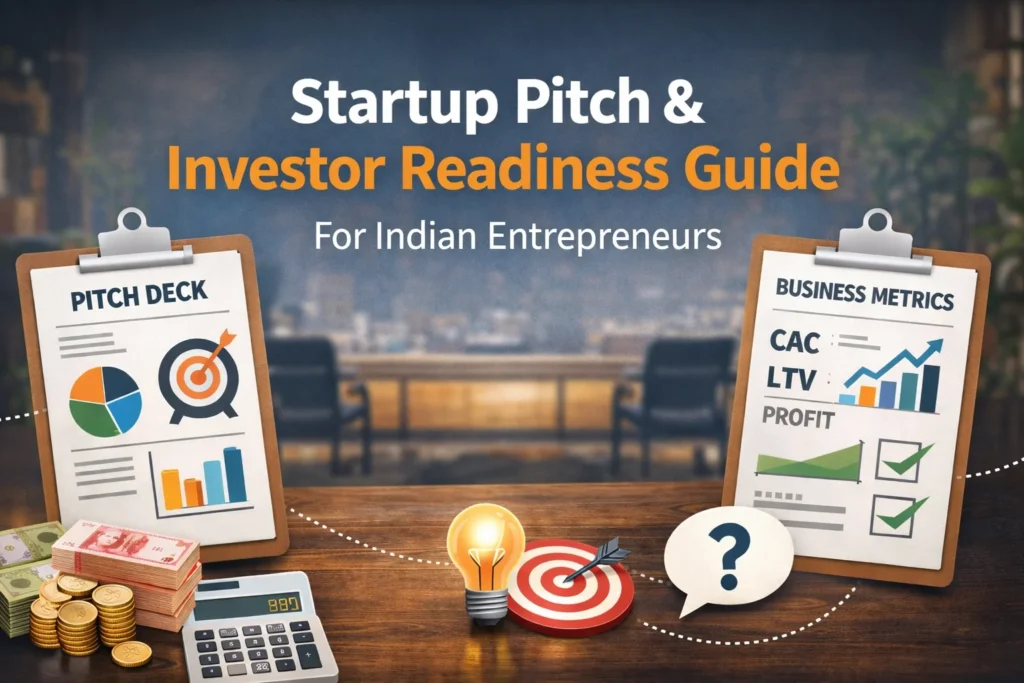
Imagine walking into a brightly lit studio and facing a panel of experienced investors. You have only a few minutes to clearly explain your business, demonstrate its potential, and justify your ask. This Shark Tank India preparation guide is designed to help founders understand how to prepare for the show in a practical and structured way. Shark Tank India has helped bring startup terminology and funding conversations into mainstream discussion in India. However, while a few companies gain strong visibility, many founders struggle because they are not fully prepared for the depth of questions and analysis required on the show.
Strong outcomes on the show usually come from structured preparation across three core areas: your pitch deck, your business metrics, and your readiness for investor questions. This guide explains how to prepare effectively in each of these areas.
Part 1: The Pitch Deck – Structuring Your Business Story
Your pitch deck is the primary visual summary of your business. Investors typically evaluate multiple pitches in a short period of time, so your presentation must be clear, concise and logically structured.
The 10-slide framework
1. The problem
Clearly define the real customer problem you are solving. Avoid generic statements and focus on a specific, well-understood pain point faced by a defined user group. Supporting the problem with a short statistic or real customer insight improves credibility.
2. The solution
Present your product or service clearly and demonstrate how it solves the stated problem. A short demo, product visual or simple workflow diagram can help investors understand your offering quickly.
3. Business model
Explain exactly how your company generates revenue. For example, clarify whether you operate through subscriptions, direct-to-consumer sales, enterprise licensing, commissions or a hybrid model. If helpful, briefly outline the cost and revenue flow.
4. Traction
Traction is evidence that customers are willing to pay for your solution. Show growth trends, revenue progression, user adoption, repeat purchase behaviour and key operational milestones.
Investors on the show consistently prioritise clear market traction and customer validation before considering a deal.
5. Market size
Use a simple TAM, SAM and SOM structure:
- TAM (Total Addressable Market): the overall market opportunity.
- SAM (Serviceable Addressable Market): the portion of the market you can realistically serve with your current model.
- SOM (Serviceable Obtainable Market): the share you expect to capture in the near to medium term.
This demonstrates both ambition and realistic planning.
6. Competition
Visually position your company against existing competitors using a simple comparison table or positioning matrix. Clearly explain what differentiates you and why customers choose your product instead of alternatives.
7. The ask
State your funding requirement clearly and link it to a valuation. Then explain how the capital will be allocated across growth activities such as marketing, hiring, operations and technology. Investors expect to see a clear plan for how the funds will be used.
8. Roadmap and vision
Outline your short-term and medium-term goals. This may include market expansion, new product launches, revenue milestones or operational improvements. A simple timeline is often sufficient.
9. Competitive advantage
Explain what makes your business difficult to replicate. This may include proprietary technology, strong supplier relationships, regulatory approvals, unique data, operational efficiencies or brand trust.
Investors typically examine whether the startup has a clear and defensible competitive advantage that can be sustained over time.
10. Team
Introduce the founding and leadership team with a short description of relevant experience and skills. Investors evaluate whether the team has the ability to execute the proposed strategy.
Part 2: The Metrics – Understanding the Numbers That Matter
Investors rely heavily on financial and operational data when evaluating early-stage businesses. You should be able to explain every major metric clearly and consistently.
Unit economics
Understand whether you earn a positive contribution on every unit sold. This helps investors assess whether your model can become profitable at scale.
Customer acquisition cost (CAC)
Calculate how much you spend to acquire one paying customer. Include marketing, sales and promotional costs in this calculation.
Customer lifetime value (LTV)
Estimate the total revenue you expect from an average customer over the entire relationship with your business.
A commonly used benchmark is that LTV should be at least three times higher than CAC, indicating a sustainable growth model.
Gross margin
Gross margin shows how much revenue remains after deducting direct production or delivery costs. Strong margins provide flexibility for marketing, operations and future expansion.
Burn rate and runway
If your company is currently loss-making, clearly state your monthly cash burn and how many months of runway you will have after receiving the proposed investment.
Valuation justification
Be prepared to explain how you arrived at your valuation. Early-stage valuations are often supported using future earnings potential, growth rates and comparable market benchmarks. Avoid presenting arbitrary figures without a supporting rationale.
Financial summary
Prepare a concise financial overview including revenue, expenses, key metrics and high-level projections. This helps investors follow your assumptions and identify potential risks quickly.
Part 3: Preparing for Investor Questions – shark tank india preparation guide
The discussion after the pitch is often more important than the presentation itself. Investors test your understanding of the business, market and execution risks.
Common questions and how to approach them
Why is your valuation justified?
Support your answer using traction, margins, growth rate and market opportunity. Keep the explanation factual and consistent with your financial projections.
What prevents large companies from entering this market?
Explain your competitive advantages clearly, such as operational strengths, customer loyalty, proprietary processes or regulatory barriers.
Why is the company not profitable yet?
Provide a clear and realistic path to profitability. Investors look for structured planning rather than general statements about growth.
How do you acquire customers?
Describe specific channels, cost effectiveness, conversion performance and early experiments with different acquisition strategies.
Handling unexpected questions
If you receive an unfamiliar or situational question, focus on demonstrating your understanding of customer needs and decision-making logic rather than attempting to provide a rehearsed response. It is acceptable to acknowledge when data is not immediately available, provided you show awareness of how it would be measured.
Preparation approach
Practice your pitch with experienced mentors or operators and review recordings of your mock sessions. Prepare data-driven answers and remain open to feedback. Clear communication and honesty are valued more than overly polished delivery.
Conclusion
Effective preparation combines a well-structured pitch, strong control over financial metrics and thoughtful responses to investor concerns. Clarity of purpose, confidence in execution and a strong understanding of the problem being solved play an important role in building investor trust.
Use this preparation framework to refine your business, your pitch and your financial understanding.
Strong preparation significantly improves your readiness for a Shark Tank India pitch.
Frequently Asked Questions (Shark Tank India Preparation Guide)
What is a Shark Tank India preparation guide?
A Shark Tank India preparation guide is a practical resource that helps startup founders prepare their pitch, financial metrics, valuation logic and investor answers before appearing on the show.
Who should use this Shark Tank India preparation guide?
This guide is useful for early-stage founders, student entrepreneurs and small business owners who want to improve their pitch quality and investor readiness.
What should be included in a Shark Tank India pitch deck?
A Shark Tank India pitch deck should clearly cover the problem, solution, business model, traction, market size, competition, funding ask, growth roadmap, competitive advantage and founding team.
Which startup metrics are most important for Shark Tank India preparation?
The most important metrics for Shark Tank India preparation are customer acquisition cost (CAC), customer lifetime value (LTV), gross margin, unit economics, burn rate, runway and revenue growth.
How should founders justify valuation in Shark Tank India?
Founders should justify valuation using revenue traction, growth trends, margins, market opportunity and realistic future projections instead of using arbitrary or emotional pricing.
Does this Shark Tank India preparation guide guarantee selection on the show?
No. This Shark Tank India preparation guide only helps founders improve their business presentation and investor readiness. Final selection and investment decisions are made by the show’s organizers and investors.
Is this guide officially associated with Shark Tank India?
No. This Shark Tank India preparation guide is an independent and educational resource created for founders and is not affiliated with the television show or its producers.
Can this preparation guide be used even if I do not plan to appear on Shark Tank India?
Yes. The same pitch structure, metrics and investor-ready practices explained in this guide can be used for angel investors, venture capital firms and startup demo days.
Editorial Disclaimer
This article is an independent and educational guide created for startup founders. It is not affiliated with, sponsored by, or endorsed by Sony Pictures Networks India, Shark Tank India, or any of its producers, partners, or judges. All trademarks and brand names mentioned are the property of their respective owners and are used only for informational and editorial purposes.

The 50 Indian Reality Show Review: Format, Gameplay, Cast & Zero-Rules Experiment

The 50 Indian reality show review covering format, gameplay, cast mix, audience response and the risks of its zero-rules experiment in India.