
Why Hindi Television Serials Feel Unrealistic: A Look Behind the Glittering Curtain
This article examines why Hindi television serials often feel unrealistic, highlighting common storytelling tropes, exaggerated drama and social portrayals.


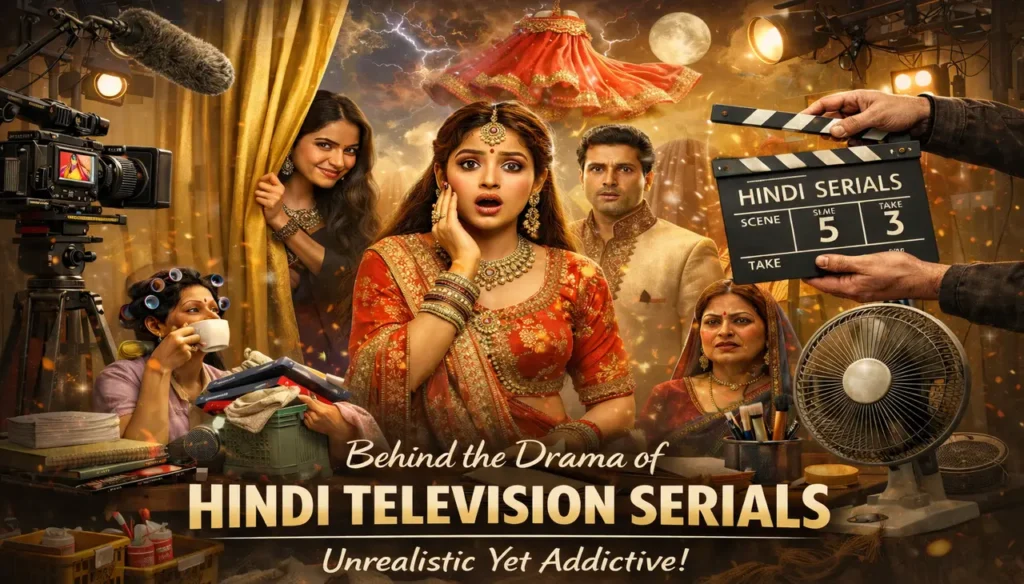
Let’s be honest. For many of us, coming home to the dramatic tune of a Hindi television serial is a familiar ritual. It’s a world of palatial homes, swirling lehengas, and dialogues delivered with intense close-ups. But as we sip our chai, a question often niggles: “Does anyone actually live like this?” The answer, of course, is a resounding no. Hindi daily soaps, while wildly popular, have crafted a parallel universe with its own, often baffling, set of physics and social rules. Let’s pull back the ornate curtain and explore what makes them so deliciously, delightfully unrealistic.
1. The Elasticity of Time and Space
In the world of Hindi serials, time is not a constant; it’s a narrative tool stretched to breaking point.
- The Never-Ending Day: A single episode can chronicle a morning prayer, a grand wedding, a murder plot, and a courtroom verdict—all supposedly before sunset. Conversely, a simple question like “Will you have tea?” can take three episodes to answer, with flashbacks within flashbacks.
- Teleportation & Omnipresence: Characters receive a phone call about a crisis in another city and appear at the scene within minutes, hair and makeup impeccable. The female lead, often the show’s moral center, has a psychic-like ability to appear whenever someone is scheming, materializing from behind potted plants with a disapproving glare.
2. The Glamour in the Grocery Aisle
The most jarring unreality is the sheer opulence in the most mundane settings.
- Everyday Wear is Red-Carpet Ready: Women cook breakfast in a full face of makeup, heavy jewelry, and silk saris with yards of fabric, seemingly unbothered by the risk of catching fire near the stove. A quick trip to the market requires a different, equally extravagant lehenga. The “poor” family, struggling to make ends meet, lives in a marble-floored mansion with a crystal chandelier.
- The Immunity to Daily Chores: We rarely see the labor behind this gloss. Dishes are never done, laundry never folded. The house is perpetually spotless, maintained by invisible forces. This creates an absurd disconnect from the lived reality of the audience, where managing a home is central to daily life.
3. Melodrama as the Default Language
Emotion is not felt; it is broadcasted at maximum volume.
- The Slow-Mo Swirl: Every revelation, slap, or entrance is punctuated by a dramatic 360-degree slow-motion shot of the protagonist’s flaring lehenga or anguished face, with thunderous background music. It’s a stylistic choice that prioritizes spectacle over subtlety.
- Villainy with a Capital ‘V’: The antagonists are not just flawed humans; they are mustache-twirling (figuratively) archetypes of evil. Their sole purpose is to plot, poison, and frown, often announcing their diabolical plans in soliloquies to the audience. This black-and-white morality simplifies complex human conflicts into a repetitive loop of revenge and righteousness.
4. Regressive Social Norms, Glossed Over
This is perhaps the most critiqued aspect. Under the glitter, many serials propagate deeply outdated values.
- The Sanctification of Suffering: The ideal Indian woman, or ‘Bharatiya Nari’, is often portrayed as one who endures endless injustice—from a toxic mother-in-law to an unjust accusation of murder—with silent tears and superhuman patience. Her ultimate victory is not through agency or systemic change, but through enduring more suffering than her opponents. This narrative frames resilience as passive martyrdom.
- Family as a Totalitarian Unit: Personal choices—career, love, fashion—are almost always subject to the ‘family’s izzat’ (honor). Independent thought is rebellion. Many media critics have pointed out that these shows often promote a conservative idea of family life, where conformity is rewarded and individuality is treated as a problem.
- The Supernatural Cop-Out: When plots run out of steam, logic is often abandoned for ‘maanjha’ (black magic), ‘pishaach’ (ghosts), or the most popular of all—reincarnation. A dead character can return as their own long-lost twin, a lookalike, or through the classic “plastic surgery” trope, negating any emotional weight their death might have carried.
5. The Narrative Groundhog Day
The storytelling is trapped in a loop. Popular shows don’t have endings; they have reboots within the same runtime. The pattern is predictable: Girl meets Boy, they face obstacles, marry, then face post-marital scheming, lose memory, separate, reunite, and the cycle continues with a new generation. This factory-style production, driven by daily ratings and fear of change, kills innovation. Several television writers and former network executives have acknowledged that fear of failure often leads to the repeated use of the same successful storytelling formulas, making content monotonous over time.
Why Does This Unrealistic Model Persist?
The answer lies in economics and audience psychology. These serials are not just stories; they are high-stakes products. The daily format demands constant, gripping twists to prevent channel-switching. The glamour offers aspirational escapism for a core viewership. The repetitive, exaggerated emotions provide a reliable, cathartic release. In a sense, they are not trying to mirror reality; they are providing a heightened, ritualistic drama that viewers can engage with passively.
Conclusion: A Call for Nuance – Hindi television serial
The unrealistic elements of Hindi serials are not failings in the traditional sense; they are the very ingredients of their unique, ritualistic genre. They function more like modern-day folklore or morality plays than realistic dramas. However, the criticism stems from a genuine desire for change—for stories where women aren’t perpetual victims, where conflicts have psychological depth, where a middle-class home looks lived-in, and where a resolution actually concludes a story.
The success of finite series on streaming platforms proves there’s an appetite for nuanced storytelling. The challenge for mainstream Indian television is to find a balance—to keep the drama but lose the regressive baggage, to embrace emotion without forsaking all logic. Until then, we’ll continue to watch, often with exasperated amusement, as our favorite characters navigate a world where time stands still, sequins are casual wear, and every problem can be solved by a dramatic monologue in a grand courtyard. The unrealism is, ironically, the one reality we can always count on.
Editorial Disclaimer:
This article is an independent editorial and opinion-based analysis of common storytelling patterns and cultural themes in Hindi television serials. It is not affiliated with, endorsed by, or connected to any television channel, production house, or streaming platform. All observations are intended for informational and commentary purposes only.

TV Shows vs OTT Shows: Production, Rules, Revenue & Who Earns More (2026 Guide)
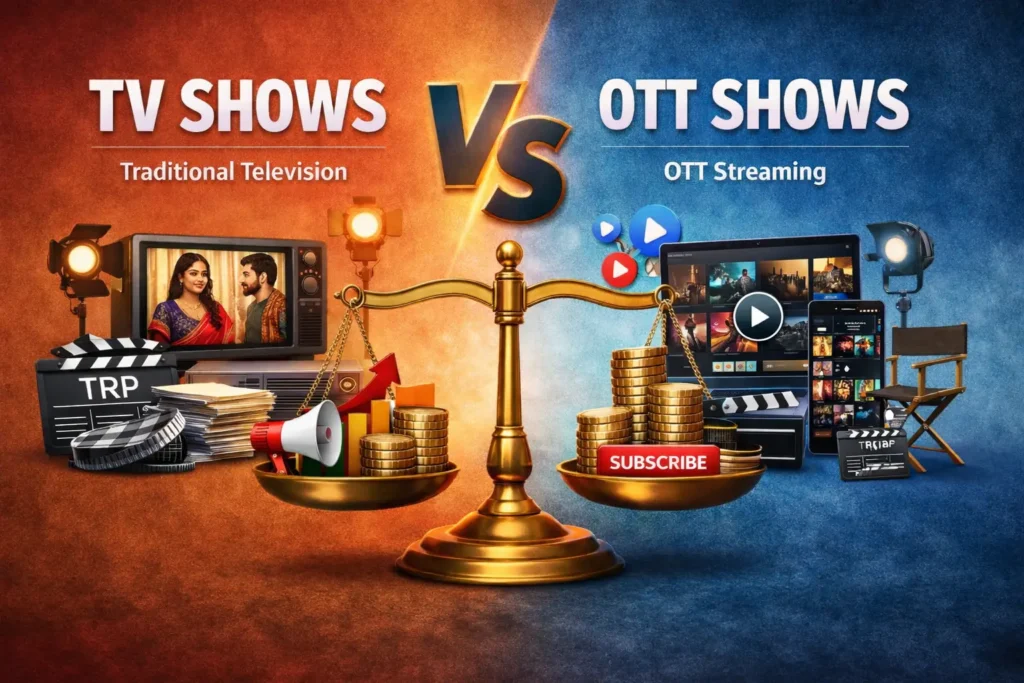
Compare TV shows vs OTT shows in terms of production, regulations, budgets, and earnings. A detailed 2026 industry guide explaining how both models work and who earns more.