
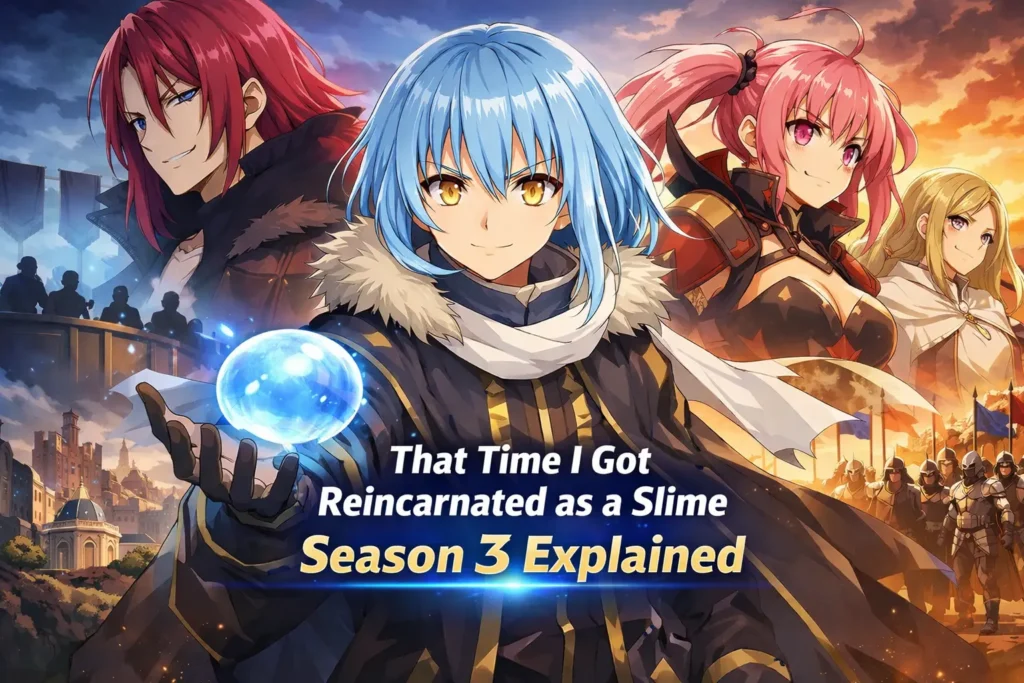
That Time I Got Reincarnated as a Slime Season 3 Explained: Political Shift, Demon Lord Alliances and Rimuru’s New Role
Explore That Time I Got Reincarnated as a Slime Season 3 Explained, Rimuru's rise as a leader, political strategy, alliances with Demon Lords, and Tempest's growth.


Section: Anime Editorial / Analysis
By Himanshu – Anime & OTT Editorial Writer at ViewersPoint
This editorial analysis is based on the anime adaptation of That Time I Got Reincarnated as a Slime and publicly available light novel material. Story details and interpretations may differ in future episodes.
For fans of That Time I Got Reincarnated as a Slime Season 3 Explained, the first two seasons were a fast-paced mix of world-building, large-scale battles and Rimuru Tempest’s idealistic vision of coexistence.
Season 3, however, moves in a noticeably different direction.
Instead of focusing mainly on combat, the narrative turns toward diplomacy, international pressure and political strategy. If the earlier seasons were about building a nation, Season 3 is largely about defending its right to exist within an increasingly hostile and complicated world order.
This shift transforms Rimuru from a powerful protector into a ruler who must think several steps ahead.
The Core Premise: Diplomacy as the New Battlefield
Season 3 follows the events after the Coleus’s Dream OVA and continues the story following Rimuru Tempest’s recognition as a Demon Lord and the growing political status of the Jura Tempest Federation.
Tempest is no longer viewed as a strange but harmless monster settlement. It is now a sovereign nation whose rapid development and military strength naturally draw suspicion from human kingdoms and rival powers.
The central question of the season is no longer simply whether Rimuru can win a battle. It becomes whether he can manage fragile alliances, political hostility and long-standing prejudice without triggering a large-scale international conflict.
The story can be understood through three major political and strategic arcs that run parallel to one another.
1. The Western States Council – A Trial by Politics
Rimuru’s first major diplomatic challenge is his appearance before the Western States Council, a gathering of powerful human nations.
Here, the conflict is not decided by strength or magical power. It is decided through negotiation, economic leverage and political positioning.
Rather than intimidating the council, Rimuru approaches them with calculated generosity.
He proposes trade agreements centered around Tempest’s unique products and infrastructure, including advanced healing potions and transportation technology. These offers are not presented as charity. They function as long-term political tools.
By creating economic dependence and mutual benefit, Rimuru quietly builds a situation where opposing Tempest would harm the interests of the very nations that fear it.
The main opposition during this arc comes from Mariabell Rosso, a representative of an old and influential human power structure. She embodies a worldview in which monsters are expected to remain subordinate and controlled. Tempest’s model of equality and cooperation directly threatens that hierarchy.
Her strategy relies less on open warfare and more on financial pressure, political sabotage and assassination plots. Rimuru is therefore forced to operate as a head of state rather than a battlefield commander.
This arc marks the first clear moment where leadership, not strength, becomes his primary weapon.
2. The Walpurgis Banquet – The Demon Lords’ Power Game
While Rimuru faces political resistance from human nations, another layer of tension unfolds among the Demon Lords themselves.
The Walpurgis gathering reveals that Tempest’s survival does not depend solely on its relationship with humans. The balance of power among Demon Lords is just as critical.
A major geopolitical concern introduced during this stage is the rise of the Eastern Empire — a technologically advanced and expansionist human superpower whose ambitions extend toward the Jura Forest region.
This changes the overall direction of the story.
The threat is no longer limited to regional politics. It becomes a continental issue.
During these events, Rimuru’s standing among the Demon Lords stabilizes. His relationship with Milim Nava — who appears to have been manipulated through external control during the events surrounding the Demon Lords’ gathering — is repaired.
More importantly, Rimuru enters a formal alliance with Guy Crimson, widely regarded as one of the most powerful and dangerous Demon Lords in existence.
This alliance is not symbolic. It represents a calculated geopolitical partnership designed to prepare for the growing influence of the Eastern Empire.
From this point forward, Tempest is no longer acting independently. It becomes part of a broader power network that spans the entire continent.
3. The Founding Festival – A Ceremony Under Pressure
The political groundwork built throughout the season reaches its most visible point during Tempest’s Founding Festival.
The event is designed to publicly establish Tempest as a legitimate nation and diplomatic partner. Leaders, representatives and allies from various regions are invited, making the festival a showcase of international recognition.
Naturally, this visibility also makes it an ideal target.
Forces connected to the Rosso family and broader external interests exploit the gathering as an opportunity to destabilize Tempest through coordinated attacks and covert operations.
The response demonstrates how much the nation has changed.
Instead of relying solely on Rimuru’s personal strength, Tempest operates as a structured military and security force. The Kijin, the ogres, the direwolves and Rimuru’s powerful summoned demons such as Diablo and Testarossa function in an organized and strategic manner.
This is no longer a collection of loyal followers protecting a charismatic leader. It is a functioning state defending itself.
The most telling moment occurs when Rimuru confronts the assassination attempts targeting both himself and his guests.
There is no hesitation and no moral confusion. He eliminates the threat decisively.
This marks a clear evolution in his leadership philosophy. Rimuru accepts that maintaining peace sometimes requires controlled and calculated force. Protecting his people now takes priority over preserving his earlier, idealistic reluctance toward violence.
Key Themes and Why They Matter
The Burden of Leadership
Season 3 presents Rimuru as a ruler whose decisions affect not only Tempest but entire regions. Political mistakes now carry consequences that extend far beyond personal loss.
Power Beyond Combat
The story expands the concept of power. Trade networks, diplomatic credibility, alliances and ideological influence are treated with the same importance as military strength.
The Cost of Stability
Peace is portrayed not as a natural outcome, but as something actively maintained through preparation, deterrence and difficult compromises.
Tempest’s growth is driven by a desire to avoid war, yet that same growth demands a constant readiness to defend itself.
Conclusion – Preparing the Ground for a Larger Conflict
That Time I Got Reincarnated as a Slime Season 3 deliberately reduces its focus on spectacle in order to strengthen its political and strategic foundation.
By shifting attention toward diplomacy, economic influence and international maneuvering, the series transforms Rimuru from an overwhelmingly powerful protagonist into a leader shaped by responsibility, restraint and long-term planning.
The season quietly prepares the audience for a future conflict involving the Eastern Empire — one that will not be fought solely through individual battles, but through alliances, national interests and competing visions of coexistence.
The story closes not with a dramatic cliff-hanger, but with a clear sense of readiness.
Tempest is no longer a fragile experiment hidden in the forest.
It is a recognized nation, politically connected, militarily prepared and fully aware of the dangers that lie ahead.
Editor’s note:
This analysis is based on publicly available episodes, official promotional material, and related light novel content for That Time I Got Reincarnated as a Slime Season 3, along with broader observations of political themes and leadership portrayal in the series.

Anime Production Process Explained: Why Anime Takes So Long to Make
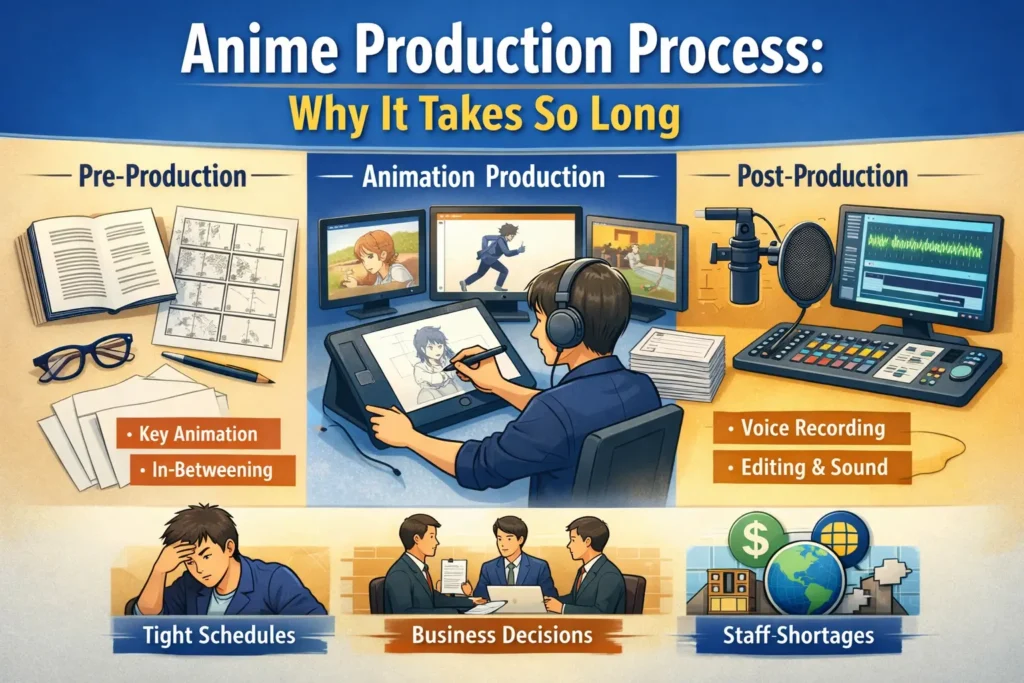
Learn how the anime production process works, including real production timelines, studio workflows, and business factors that explain why anime series take so long to produce.